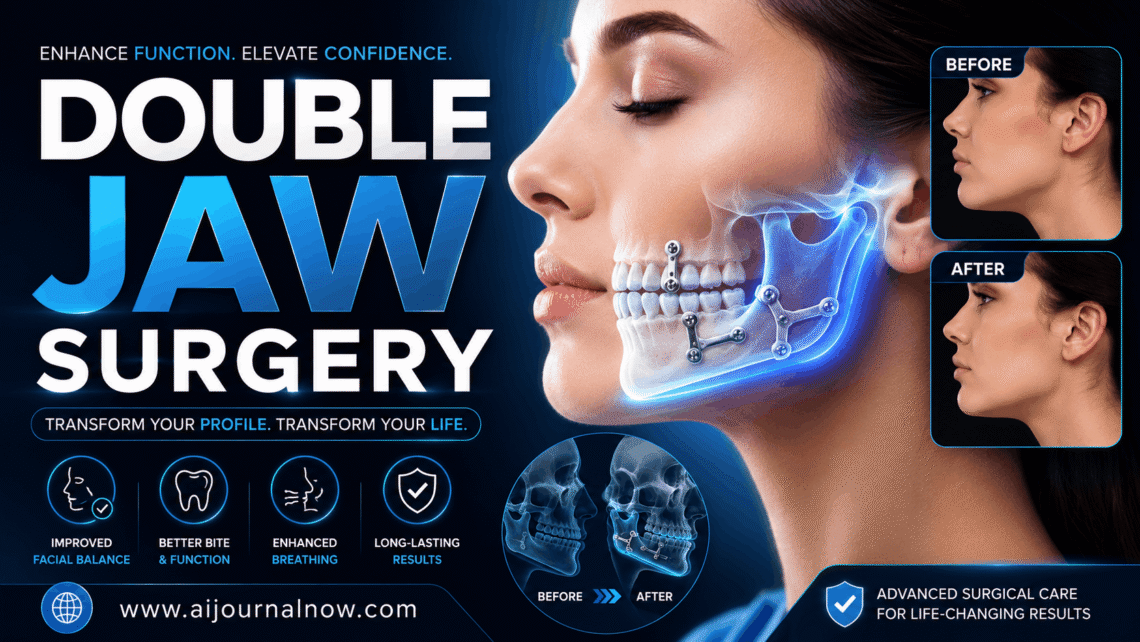
Double jaw surgery is one of the most life-changing — and most misunderstood — operations in modern oral and maxillofacial medicine. Often, people find out about it when exploring bite difficulties, facial asymmetry, or orthodontic therapy and have an epiphany that there is a surgical remedy they never realized was out there. Sounds intense, and it is, honestly. But the rewards for the right applicant might be so much more than good looks. This handbook lays it all out in plain language—no medical mumbo jumbo, no scare tactics, just the information you need to make sense of it all.
What is double jaw surgery?
Double jaw surgery, also known as bimaxillary osteotomy, is a corrective operation that involves moving both the upper jaw (maxilla) and lower jaw (mandible) concurrently.
In single jaw surgery, just one jaw is corrected, while this method targets both jaws at the same time. Both jaw bones are cut and moved by surgeons and then held in place with titanium plates and screws. The goal is proper alignment, functional, structural, and, in many situations, attractive.
Usually performed by an oral and maxillofacial surgeon, after years of orthodontic preparation. Also, it is nearly often done in a hospital, under general anesthesia, not at a dental clinic.
What is double jaw surgery?
The process takes months, maybe years, before the first incision is done.
Pre-surgical orthodontics comes first. Braces reposition the teeth to a position that will fit once the jaws are shifted. This phase normally takes 12 to 18 months. So when patients come in for surgery, they’re already in braces.
Surgical planning involves 3D imaging and computer modeling. Surgeons determine exactly how much each jaw must move—typically only millimeters—to produce the desired bite and facial balance.
The operation itself takes anything from three to six hours. Surgeons make incisions inside the mouth so there are no visible scars on the face. The upper jaw, lower jaw, or both are cut, moved into the correct position, and secured in place using titanium hardware. The patient is then maintained under general anesthesia.
After the healing phase, orthodontics after surgery positions the bite in its final location. Treatment—from first braces to last retainer—frequently takes two to three years, all in all.
Advantages of Double Jaw Surgery
Often the functional gains are larger than individuals expect.
Correction of bite. Double jaw surgery is the immediate answer to severe underbites, overbites, open bites, and crossbites that cannot be fixed with braces alone. Easier, more efficient, less painful mastication.
Breathing improvement. Correcting the jaws can widen the airway greatly. As a result, many patients report less snoring, and some report improvement in obstructive sleep apnea symptoms.
Speech clarity. Sometimes, jaw misalignment can influence pronunciation. “Fixing the skeletal structure can improve articulation in ways that speech therapy cannot.”
Symmetry of the face: Double jaw surgery provides structural equilibrium in the face in patients with apparent asymmetry. This transformation is not cosmetic—it is skeletal and thus irreversible.
Long-term joint health. Misalignment commonly leads to long-term issues such as chronic jaw pain, TMJ condition, and uneven tooth wear. Addressing fundamental causes is about fixing the underlying structure and not the symptoms.
Real Limitations & Challenges
This is big surgery, and it’s important to have a clear expectation going into it.
Recovery’s hard. Most patients will be on liquids for the first two weeks and will have to put up with edema, numbness, and exhaustion. Full recovery complete with full mending of the bone takes six to twelve months. So it demands careful preparation around work, school, and everyday life.
Numbness is prevalent and occasionally permanent. Temporary numbness of the lips, chin, and cheeks is almost ubiquitous. Most patients recover sensation within months. Some do, however, have patches of chronic partial numbness in tiny locations.
Cost matters a lot. In the USA, double jaw surgery can cost between $20,000 and $40,000 without insurance. Many insurance companies will cover a large percentage of the cost if the operation is deemed medically essential (functional impairment demonstrated). Purely cosmetic cases usually aren’t covered.
Not all of you are eligible. You need to have completely formed facial bones, usually after 17-18 for women and 21 for men. Good general health is also needed for safe anesthesia and healing.
Real Life Double Jaw Surgery and Who Considers It
Knowing if you are a candidate for this surgery makes it easy to know if it applies to you.
Severe skeletal Class III malocclusion—a condition in which the lower jaw is extremely protruded—is commonly treated with braces, but the alignment is corrected without addressing the skeletal issue. Double jaw surgery fixes what orthodontics alone can’t.
Patients with chronic TMJ pain who have tried splints, physical therapy, and other non-surgical treatments sometimes discover that surgery can give them long-lasting structural relief.
Double jaw surgery, or maxillomandibular advancement, may be used as a permanent airway treatment for those with obstructive sleep apnea who are unable to tolerate CPAP therapy.
Others need it when facial trauma has thrown the alignment of the jaw out of whack in ways that impact chewing, speaking, or comfort in everyday life.
Summary
Double jaw surgery is serious, long, and truly life-changing for the right person. It corrects structural flaws that no amount of orthodontics, physical therapy, or cosmetic treatment can correct, at the source. If you have been told that your bite abnormalities cannot be fixed with braces or that you have jaw pain and breathing problems that have not responded to treatment, this procedure should be discussed seriously with a trained surgeon. It takes a long time, but if you need it, the results are worth every step.
Frequently Asked Questions
Q1: Is double jaw surgery cosmetic only, or is it medically necessary?
Depends on the specific circumstance. Many patients opt for double jaw surgery to address functional difficulties—trouble chewing, respiratory issues, chronic pain, or severe bite misalignment. In certain circumstances, it’s medically required. Patients also may seek it for reasons of facial symmetry, which insurers usually consider cosmetic.
Q2: How painful is recuperation from double jaw surgery?
Pain during the first week is usually controlled with medicine provided by the doctor. Most patients say that the experience is more uncomfortable and tiring than intensely painful. Swelling is maximal at day 3 and reduces gradually over 2-4 weeks.
Q3: Will I look different after double jaw surgery?
Yes, often noticeably so. The slope of the jaw, the projection of the chin, and the overall equilibrium of the face are affected by the position of the jaw bones. “Surgeons are now using 3D imaging to show patients the projected outcome of a procedure before it is done. Changes are planned, not a surprise.”
Q4: How can I know whether I am a candidate for double jaw surgery?
You will be evaluated by an oral and maxillofacial surgeon with a clinical examination, X-rays, and 3D imaging. Referrals are usually from orthodontists, who see skeletal problems that can’t be fixed with braces alone. The assessment takes into account age, bone growth, health in general, and the specifics of the jaw misalignment.
Also Read: Buy Me a Coffee: The Creator Support Platform Explained

