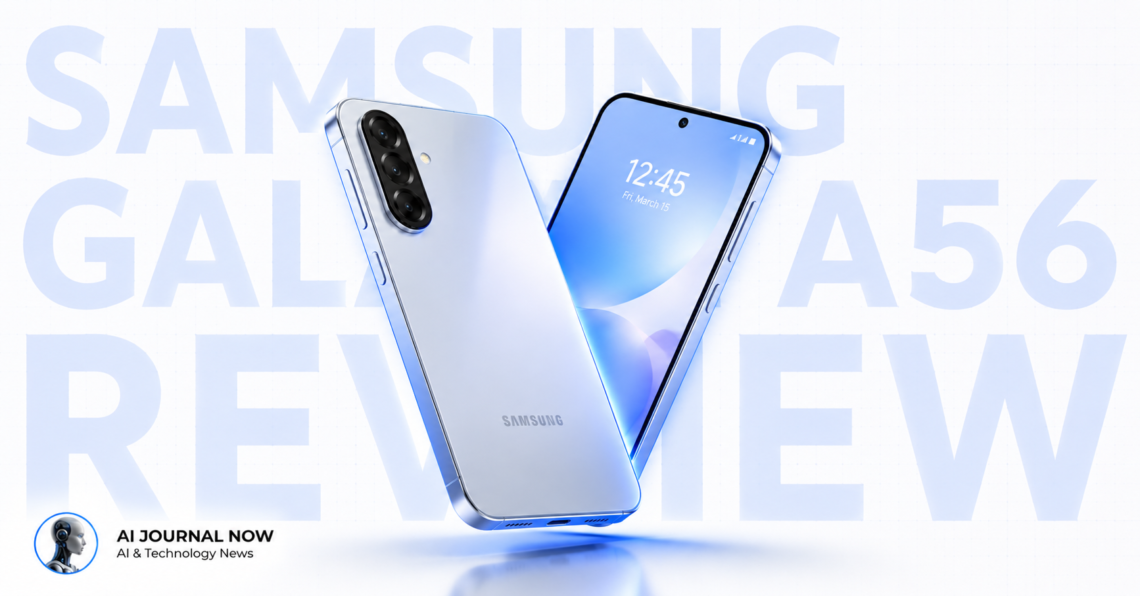
The Samsung Galaxy A56 launched in March 2025 as the brand’s flagship mid-ranger, and it’s still one of the more popular choices in Samsung’s A-series lineup. But with the newer Galaxy A57 now on shelves, a lot of buyers are asking a simple question: does the A56 still make sense?
This Samsung Galaxy A56 review walks through the design, display, camera, battery, and performance, then looks at where you can find it today and who it’s actually right for.
Quick Take
The Galaxy A56 pairs a genuinely premium-feeling design with a bright, smooth 120Hz display, a dependable camera setup, and six years of promised software support. It’s not built for heavy gaming, and the Exynos 1580 chip won’t impress flagship shoppers. But for everyday use — messaging, browsing, streaming, and casual photography — it holds up well, especially now that prices have dropped from their original launch level.
Design and Build Quality
Samsung gave the A56 a noticeable upgrade over the A55 without changing the formula too much. The frame is aluminum, and both the front and back use Corning Gorilla Glass Victus+, which is the kind of glass you’d expect on a far pricier phone. The body measures 162.2 x 77.5 x 7.4mm and weighs 198g, and despite the larger screen than its predecessor, Samsung managed to keep it thinner and lighter.
It carries an IP67 rating, so it can handle rain, splashes, and dusty conditions, though it’s not rated for full submersion the way the newer A57 is. The camera housing groups all three rear lenses into a single raised island rather than separate rings, which gives the back a cleaner look. Color options include Awesome Graphite, Awesome Lightgray, Awesome Olive, and Awesome Pink.
One thing several reviewers flagged is the bottom chin—the bezel under the screen is noticeably thicker than the other three sides. It’s a minor cosmetic point, but it’s the clearest sign you’re looking at a mid-range device rather than a flagship.
Display
The screen is a 6.7-inch Super AMOLED panel running at FHD+ resolution (1080 x 2340) with a 120Hz refresh rate and HDR10+ support. In daily use, the panel offers smooth animation, fluid scrolling, and good overall responsiveness. Peak brightness reaches around 1,900 nits, which makes the screen comfortably readable outdoors, even in direct sun.
Colors look natural rather than oversaturated, and the curved edge of the glass gives the front a more premium finish than you’d expect at this price. For watching videos, scrolling social media, or reading, this is one of the better displays you’ll find in the mid-range category.
Performance
The Galaxy A56 runs on Samsung’s Exynos 1580 chipset, built on a 4nm process and paired with the Xclipse 540 GPU, which is based on AMD’s RDNA 3 architecture. It comes with either 8GB or 12GB of RAM and storage options of 128GB or 256GB—though there’s no microSD slot, so what you buy is what you’re stuck with.
In real-world use, the phone handles everyday tasks like app switching, browsing, and social media without much hesitation. Benchmark testing has put Geekbench 6 scores around 1,150 for single-core and roughly 3,900 for multi-core performance, which lands it firmly in upper mid-range territory. Casual games and video playback run fine, but anyone hoping to play graphically demanding titles at high settings will notice the limits. This isn’t a gaming phone, and Samsung never marketed it as one.
Samsung Galaxy A56 Review: Camera
The rear setup includes a 50MP main sensor with optical image stabilization, a 12MP ultra-wide lens, and a 5MP macro camera. The front camera uses a 12MP sensor, an upgrade in quality (if not megapixel count) over the A55’s front camera. Video recording tops out at 4K at 30fps on both the front and rear cameras.
Image processing has improved compared to the previous generation, with photos generally avoiding the oversaturated, overprocessed look common on many phones in this price range. Daylight shots come out crisp and well balanced, and the ultra-wide lens holds up reasonably well too. Low-light performance benefits from Samsung’s on-device AI, which helps with exposure and noise reduction, though it still can’t match what flagship sensors deliver in the dark.
For most people — parents capturing everyday moments, casual photographers, or anyone who just wants reliable shots without fiddling with settings — the A56’s camera does the job well.
Battery Life and Charging
The phone packs a 5,000mAh battery, which is standard for this segment but still generous. Samsung also bumped charging speed up to 45W wired, a notable jump from the A55 and actually faster than the base Galaxy S25 supports. With a compatible charger, expect a full charge in roughly 70 to 90 minutes. Note that Samsung doesn’t include a charger in the box, so you’ll need to buy one separately if you don’t already own a USB-C PD charger.
There’s no wireless charging here, which is one of the clearer trade-offs of buying mid-range over flagship. Battery life itself is solid: moderate daily use — calls, texting, photos, social apps — should get you through a full day comfortably, with light users sometimes stretching it across two days. Heavy gaming or extended video recording will drain it noticeably faster.
Software and AI Features
The Galaxy A56 launched on Android 15 with One UI 7, and it has since picked up the One UI 8.5 update, which began rolling out to A56 devices in mid-2026. Samsung promises six years of major OS upgrades and security patches, which is among the longest support windows offered on any mid-range Android phone, matching what Samsung gives its flagship Galaxy S devices.
On the AI side, the A56 includes a trimmed-down version of Galaxy AI, branded as part of Samsung’s broader AI feature set. That includes Circle to Search with Google, Object Eraser for cleaning up photo backgrounds, Best Take for blending group photos so everyone looks good, and a Now Bar on the lock screen that works similarly to Apple’s Dynamic Island for media controls and live updates. It’s not the full flagship AI suite, but it covers the features most people actually use.
Samsung Galaxy A56 Review: Price and Availability in 2026
At launch, Samsung priced the Galaxy A56 at $499 for the 128GB configuration and $549 for 256GB in the US, with similar pricing in the UK and Europe. As of June 2026, the picture has changed. Samsung’s official US store now lists the A56 as out of stock, since the Galaxy A57 5G has taken over as the current-generation model, starting at $549.99.
That doesn’t mean the A56 has disappeared. Retailers like Walmart, Newegg, and Amazon still carry remaining stock, and prices have dropped well below the original launch price — commonly somewhere between $330 and $430 depending on storage, region, and seller. If you’re comparing prices, it’s worth checking a few retailers, since A56 pricing varies more than it did at launch.
Pros and Cons
Pros
- Premium metal-and-glass build with Gorilla Glass Victus+ on front and back
- Bright, smooth 6.7-inch 120Hz Super AMOLED display
- Reliable 50MP camera with solid daylight and reasonable low-light results
- 45W fast charging, quicker than some Samsung flagships
- Six years of OS and security updates
- IP67 water and dust resistance
Cons
- No wireless charging
- No microSD card slot for storage expansion
- Exynos 1580 isn’t suited for demanding games
- Noticeable bottom bezel compared to true flagship designs
- Charger not included in the box
How It Compares to Alternatives
| Phone | Display | Chipset | Starting Price (approx.) | Best For |
|---|---|---|---|---|
| Samsung Galaxy A56 | 6.7″ AMOLED, 120Hz | Exynos 1580 | $330–$430 (current) | Display quality, camera, long-term support |
| Samsung Galaxy A57 | 6.7″ AMOLED+, 120Hz | Exynos 1680 | $549.99 | Latest specs, IP68 rating, more storage |
| Google Pixel 9a | 6.3″ OLED, 60Hz | Tensor G4 | ~$499 | Camera software, clean Android, Gemini AI |
| Apple iPhone 16e | 6.1″ OLED, 60Hz | A18 | ~$599 | iOS ecosystem, longer-term resale value |
The Galaxy A57 is the most direct comparison, since it’s the A56’s official successor. It brings a newer Exynos 1680 chip, an upgraded IP68 rating, a slimmer body, and a 512GB storage option that the A56 never offered. The camera hardware is unchanged between the two, so photo quality is similar. If you can find the A56 at a meaningfully lower price, it remains the better value; if pricing is close, the A57 is the more future-proof pick.
Outside of Samsung’s own lineup, the Google Pixel 9a is worth a look if camera software and a clean version of Android matter more to you than raw screen size. The iPhone 16e is the option for anyone tied to Apple’s ecosystem, though it costs more for less storage at the entry tier. For Samsung loyalists who want a telephoto lens, the Galaxy S24 FE is a step up in both price and camera versatility.
Who Should Buy the Galaxy A56
This phone makes sense for people who want a premium-feeling Samsung phone without paying flagship prices, especially now that street prices have dropped. It’s a strong fit for anyone upgrading from an older A-series device, a budget-conscious buyer who still wants a great display and camera, or someone who plans to keep their phone for several years and values long software support.
It’s a weaker fit for mobile gamers, anyone who relies on wireless charging daily, or buyers who specifically need expandable storage. Those users will likely be happier with the Galaxy A57 or a different phone entirely.
Final Verdict
The Samsung Galaxy A56 was already a strong mid-range phone at launch, and the arrival of the Galaxy A57 has only made it a better deal. With prices now well below their original level, it offers a bright AMOLED display, a capable camera, fast charging, and years of promised software updates — all in a build that feels far more expensive than it is. If gaming performance and wireless charging aren’t priorities, the A56 is still an easy phone to recommend, particularly at its current discounted pricing.