AI data analytics is often the answer to the question of how businesses seem to “predict” what customers want or make smart choices in a matter of seconds. It’s not magic; it’s a powerful combination of AI and data that helps people find insights that would be hard for them to find on their own.
We’ll explain it in a simple, human way in this article. No jargon or robotic explanations—just clear ideas, real-life examples, and a good understanding.
What is AI data analysis?
AI data analytics is the use of AI to look at large amounts of data and automatically find useful information. AI tools can process data, find patterns, and even guess what will happen in the future, so you don’t have to check spreadsheets or dashboards by hand.
You can think of it this way: AI analytics tells you why something happened and what might happen next, while traditional analytics only tells you what happened.
For instance, if a company notices that its sales are going down:
- “Sales fell by 20% last month” is what traditional analytics would say.
- AI analytics: “Sales went down because of price changes, competition, and less customer engagement. Here’s what you can do about it.”
That’s a big change.
Why AI Data Analytics is Growing Quickly
AI data analytics isn’t just a fad; it’s becoming necessary. Recent reports say:
- 73% of businesses now use AI in their data analysis processes
- Compared to older methods, insights are made up to five times faster.
- Companies that use AI analytics are 2.6 times more likely to do better than their competitors.
So why is it growing so quickly?
Because businesses have too much data to handle. Every click, buy, and interaction makes data. AI helps you quickly and accurately make sense of all that information.
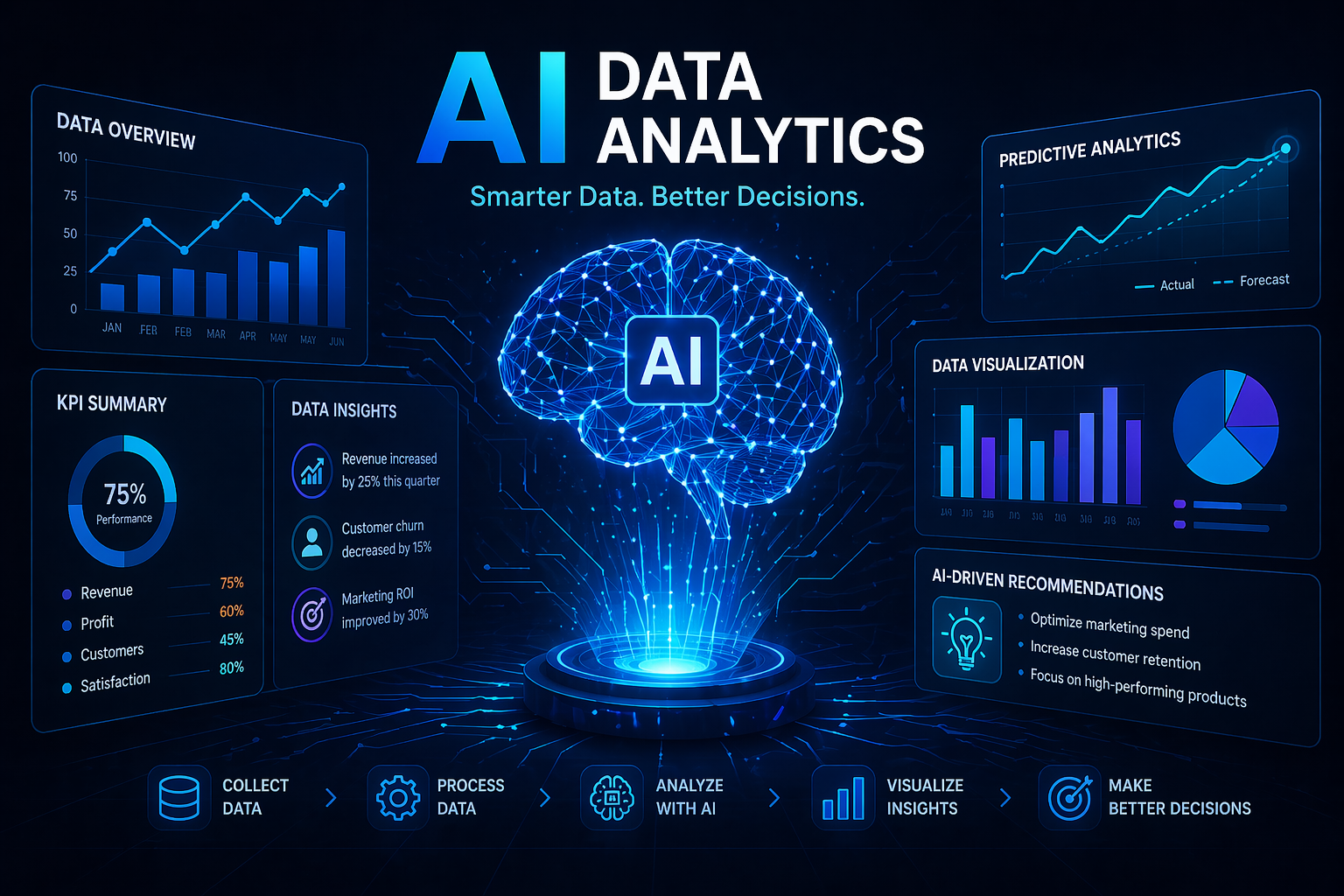
How Data Analysis Works
AI data analytics is based on a simple process, even though the technology behind it is very advanced.
- Gathering Data
Websites, apps, sales systems, and social media are just some of the places where data is collected.
- Processing Data
AI sorts and cleans the data so that it can be properly analysed.
- Finding patterns
Models that use machine learning find patterns, links, and outliers.
- Predictions and Insights
AI makes predictions and gives useful information.
- Making Decisions
These insights help businesses make decisions that are smarter and faster.
It’s interesting that modern tools let you ask questions in plain English, like “Why did sales drop last week?” and get answers right away.
AI Data Analytics in the Real World
Let’s make this more useful by using examples from the real world.
- Suggestions for online shopping
AI data analytics is what makes the “You may also like…” suggestions you see when you shop online. It looks at your past purchases, behaviour, and preferences to suggest products.
- Finding Fraud in Banking
Banks use AI to find transactions that don’t seem right. AI will flag your card right away if it is used in another country.
- Predictions for health care
AI analytics help hospitals figure out how likely it is that a patient will have to go back to the hospital or that their disease will get worse.
- Improving Marketing Campaigns
AI looks at which ads work best and changes campaigns on its own to get better results.
- Predicting the Supply Chain
AI cuts forecasting mistakes in supply chains by as much as 50%, which helps businesses avoid having too much or too little stock.
The main benefits of data analysis
AI analytics has a lot to offer. Here are the main benefits:
Making decisions faster
AI gives you information right away, so you don’t have to wait days for reports.
Better accuracy
AI models can make predictions with 85–92% accuracy, like predicting sales.
Saving Money
Automation speeds up processes and makes less work necessary.
Better Service for Customers
Companies can tailor their services to each customer based on how they use them.
Advantage over the competition
Companies that use AI analytics are more likely to do better than their competitors.
AI vs. Data Analytics the Old Way
Let’s look at both methods side by side to see how they are different.
| Feature | Traditional Analytics | AI Data Analytics |
|---|
| Speed | Slow | Fast (real-time) |
| Insights | Descriptive | Predictive & prescriptive |
| Automation | Low | High |
| Accuracy | Moderate | High |
| User Skill Needed | Technical | Beginner-friendly |
The biggest change is that AI makes analytics easier to use. Even people who aren’t tech-savvy can now easily look at data.
Problems with data analysis
AI analytics is powerful, but it’s not perfect.
Problems with the quality of the data
AI results won’t be accurate if your data is messy. If you put in garbage, you’ll get garbage.
High Cost Up Front
For small businesses, using AI tools can be expensive.
Not enough skills
Some companies have a hard time finding skilled workers.
Concerns about privacy
When you have to deal with a lot of data, you have to worry about security and privacy for users.
Too Much Dependence on AI
If you trust AI without human judgement, you could make bad choices.
The Future of AI data analysis
The future looks bright. AI is changing from a tool to a partner that helps people make decisions.
We can expect this:
- More automated insights with little to no human effort
- The rise of natural language analytics (just ask questions like you would in a conversation)
- The rise of real-time analytics
- More use of models that predict and tell what to do
- By 2035, the market is expected to grow a lot, reaching more than $102 billion.
To put it simply, AI won’t just look at data; it will also help people make decisions.
How to Start Using AI for Data Analytics
Don’t worry if you’re new to this field; it’s not as hard as it sounds.
These are the steps you should take:
- Get to know the basics of data (Excel, charts, etc.)
- Look into tools that are easy for beginners to use, like Google Data Studio or Power BI.
- Use AI-powered platforms that can understand natural language.
- Use real datasets to practise
- Keep learning because AI changes quickly.
You don’t have to know how to code to get started. A lot of tools are made for people who are just starting out.
In conclusion
AI data analytics is changing how we think about and work with data. It works faster, smarter, and more powerfully than old ways. Its effects can be seen everywhere, from guessing what customers will do to making better business decisions.
What’s the best part? It’s becoming available to everyone, not just data scientists. Learning AI analytics can help you find new opportunities, whether you’re a student, a business owner, or a marketer.
AI is leading the way as the world moves toward making decisions based on data.
Questions and Answers
- What does AI data analytics mean in plain English?
AI data analytics is when computers use AI to look at data, find patterns, and guess what will happen in the future.
- Is it hard to learn AI data analytics?
Not really. A lot of tools are easy to use for beginners and let you look at data without having to write code.
- How reliable are AI analytics?
It can be very accurate, up to 85–92% in some cases, but this depends on the quality of the data.
- Where is AI data analysis used?
Healthcare, finance, e-commerce, marketing, and a lot of other fields use it.
- Can small businesses use AI to analyse data?
Yes. There are a lot of cheap tools available, so even small businesses can use them.