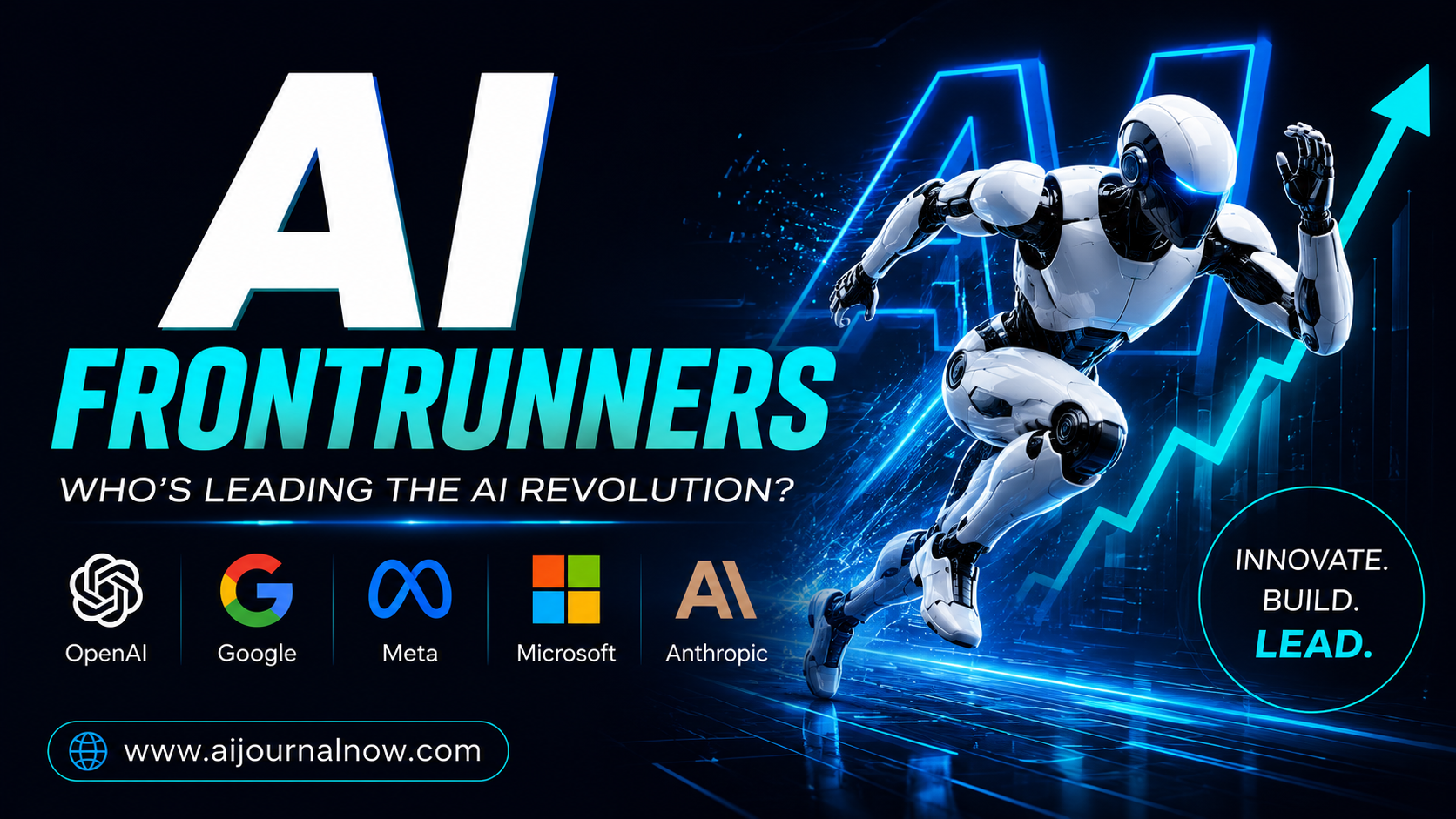
A few years ago, “artificial intelligence” was an idea that belonged to science fiction and tech conferences. Now it’s built into the apps on your phone, the search engine you use every morning, and the tools your coworkers won’t shut up about. And behind it all? A small handful of ai frontrunners — corporations and research institutes pushing themselves harder and quicker than all the others.
These are the AI frontrunners – the organisations at the forefront, forging the path, defining the course and taking decisions that echo across every industry. If you’ve ever asked yourself what they are, how they’re different, and why it really matters to you, this article clears the fog of buzzwords and explains it all.
Who are the AI FrontRunners?
The word “frontrunner” is pretty much what it sounds like – these are the players at the top of the list. But the top spot in AI is not simply about having the highest expenditure. It’s about the depth of research, about real-world deployment, and about the ability to keep iterating faster than anyone else.
A few names are dominating the discourse at the moment:
OpenAI brought AI to the masses with ChatGPT. Prior to 2022, most humans had not interacted with a huge language model. Over a million users signed up in five days after ChatGPT launched. That type of adoption doesn’t happen by mistake – it’s the result of years of research and a gamble on making AI accessible, not just strong.
Google DeepMind has been in this competition longer than others. DeepMind’s AlphaFold project solved a 50-year-old biology problem – predicting how proteins fold – and has opened up a brand new world of drug development possibilities. That’s not launching a product. That is a scientific miracle!
The company behind Claude, Anthropic, emphasises AI safety as much as capabilities. The point is constructing powerful AI and building responsible AI shouldn’t be in opposition.
Meta AI is pushing open-source AI development, making its models openly available for researchers and developers throughout the world to build upon. That’s a very different mentality than the closed model approach of others.
Outside the US, Baidu, Mistral and Cohere are finding their own paths — in China, Europe and enterprise markets respectively.
AI Frontrunners and What Makes Them Different
It’s easy to think of this as a horserace — whomever designs the smartest chatbot wins. But the true differentiators go deeper.
Product vs. Research Focus
Some of the AI frontrunners are mostly research organisations that also supply products. Others are product corporations with large investments in research. It’s the balance that matters. Breakthroughs come from pure research laboratories. Product teams make stuff that people use every day.
OpenAI is a bit of a hybrid – it was formed out of research, but is now very product- and commercial partnerships-focused. DeepMind is more like foundational science.
Safety Philosophy
This is a true difference, not simply PR nonsense. Some organisations feel the best route forward is to go rapidly and rectify things as they go along. Others—Anthropic being the clearest example—believe that safety research ought to proceed alongside capability development, not chase it.
For example: A small marketing agency began employing AI writing tools to write client copy. Within a few months they found that the tool sometimes made factual errors that seemed confident. This is not hypothetical, it happens all the time with less safety conscious models. The frontrunners who really care about alignment are actively working to fix this problem, not merely ship it around.
Computing and Infrastructure
Training large AI models is expensive in terms of both money and computational resources. The AI frontrunners have either built their own infrastructure (Google for instance with its TPUs) or locked down big cloud partnerships. It’s not glamorous, but this is what distinguishes labs that can train frontier models from those that can’t.
AI Frontrunners and How Their Work Affects You Directly
Here’s the portion that really matters to most readers.
And you might not be a machine learning researcher, but the race between AI frontrunners is changing the tools you use every day — from how well your email writes itself, to how precisely a medical AI flags a scan, to how a student gets tutored on a concept they’re struggling with.
For students: AI tutoring systems built on frontier models are getting really adept at helping you understand tough ideas in personalised ways. That’s a direct consequence of frontrunners pushing the quality of language models forward.
For bloggers and content creators: All of those tools — AI writing assistants, picture generators, SEO analysis platforms — are built on technology that came out of or was inspired by research at these laboratories.
For business owners: chatbots for customer care, tools that summarise contracts, inventory forecasting tools – these are now available to small firms, all thanks to the frontrunners driving down prices and improving quality over the past several years.
The competition between these organisations is fierce, but it’s a boon to the end user. More competition equals faster innovation, more choice, and ultimately lower prices.
AI Front-Runners and the Risks to Watch out for
There is another side to the coin here to be fair.
That’s a legitimate concern when you’re dealing with a transformative technology and that much concentration of power in a few organisations. Decisions taken in boardrooms and research labs in San Francisco, London and Beijing can have repercussions throughout the world.
There are also serious issues about:
- Job displacement — not overnight, but gradually, in particular jobs
- Misleading information — AI-generated content that is difficult to distinguish from human-generated content
- Bias in models — models can replicate past inequities if training data is biased
These challenges are on the AI frontrunners’ radar. The difference is how much each organization cares about solving them, vs shipping the next edition.
AI Pioneers: Staying Ahead Without Getting Overwhelmed
Most people don’t have the time to read AI research articles. That’s fine—you don’t have to. But having a loose understanding is really useful, especially if your profession is in any way related to something that AI could automate or better.
Some practical habits:
- Follow one or two trusted AI newsletters instead of doomscrolling tech Twitter
- Allow new AI tools to get popular for two weeks before determining if it’s worth studying — hype and reality frequently need time to align
- Pay attention to what the frontrunners are prioritising, not just what they’re releasing. “Where they put research tells you where things are headed”
Frequently Asked Questions: AI Frontrunners
Q: As an ordinary person, does it matter which AI company’s tools I use?
A: More than you’d suppose. varied companies have varied approaches to data privacy, accuracy and safety. It’s worth taking five minutes to study a platform’s privacy policy before you paste in your work papers or personal information. Not all AI technologies treat your data the same way.
Q: Is there collaboration or competition among the AI frontrunners?
A: Mostly competing, indeed. They are business organisations with real rivalry. But there is some collaboration on safety standards and policy issues. For example, a number of the front-runner labs are members of the Partnership on AI. Competition and selective collaboration can co-exist.
Q: Are open-source AIs from businesses like Meta as good as closed models?
A: Yes, increasingly. Open source models have narrowed the gap considerably during the previous two years. They function on par with closed models for many applications and offer greater flexibility for developers who want to customise or self-host.
Q: How does a non-technical individual keep up with AI breakthroughs without being overwhelmed?
A: Choose one or two sources you trust and stay with them. Newsletters like Andrew Ng’s The Batch or Import AI offer weekly summaries of advancements in layman’s terms. You don’t need to read the technical papers, just comprehend what changed and why it matters.
Thoughts Final
The AI frontrunners are doing more than building fascinating technology. The decisions they make will affect how people work, learn, create and communicate for decades to come. Whether you are a student, a business owner, or just trying to understand a world that appears to be changing quicker than it used to, it is really useful to know who they are – and what ideals are behind them.
You don’t need to choose. But to be apprised? That aspect is worth the effort.
Also Read: How to Make Roles on Discord: A Step-by-Step Guide