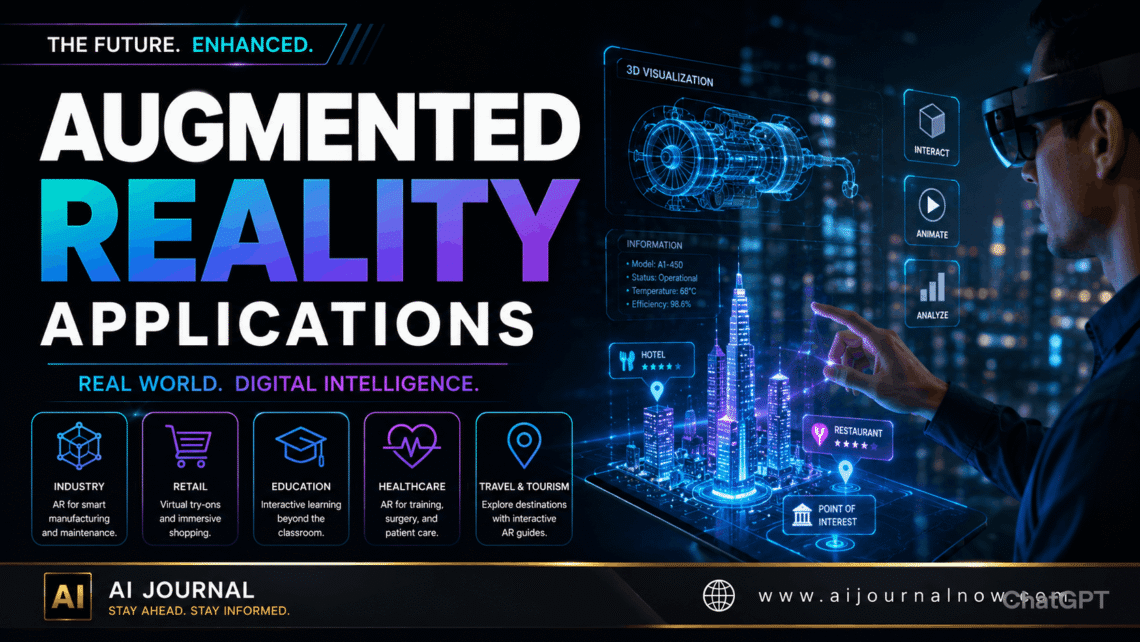
Augmented reality applications have silently transitioned from science fiction to our daily lives, with most people already using them without even knowing it. That Snapchat filter where it puts sunglasses on your face? That’s augmented reality. The IKEA software that lets you see a simulated sofa in your living room before you buy it? AR also. The technology has progressed rapidly and is now open to anyone with a smartphone.
But it’s more than just fun filters. From hospitals to classrooms, design studios to warehouses, augmented reality apps are being used everywhere, and the results are really amazing. If you’ve been asking yourself what this technology accomplishes and where it’s headed, you’ve come to the perfect spot.
What Are Augmented Reality Apps?
Augmented reality applications are basically software applications that superimpose digital content such as photos, text, audio, or 3D objects onto the real world as viewed through a camera or monitor. AR is different from virtual reality, which takes over your environment, because it makes your view better already.
Imagine looking through a magic lens. You hold your phone up to a restaurant, and reviews pop up beside it. You turn to a page in a textbook, and a 3D model of the human heart emerges on top of it. The real world is still there – the digital layer just makes it better.
Augmented reality applications often integrate GPS, cameras, motion sensors, and computer vision to properly place digital items in a physical environment. Some run on smartphones, others on dedicated headsets like Microsoft’s HoloLens or Apple’s Vision Pro. But the concepts remain the same: sense the surroundings, process it in real time, and overlay valuable or entertaining content.
How Do Augmented Reality Apps Work, Actually?
Augmented reality applications work through a few crucial phases that take place in a fraction of a second.
The device’s camera first collects the physical environment. The software then identifies surfaces, objects, or marks in the space. Once the environment is mapped, digital material is anchored at specified spots, like a virtual chair sitting on your actual floor, a label floating over a machine part, or a character walking over your real tables.
This approach is known as simultaneous localization and mapping, or SLAM. This is what makes AR experiences feel anchored and steady instead of floating around the screen.
Marker-based AR is a type of augmented reality that is activated by a specific image or QR code to trigger the digital overlay. Others rely on markerless AR, which only uses ambient recognition, a more flexible approach, but one that is computationally more intensive. Either way, the end effect is a mixed experience that seems surprisingly natural once you get used to it.
Key Sectors Using Augmented Reality Applications
Augmented Reality Applications in Health Care
Surgeons are employing AR overlays during procedures to monitor real-time imaging data without taking their eyes off the patient. Medical students use augmented reality apps that project anatomy onto physical mannequins. Nurses have devices that locate veins and map out blood vessels right on a patient’s arm.
The practical effect here is huge. Hospitals that have used AR technologies have shown benefits like fewer errors, faster training, and better patient outcomes.
Applications of Augmented Reality in Education
Classrooms are no longer flat visuals or diagrams from textbooks. Augmented reality apps can add a 3D model of ancient Rome to a history lecture. A biology class may dissect a virtual frog without formaldehyde. Geography students may study maps of terrain that rise up from the desk.
Companies like Google Expeditions and apps such as Merge Cube have already brought this to actual schools. Teachers claim improved engagement and retention with AR in the lesson.
Retail and E-Commerce Use Cases of Augmented Reality
The most practical application of augmented reality applications has probably been in retail. Furniture businesses allow customers to see pieces in their own rooms. Virtual try-ons are available from eyewear brands. Cosmetics brands like L’Oréal and Sephora allow buyers to try lipstick hues or eyeshadow without touching a product.
That minimizes the uncertainty for internet shoppers. And for companies, it cuts returns. It’s a realistic solution to a real problem, and the adoption rate proves it.
AR Use Cases in Manufacturing and Logistics
Assembly line workers utilize AR headsets to see hands-free, step-by-step instructions in their field of view. DHL has used augmented reality apps in warehouses to help pickers find the right shelves by overlaying visual hints onto the environment. AR helps Boeing professionals wire aircraft, lowering wiring time by 25%, according to internal research.
And the productivity improvements here are measurable and meaningful, which is why the pace of industrial adoption has been faster than most people think.
Advantages of Augmented Reality Apps
- Hands-free guidance — Guidance can be provided to workers without the need to stop and look at a manual or screen.
- Improved learning outcomes — Spatial and visual learning is more effective than text alone.
- Fewer mistakes — Real-time overlays catch mistakes before they happen.
- Greater engagement – AR captures more attention in retail or educational settings.
- Remote assistance – Experts can mark up a technician’s view from thousands of miles away.
These are not hypothetical benefits. Today, they are being measured and reported across industries.
Know Your Limits
But there are several limitations to augmented reality applications. Battery depletion is a significant issue—AR is computationally intensive, and prolonged use can lead to devices overheating rapidly. Most consumer AR headsets currently have a shorter field of view than natural human eyesight, which can be disconcerting.
Another problem is privacy. For applications that scan settings or faces, problems about data storage and consent come up. Regulations are still struggling to keep up with the technology.
Another stumbling block for small enterprises is cost. High-end AR technology is still expensive, and creating custom augmented reality applications demands specialized skills that are currently scarce and expensive.
That said, they are challenges that are actively being worked on—not permanent walls.
Augmented Reality Applications for the Masses
You don’t need an enterprise budget or a headset to experience AR. Your smartphone already has the power to run a host of augmented reality applications. Google Maps has AR walking directions. Pokémon GO created a worldwide frenzy around AR. Apple’s Measure app uses AR depth mapping to turn your phone into a tape measure.
AR apps can bring textbooks to life for pupils. Instagram and TikTok AR filters create new opportunities to form a visual identity for bloggers and content creators. AR tools allow designers and architects to communicate concepts to clients before anything is produced.
There are AR solutions for product visualization, virtual showrooms, and interactive business cards for small business owners, and they are reasonable. The entrance point has decreased a lot.
Augmented Reality Apps: What’s Next
In the next few years we’re going to see AR glasses that look and act like normal glasses. Apple, Google, Meta, and a slew of startups are all working on lightweight form factors that don’t scream “tech device.” Once that technology barrier is solved, augmented reality apps will be something people use all day—navigation, communication, work, and entertainment, all integrated into one layer over the physical environment.
AI integration is also speeding up the ability of augmented reality apps. Real-time object detection, language translation, and contextual help are all joining the toolbox of AR.
Conclusion
Most people don’t realize augmented reality apps are already more integrated into daily life. These are not just cool demos; they are solving actual problems in health care, education, retail, and industry. As hardware gets lighter and software smarter, the border between the real and digital world will continue to dissolve in very helpful ways. If you’re a student, a business owner or just someone interested in where technology is headed, AR is worth keeping an eye on.
Frequently Asked Questions
Q1: What are augmented reality apps used for?
Augmented reality applications are applied in several industries like healthcare, education, retail, manufacturing, and entertainment. Typical applications include virtual try-ons, surgical assistance, employee training, warehouse navigation, and interactive learning tools.
Q2: Do I need special hardware to use augmented reality applications?
Not necessarily. Augmented reality is often run on smartphones and tablets that you can buy anywhere. Specialized glasses like Microsoft HoloLens or Apple Vision Pro offer more immersive experiences, but the entry point for basic AR is simply a current phone.
Q3. Are augmented reality apps safe to use?
Yes, normally. However, there are privacy concerns with environmental scanning and facial recognition features. Always read the privacy policy of an AR app before you use it, especially if it’s constantly accessing your camera.
Q4. What is the difference between augmented reality applications and virtual reality?
Virtual reality completely replaces your environment with a digital one and requires headgear to block out the actual world. Augmented reality apps add digital information on top of the real environment, yet still allow you to see the space around you. AR is generally more practical for everyday use.
Q5: Can augmented reality applications help small businesses?
Absolutely. AR can help small firms with product visualization, virtual showrooms, interactive marketing, and remote customer consultations. Several economical platforms are tailored for small business use cases, reducing the cost necessary to get started.

