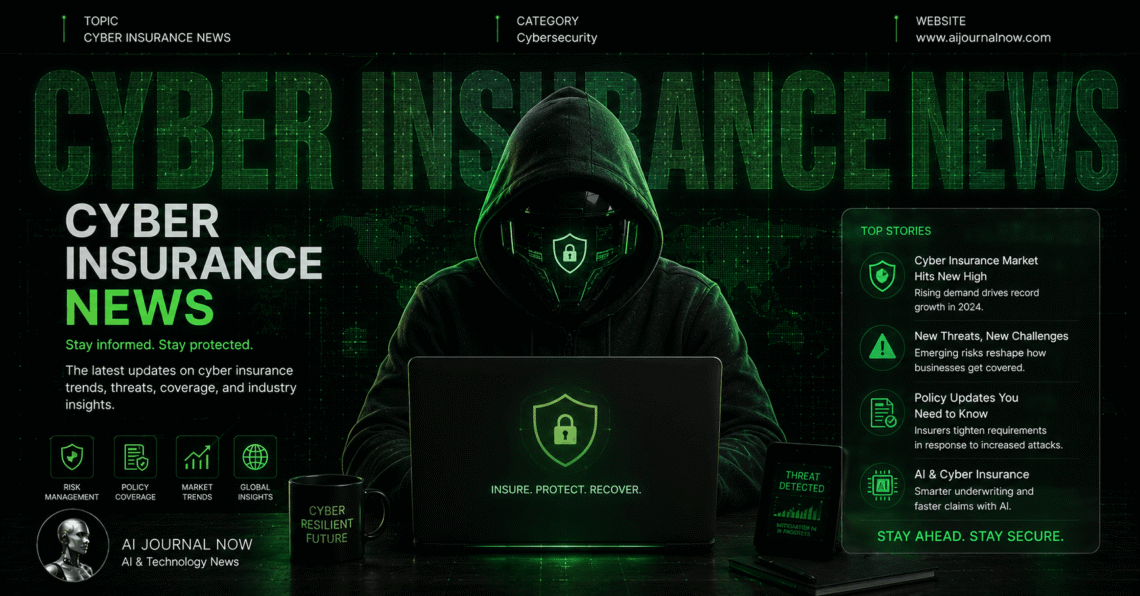
If you’ve been watching cyber insurance news lately, you know the market is shifting in ways that affect every business owner, IT manager, and risk professional. Premiums that dropped for two straight years are climbing again. Insurers are asking harder questions. And the types of attacks driving claims look different than they did even 18 months ago.
This isn’t abstract. It directly affects what coverage you can get, what you’ll pay, and whether a claim will actually get paid when something goes wrong.
Let’s break it down.
Cyber Insurance News: The Big Shift—Premiums Are Rising Again
For a while, it was actually a buyer’s market. Premiums dropped roughly 6% in 2025 compared to the year before. That was a relief after years of steep rate hikes following the ransomware explosion of 2020 to 2022.
But that trend is reversing. According to S&P Global Ratings, premiums are expected to rise 15% to 20% in 2026. The reasons are straightforward: attacks are more frequent, more expensive, and harder to contain.
The average claim severity hit an all-time high of $221,000, according to At-Bay’s 2026 InsurSec Report. Ransomware claims alone averaged $508,000 — up 16% from the previous year.
So if your renewal is coming up, don’t expect last year’s rate. Budget for a meaningful increase.
Cyber Insurance News: What’s Driving Claims Right Now
Not all threats are created equal. The current cyber insurance news cycle is dominated by a few specific attack patterns.
Ransomware via Remote Access
Here’s a stat that stopped me in my tracks. Remote access services were the entry point for 87% of ransomware claims in 2025. VPN compromises alone accounted for 73% of ransomware intrusions where the entry vector was identified. That’s up from 38% in 2023.
If your team uses a VPN and hasn’t audited it recently, that’s a serious gap. Insurers are noticing this pattern too.
Data Theft Over Encryption
The other big shift: attackers are skipping full encryption and going straight to stealing data. According to Allianz Commercial, data exfiltration appeared in 40% of large 2025 claims — up from 25% the year before. The focus is now less on paying ransom and more on managing notification costs, credit monitoring, and regulatory response.
AI-Powered Phishing
This one’s evolving fast. Threat actors are using AI to customize phishing campaigns at scale. Deepfake voice and video tools are making impersonation convincing enough to fool employees who know to be careful. According to CFC Underwriting, AI is quietly multiplying attacker efficiency rather than creating sci-fi-style super-attacks.
What Insurers Are Requiring Before They’ll Cover You
This is where Cyber Insurance News gets very practical. The rules for getting covered — and keeping that coverage — have tightened significantly.
Multi-Factor Authentication (MFA)
This is now non-negotiable. Organizations without MFA are seeing premium increases of 25% to 40%, or outright denial of coverage. If you’re still relying on passwords alone, that’s not just a security problem — it’s an insurance problem.
Endpoint Detection and Response (EDR)
87% of cyber insurance applications now require proof of EDR software. Insurers want to see that you’re actively monitoring endpoints, not just hoping nothing bad happens.
Incident Response Planning
You need a documented plan for what happens when an incident occurs. Who gets called? What gets shut down? Who handles communication? Insurers want to see this exists before the claim, not after.
Annual Security Audits
Under CCPA amendments that took effect January 1, 2026, businesses in California are now required to conduct annual cybersecurity audits. Similar requirements are spreading. Insurers are aligning their requirements with these regulations.
In my experience, businesses that treat these requirements as checkboxes get burned eventually. The ones that actually build the controls earn both better premiums and a smoother claims process.
Cyber Insurance News: The SME Coverage Gap Problem
Here’s a story the headlines don’t tell enough. Large corporations are generally well covered — 60% to 70% of them have adequate cyber insurance. Mid-market firms sit at around 40% to 50%. But small and medium-sized businesses? Only 10% to 20% have sufficient coverage.
That gap is a problem for two reasons.
First, attackers know it. Allianz noted that threat actors are increasingly shifting focus to less mature mid-market targets where they expect faster paydays and fewer defenses.
Second, the financial impact of a breach on a small business is often fatal. A $221,000 average claim would wipe out most small operations. And yet that’s the population least likely to be properly insured.
If you run a smaller business and you’re relying on a general liability policy to cover a cyber incident, it almost certainly won’t. Cyber events require cyber-specific coverage.
Supply Chain Risk: The Coverage Blind Spot
One of the quieter stories in recent cyber insurance news is supply chain exposure. Cyber incidents continue to amplify risk across entire supply chains — upstream to suppliers and downstream to customers.
The problem is that many standard cyber policies don’t clearly cover third-party supply chain incidents. If your vendor gets hit and that causes your operations to go down, you may find yourself in a gray area when you file a claim.
The World Economic Forum’s Global Cybersecurity Outlook 2026 flagged AI-driven threats and supply chain vulnerabilities as top systemic risks for the year. Insurers are starting to catch up, but policy language varies enormously between providers.
Before you sign a policy, ask directly: “What happens if a vendor breach causes my business interruption?” Get the answer in writing.
What Gets Claims Denied — and How to Avoid It
21% of cyber insurance claims are denied due to non-compliance with policy security requirements. That’s a sobering number. You paid for coverage, got hit, and the insurer said no.
The most common reasons for denial:
- MFA wasn’t in place at the time of the incident
- Security controls listed in the application weren’t actually implemented
- The incident fell under a policy exclusion (nation-state attacks, war clauses)
- The claim was filed late or the insurer wasn’t notified within the required timeframe
The nation-state exclusion issue deserves its own mention. After the NotPetya litigation involving Merck and Mondelez, insurers tightened the language around what counts as a nation-state attack. Some policies now exclude any incident that can be attributed to state-sponsored actors — even if it’s a broad attack and you weren’t the intended target.
Read your policy’s exclusions carefully. If something is unclear, ask your broker to explain it in plain language.
Cyber Insurance News: FAQs
Is cyber insurance worth it for small businesses? Yes — especially given that SMEs are increasingly targeted. A single ransomware attack or data breach can cost more than most small businesses carry in reserves.
What’s the fastest way to lower my cyber insurance premium? Implement MFA everywhere, deploy EDR software, document an incident response plan, and be able to prove all three when you apply or renew.
Does cyber insurance cover ransomware payments? Most policies cover ransom payments, but many also have sublimits on that coverage. More importantly, they should cover the larger costs: forensic investigation, legal fees, notification, and business interruption.
How often should I review my cyber insurance policy? At minimum, annually — ideally before renewal. As your business grows and technology changes, your exposure changes. A policy that was adequate two years ago may not cover your current risk profile.
The cyber insurance market in 2026 is more demanding but also more mature. Insurers understand the risk better. They’re asking harder questions, but the coverage they’re offering is sharper too.
The businesses that will get the best outcomes are the ones treating security and insurance as two sides of the same coin—not separate budget line items. Strong controls earn better rates. Better documentation earns faster claims. And reading the fine print before you need it earns you the payout when things go wrong.
That’s the real story behind this year’s Cyber Insurance News—and it’s one worth paying close attention to.
Also Read: AI Tools for Freelancers: Work Smarter, Earn More