Few internet spaces generate as much curiosity as 4chan pol. Journalists write about it. Researchers study it. And yet, most people misunderstand it completely. Whether you encountered the term in a documentary, a news article, or a media studies class, this guide explains it clearly and honestly.
What is 4chan pol?
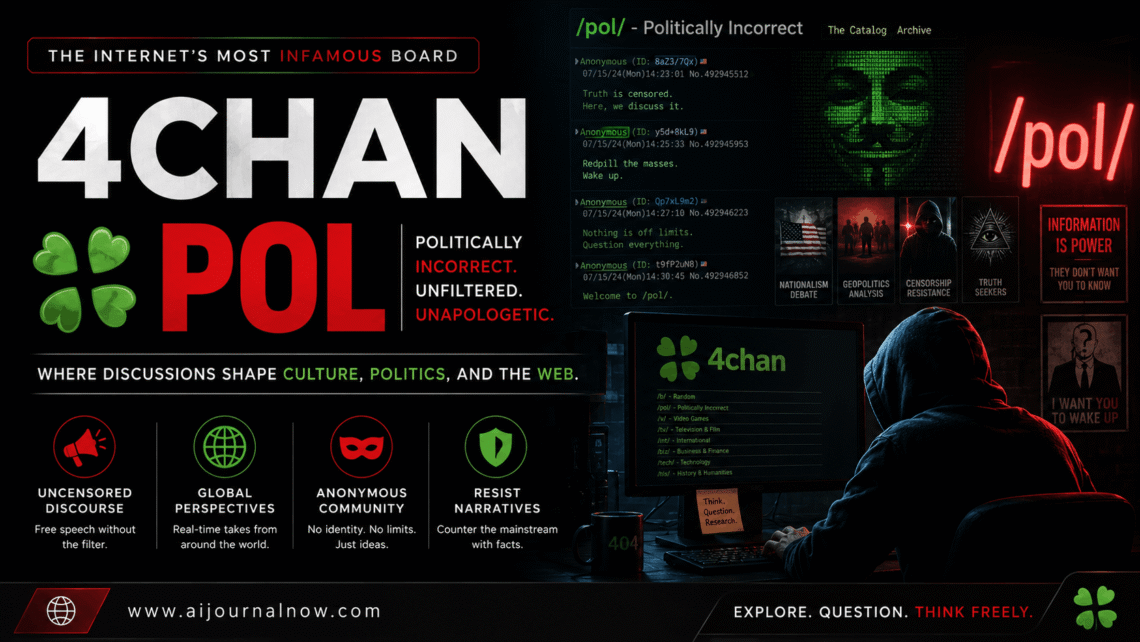
First and foremost, “4chan pol” refers to the /pol/ board on 4chan. Specifically, /pol/ stands for “Politically Incorrect.” Christopher Poole founded 4chan back in 2003. Initially, he built it as an anime discussion space. Over time, however, it expanded into dozens of topic-specific boards. Consequently, /pol/ became one of the most active boards on the entire site.
Google created the board in 2011. Actually, the site’s administrators created it—not as a hub for politics, but as a containment space. The goal was simple: keep political arguments off other boards. Nevertheless, it quickly grew into something far larger and far more influential.
Furthermore, 4chan’s /pol/ runs on a fully anonymous format. There are no user accounts. There are no usernames. And there is no persistent identity whatsoever. Posts vanish once a thread fills up or drops off the front page. Everything disappears by design. That anonymity, therefore, sits at the heart of everything the board is.
How 4chan pol Actually Works
So how does 4chan’s /pol actually function? The mechanics are straightforward. Anyone can visit the board without signing up. To post, you simply submit text, an image, or both together. The first post creates a thread. Replies build on top of it. Meanwhile, the most recently active threads stay at the top. Inactive threads sink and eventually disappear entirely.
Additionally, each post receives a random number ID. Most users display simply as “Anonymous.” There is no karma system here. There is no follower count. and There is no algorithm deciding what you see. Instead, the front page shows only the most recently active threads. As a result, the experience feels raw and unfiltered compared to mainstream platforms.
Moreover, moderation does exist—but it is widely acknowledged as inconsistent. Illegal content, such as anything involving minors, gets removed promptly. However, much other content that would violate Twitter or Reddit policies stays up. That inconsistency, therefore, remains one of the board’s most criticized qualities.
The Political Content on 4chan pol
So what do people actually post on 4chan pol? The content spans an enormous range. Nevertheless, it skews heavily toward far-right, nationalist, and contrarian politics. Threads cover current events, elections, immigration, conspiracy theories, and cultural debates. Furthermore, the tone constantly shifts between serious political analysis and deliberate shock content.
Researchers who study 4chan pol consistently note one key pattern. The board functions as an idea incubator. Memes, political narratives, and framing devices that originate there often migrate outward. Specifically, they spread to Twitter, then to Reddit, and eventually into mainstream media—sometimes within hours. The “Pepe the Frog” symbol is one clear example. QAnon content is another. Both have documented amplification pathways through 4chan pol.
Consequently, journalists and political scientists watch the board closely. It sits outside the mainstream social media ecosystem. Yet, its downstream influence on political discourse is real and well-documented.
Real-World Influence and Documented Impact
The real-world influence of 4chan pol is not theoretical. Multiple academic studies have traced specific campaigns back to threads on the board. Journalistic investigations have done the same. Therefore, dismissing the board as irrelevant misses something important.
During the 2016 US presidential election, researchers documented a clear pattern. Content from 4chan pol spread through right-wing media ecosystems. Occasionally, it entered mainstream news coverage directly. The board’s anonymous, high-volume environment made it an effective testing ground. Political slogans and framings that got strong reactions there sometimes spread much further.
Additionally, organized harassment campaigns have roots in 4chan pol threads. The Gamergate controversy in 2014 is one well-known example. It involved widespread harassment of women in gaming. Researchers traced significant organizational activity back to 4chan and specifically to /pol/. As a result, the board drew serious scrutiny from journalists, policymakers, and platform safety researchers.
Furthermore, researchers now monitor 4chan pol as an early warning system. Conspiracy theories and disinformation narratives often appear there before surfacing elsewhere. Tracking what spreads on the board, therefore, has become a legitimate intelligence-gathering practice.
Why People Study 4chan pol
Researchers, journalists, and security professionals study 4chan pol for concrete, practical reasons. Understanding where extremist narratives form is essential for counter-extremism work. It also matters for platform moderation and political analysis.
Media scholars study 4chan pol to understand anonymous online environments. Specifically, they ask: what happens to political speech when identity disappears? What content thrives? What communities form? These questions have real implications for how we design and moderate online spaces.
Additionally, digital humanities researchers use archived data from the board. Multiple published studies have analyzed this data. They examine network effects, meme propagation, and information diffusion across the internet. Moreover, journalists reference 4chan pol regularly when tracing the origins of viral disinformation. Understanding the source, after all, matters for accurate reporting.
Honest Limitations and Criticisms
Any fair treatment of 4chan pol must confront its documented problems directly. Therefore, this section does exactly that.
The board hosts significant volumes of racist, antisemitic, and misogynistic content. This is not a fringe phenomenon on 4chan pol. Rather, it is pervasive and often normalized within the board’s culture. Academic researchers who study the board consistently document this finding.
Furthermore, the radicalization question is real and still debated. Some researchers argue that 4chan’s /pol/ draws in people already predisposed to extreme views. Others argue it actively pushes users toward increasingly radical content. Honestly, both dynamics likely coexist. The research does not yet offer a clean answer.
Additionally, the anonymity that makes 4chan pol a unique research subject also makes accountability nearly impossible. Harassment campaigns are difficult to trace to individuals. False information spreads without correction. There are no mechanisms for community self-correction. On platforms with persistent identity, those mechanisms exist. On 4chan pol, they simply don’t.
Finally, media coverage sometimes overstates the board’s influence. Not every political meme originated on /pol/. Not every conspiracy theory traces back there. Treating 4chan pol as the sole source of online radicalization, therefore, misrepresents a far broader ecosystem.
What This Means for Students, Researchers, and Media Professionals
For students studying media, politics, or internet culture, 4chan’s /pol/ offers a genuinely important case study. It shows how anonymous spaces function, how political content spreads, and how platform design shapes behavior.
For journalists and bloggers, understanding 4chan pol provides useful context. Specifically, it helps trace the origins of viral narratives. It also helps explain how fringe ideas enter mainstream discourse. That context makes reporting more accurate and more complete.
For business owners and marketers, the lesson is more indirect. Nevertheless, it is worth noting. Anonymous online communities can shape public perception of brands and public figures in unpredictable ways. Awareness of spaces like 4chan pol, therefore, matters for reputation monitoring and crisis preparedness.
Frequently Asked Questions
Q1: Is 4chan pol legal to visit? Yes, visiting 4chan’s /pol/ is legal in most countries. The board is publicly accessible without registration. However, some content posted there may violate laws in specific jurisdictions. The site operates legally overall, though it regularly faces criticism over inconsistent content moderation.
Q2: Why is 4chan pol associated with far-right politics? 4chan’s /pol/ started as a general political debate space. However, its user base shifted significantly rightward over time. Researchers attribute this partly to the board’s culture of provocation. That culture tends to reward extreme positions. Additionally, far-right communities deliberately used the board as an organizing space.
Q3: Can 4chan’s /pol/ be used for legitimate research? Yes, absolutely. Archived data from 4chan’s /pol/ has appeared in peer-reviewed academic studies. Topics include meme propagation, political communication, and disinformation spread. Several universities maintain datasets of public posts for scholarly analysis. Engaging with it critically and analytically is, therefore, a fully legitimate research activity.
Q4: How does content from 4chan pol spread to mainstream platforms? Content from 4chan pol typically moves through a multi-step process. First, it originates or gets amplified on the board. Next, users carry it to Reddit or Twitter. Then, shares and engagement push it further. Finally, mainstream media occasionally covers it. Researchers call this cross-platform migration. Moreover, multiple peer-reviewed studies have documented it in detail.
Also Read: Film of Camera: A Complete Beginner’s Guide