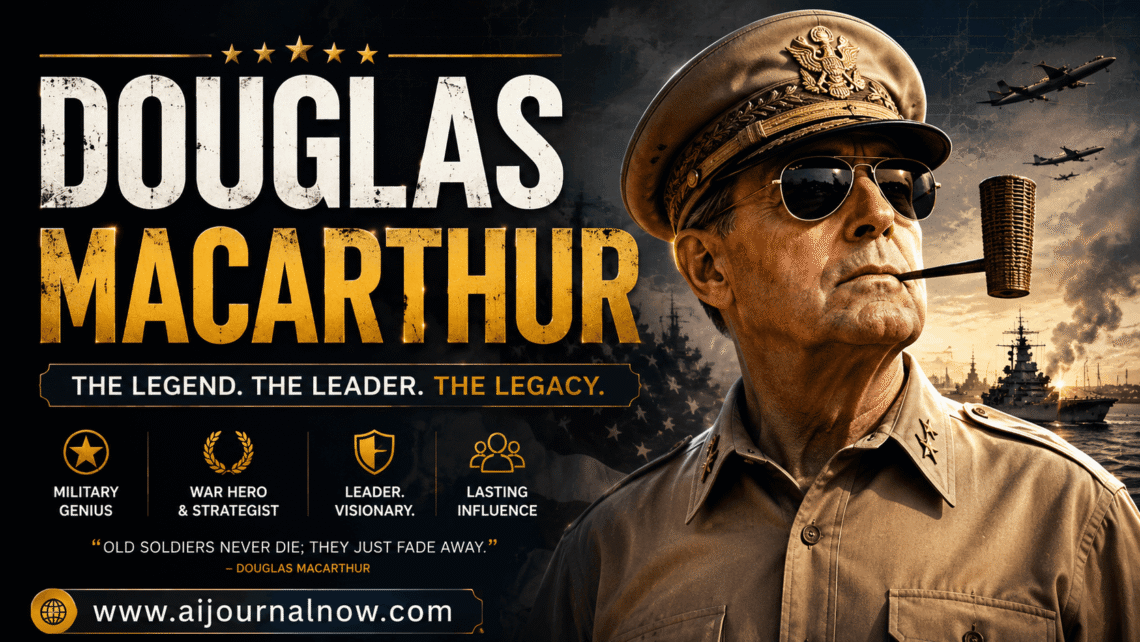
Douglas MacArthur is one of the most researched, discussed, and interesting military personalities in American history. Few leaders have ever inspired such devotion among their men and at the same time exasperated the presidents for whom they worked. He was clever. Flawed. Dramatic. And significant. If you are a student writing a thesis or just someone with an interest in history, understanding Douglas MacArthur means understanding a turning point in the conduct and leadership of modern warfare.
Who Is Douglas MacArthur?
Douglas MacArthur was born into a military family on January 26, 1880 in Little Rock, Arkansas. His father, Arthur MacArthur Jr., was a renowned general in the Civil War and Philippine-American War. That background colored everything.
Graduated first in his class at West Point, 1903. And after that, he quickly advanced in his profession. He fought in World War I, was Army Chief of Staff in 1930, and later commanded Allied forces in the Pacific in World War II. His résumé was staggering—and so was his egotism.
How MacArthur Came to Military Prominence
MacArthur accomplished more than make history. He thrust himself into its very middle again and again.
He won several honors for battlefield courage in France in World War I. But it was World War II that made him. President Roosevelt ordered MacArthur to depart after the defeat of the Philippines in 1942, He famously promised, “I shall return,” and return he did, in 1944.
His island-hopping tactic across the Pacific was ingenious, but costly. At the same time, his theatricality—sunglasses, corncob pipe, and simulated wading ashore—made him a media figure. He also forever sealed his place in history when he accepted the surrender of Japan on September 2, 1945, aboard the USS Missouri.
Douglas MacArthur: Strengths and Leadership Style
Douglas MacArthur was effective because he had strategic insight and a personal mythology.
He knew morale. Soldiers fought harder for a commander they believed in, and MacArthur obsessed about that conviction. He also grasped logistics and amphibious warfare and the psychological aspects of battle to an extent few of his contemporaries could match.
His postwar governance of occupied Japan was also favorably praised. He supervised a near-total rebuilding of Japanese society—democratic elections, land reform, a new constitution. The transition for a conquered nation was extraordinarily smooth. So MacArthur is credited by many historians as much for his peacetime rule as for wartime command.
The Controversies and Limitations of Douglas MacArthur
No honest survey of Douglas MacArthur ignores the tough spots.
His personality was often a severe concern. He was vain, insubordinate, and prone to self-promotion at the expense of accuracy. In the Korean War he challenged the authority of President Truman by advocating an expanded fight with China. That decision lost him his command. In April 1951, Truman sacked him.
The sacking was constitutionally valid but politically combustible. MacArthur came home a hero, but his political ambitions never came to anything. His response to the Bonus Army protest in Washington in 1932, in which he violently dispersed World War I veterans demanding payment, is a sad chapter that historians continue to dispute.
So his legacy is actually difficult. A master strategist. Defective human. Both are true and true at the same time.
Real-World Lessons from the Leadership of Douglas MacArthur
Students, bloggers, and business-minded readers will find some unexpectedly useful insights from Douglas MacArthur.
On sight: Things altered tremendously, yet he never lost sight of the eventual aim. Adaptability in a static target. That’s a transferable skill.
About Communication: His speeches and public pronouncements were meticulously constructed. He knew perception was built of words. Freelancers and marketers instinctively know this: framing matters immensely.
On being accountable: Truman’s dismissal of him is a warning that no amount of experience, however real, justifies disobeying the chain of power. That lesson is true for any company.
On building a legacy: History, MacArthur knew, is the story, not the facts. He fiercely managed his own narrative. Whatever you think of the technique, the consciousness behind it is worth recognizing.
Douglas MacArthur’s Enduring Legacy in Military and World History
The impact of Douglas MacArthur stretches far beyond his years of active duty.
His Pacific campaign was a blueprint for U.S. military doctrine for decades. His leadership of Japan’s reconstruction created a secure democratic ally that remains crucial to world security today. AlFurthermore,is conduct of the Korean War, although it ended in dismissal, established important precedents for civilian leadership of the military.
He died April 5, 1964, at the age of 84. But the argument over his judgments, his character, and his paradoxes has never truly stopped. And that exchange was proof of how much his choices mattered.
Conclusion
Douglas MacArthur was never a simple man, and that’s precisely what makes him worth studying. He fought and won battles. He rebuilt nations. He challenged presidents. He left a legacy that historians still debate today. Whether you love him or hate him, his life is a lesson in ambition, strategy, and the complex link between excellence and ego. History seldom provides us pure heroes. And MacArthur is a prime example.
FAQ
Q1: Why is Douglas MacArthur so renowned?
He is most farenownedor his leadership of Allied troops in the Pacific during World War II, his famous “I shall return” vow concerning the Philippines, and his leadership of Japan’s rehabilitation after the war.
Q2: Why did President Truman fire Douglas MacArthur?
In April 1951, during the Korean War, Truman fired MacArthur when he publicly defied the president by advocating war with China, contrary to Truman’s goal of containment of the conflict.
Q3: Did Douglas MacArthur run for president?
He never formally campaigned, but he had presidential ambitions and was considered at Republican conventions in 1944 and 1948. Neither team could find any traction.
Q4. What was MacArthur’s role in post-war Japan?
MacArthur was Supreme Commander for the Allied Powers, in charge of Japan’s occupation, from 1945 to 1951. He instituted major democratic reforms, including a new constitution, land redistribution, and the institution of free elections.