That discussion regarding edge computing vs cloud computing is one that quickly comes up when people discuss where data is processed. Both are transforming how companies, applications, and devices work with information. But they work extremely differently, and choosing the wrong one can slow you down or cost you more than it should.
Let’s just put it all out there in clear language.
Edge Computing vs Cloud Computing: What’s the Difference?
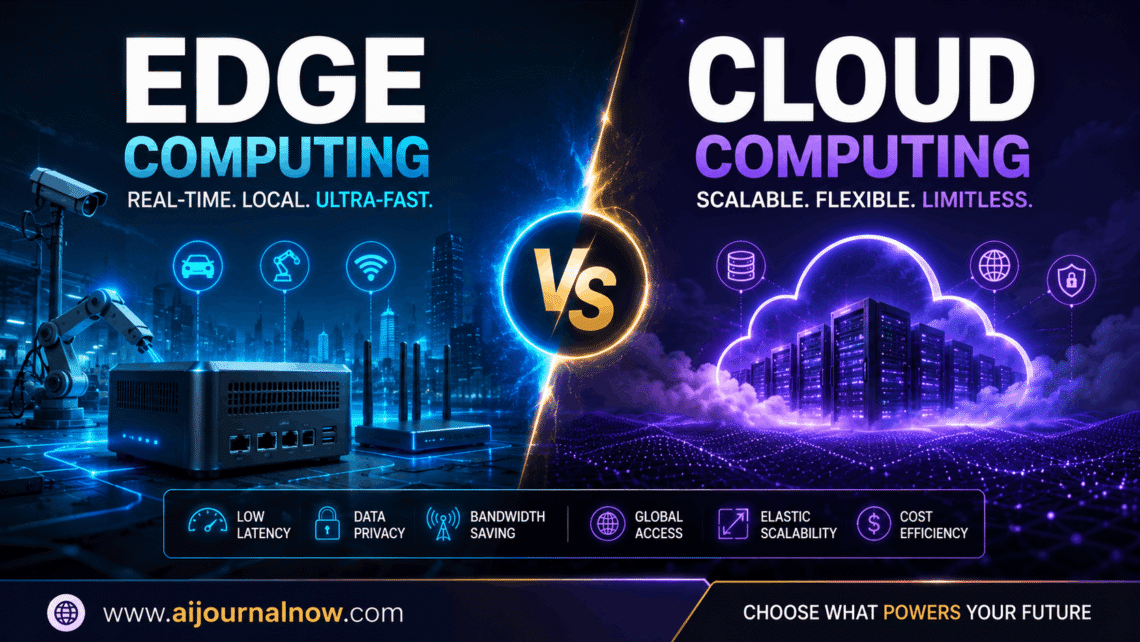
Think of cloud computing as one big, central brain. Your data is sent from your device to a remote server (sometimes thousands of kilometers away), processed remotely, and the result is sent back to you. It does a great job for a vast variety of activities—but that back and forth takes time.
Edge computing turns that model around. It does not transfer data to a central server to be processed, but rather it happens closer to where the data is generated—sometimes on the device or on a local server nearby. Travel less, get results faster.
A basic one is a smart security camera that processes footage locally to recognize a face rather than uploading every frame to the cloud. It’s edge computing. The cloud may still keep the recordings, but the hard work is done right there at the “edge.”
Definition of Cloud Computing?
The premise behind cloud computing is that there are huge data centers maintained by the likes of Amazon Web Services, Microsoft Azure, or Google Cloud. You tap into their processing power, storage, and tools via the internet. You only pay for what you use, you may scale up as needed, and you don’t have to manage physical servers yourself.
It’s really flexible. A startup can use the same infrastructure as a Fortune 500 firm without owning a single server rack. Cloud computing is the default for most web programs and software platforms, and usually the right choice.
The trade-off: latency. Each request has to travel to the data center and back. That’s fine with most apps. This might be a concern for real-time systems.
How Edge Computing Works
Edge computing pushes computing out to the edge of the network, which means local devices, gateways, or neighboring micro-data centers. Edge processing benefits factory-floor industrial sensors, self-driving automobiles collecting and analyzing road data, or a hospital device monitoring a patient’s vitals in real time.
The goal is quick and reliable. An edge gadget stays working if you lose your internet connection. Edge computing is given if your app needs to reply in milliseconds, not seconds. You don’t have to make a round trip to a faraway server.
The trade-off is complexity. Maintaining distributed edge devices is more difficult than maintaining a centralized cloud infrastructure. Updates, security patches, and monitoring all have to happen across several physical places.
Edge Computing and Cloud Computing: A Comparison of Benefits
Benefits of Cloud Computing
– Scalability: Need more storage or compute? Cloud providers can handle rapid spikes without you having to do anything.
– Cost efficiency: No upfront hardware purchase. Pay-as-you-go pricing is great for developing enterprises.
– Maintenance-free The provider takes care of hardware upgrades, cooling, electricity, everything.
– Access anywhere: Access your data and apps wherever you have an Internet connection.
– Collaborate: Teams across continents can work together on the same files and systems, seamlessly.
Benefits of Edge computing
– Low latency: As the processing is local, the responses are nearly instantaneous.
– Works offline: Edge devices can run without a connection to the internet.
– Bandwidth savings: Transmission costs are reduced because only relevant data is delivered to the cloud.
– Privacy benefits: Sensitive data can be processed locally, on the premises, without leaving the premises.
– Reliability: Lower chance of failure on the critical path of real-time systems.
Limitations You Need to Know
No technology is ever flawless. Here is where each one falls short.
Cons of Cloud Computing:
– Latency might be a deal breaker for time-critical applications
– Requires a reliable Internet connection to work properly
– Some industries’ compliance and privacy worries about distant data storage
– Long term expenditures can build up, especially at scale
Limitations of Edge Computing:
– More upfront costs for local hardware and infrastructure
– More difficult to coordinate across multiple sites
– There are numerous distinct devices where it is harder to maintain security
– Lower processing power than big cloud servers
The real truth is that neither wins outright. You’re building the right thing, and you’re building it the correct way.
Edge Computing vs Cloud Computing in Practice
That’s when the rubber meets the road. Various industries have taken on either one model or a blend of the two.
Manufacturing: Factories are using edge computing to monitor machines in real time and predict failures before they happen. Downtime is expensive; therefore, waiting for cloud responses is not an option.
Retail: Millions of users and inventory are tracked around the globe by a huge e-commerce site that uses the cloud to manage payments. The scale is enabled by cloud computing.
Healthcare: Edge computing enables local analysis of data and immediate alerts to the user or clinician via wearable health monitoring. But analytics and patient files? Often stored and processed in the cloud.
Autonomous vehicles: A self-driving car can’t wait 300 milliseconds for a cloud server to tell it to brake. Edge processing in the car handles split-second judgments. Cloud servers do map updates and fleet learning.
Content delivery: Streaming platforms use edge servers situated in different regions to eliminate buffering and enhance load times. This is a hybrid solution that uses both approaches.
Which One Is Better For You?
This is the real question that most people want answered.
Select cloud computing when:
– You are constructing a web app, SaaS application or mobile platform
– You need to scale fast without managing the hardware
– Your users are worldwide and need uniform access
– Latency under a second is OK for your use case
Opt for edge computing if:
– Your application needs real-time answers (think IoT, robots, or live analytics)
– You work in places where the internet is flaky.
– You are working with sensitive data that will not leave a physical location
– Large amounts of data raise concerns about bandwidth costs
If you consider a mixed approach:
– You want real-time processing at the edge, but you also want centralized storage and analytics
– You have a sophisticated system with both consumer-facing features and physical infrastructure
They are both in use in most major systems today. The edge handles speedy crucial operations. The cloud handles scaling and storage.
FAQ:
Q1: Will edge computing replace cloud computing?
No, edge computing is not an alternative to cloud computing but a supplement. Most real-world systems combine both edge for speed and local processing and cloud for storage, analytics, and global access.
Q2: Edge vs Cloud: Which is more secure?
Both have security dangers. Just different ones. Cloud providers invest a lot of money in security infrastructure. Edge devices are more difficult to patch uniformly and are prone to physical tampering. The correct solution relies on your threat model.
Q3. Edge computing is more expensive than cloud computing?
It can be up front. Edge hardware is more expensive up front, but it can cut down on bandwidth and cloud service prices over time. Cloud computing has lower setup costs but recurring fees that scale with usage.
Q4: How can small firms benefit from edge computing?
Yes, although it is more prevalent in companies that have special real-time requirements. Small stores or manufacturers with IoT equipment are already using edge computing, even if they don’t necessarily realize it. Most small businesses with a website or app will find it more practical to start in the cloud.
Q5: Which industries benefit the most from edge computing?
Manufacturing, healthcare, transportation, energy, and agriculture are the biggest winners, really any industry where real-time data processing and reliability are more important than centralized access.
Concluding Remarks
The edge computing vs. cloud computing debate is not really a question of who wins. It’s about recognizing the strengths and weaknesses of each model. The cloud provides size, flexibility, and ease of usage. Edge computing brings speed, reliability, and local control.
The truth is that cloud computing is the affordable option for most people and small enterprises. If you’re an engineer designing connected devices, real-time systems, or infrastructure that can’t afford latency, then edge computing is where the action is.
Know your use case. Then select accordingly.
Also Read: Edge AI News: What’s Happening Right Now and Why It Matters