How to sell on Amazon without inventory? If that’s been on your mind, the simple answer is it’s absolutely doable, and countless are doing it now without a warehouse, a garage full of boxes, or a big initial investment. You need a clear model, realistic expectations, and the patience to construct something that actually works.
So let’s go through what you need to know.
How to Sell on Amazon with No Inventory (Why It’s Smart in 2026)
The only way to enter e-commerce was to buy inventory upfront. Purchase a significant quantity, store it in a warehouse, transport it yourself, and hope it sells before the fees erode your margins. That model is a quick method to lose money for many newbies.
The smarter way is to validate demand first, then scale what works. You can do noninventory approaches to test things at no financial risk. If something flops, you just move on. If it sells, you double down. That’s why a lot of people are looking at how to sell on Amazon without inventory as their entry into internet companies.
The four major strategies discussed
1. Dropshipping
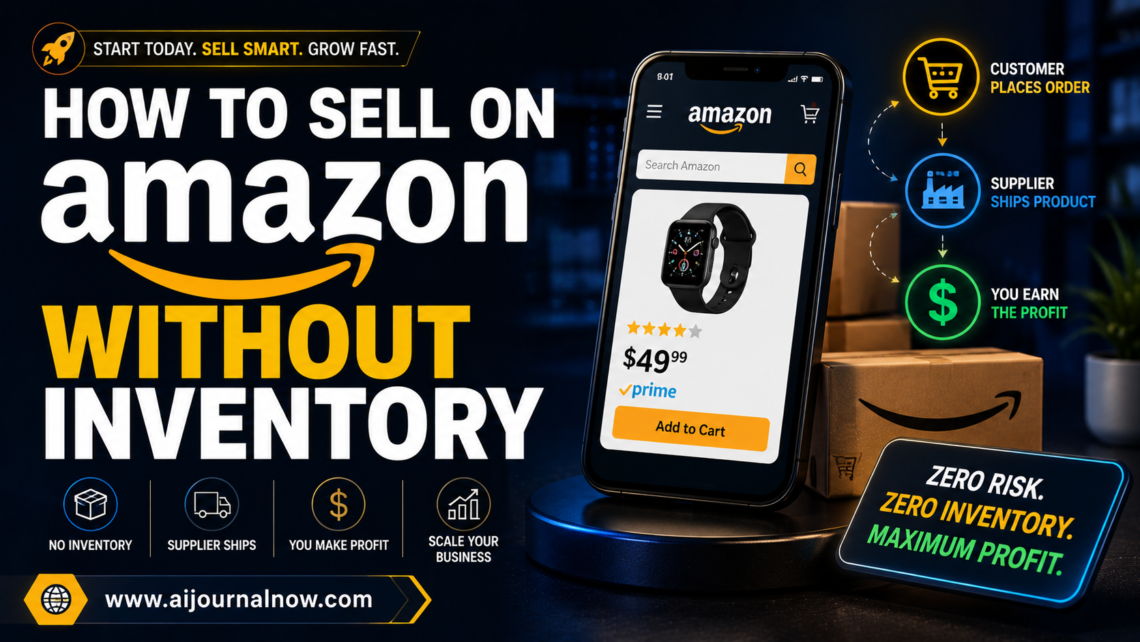
The simplest model is drop shipping. You put a product on Amazon, someone buys it, and the provider ships it straight to the customer. You never touch the merchandise.
For example, imagine you come across a source providing portable blenders at a price of $18. You sell them on Amazon for $34.99, which covers your costs, Amazon’s 15% referral fee, and leaves you a profit margin. When someone places an order, you send that order to your supplier with the customer’s shipping address. The supplier takes care of the rest.
Amazon does allow dropshipping, but they have very severe requirements. You have to be the seller of record on your store, deal with customer service and returns, and make sure your supplier never puts their own branding or packing slips in the package. If you break these rules, your account can be suspended—so choose suppliers carefully and always order a sample before listing anything.
2. POD (Print on Demand)
Print-on-demand is the cleanest entry point for most new merchants. You upload a design, select a product type (t-shirts, mugs, phone covers, tote bags), and a third-party source prints and sends each item only after a buyer places an order. You never buy stocks ahead of time.
Amazon has its own version called Merch on Demand. You apply, upload your designs, and choose your price, and Amazon does the printing, shipping, and customer service. You get royalties for every sale. It’s competitive, but for designers, painters and anyone with a creative niche, it’s a really low-risk route in.
Third-party POD platforms like Printify and Printful also integrate with Amazon and give more possibilities for products and branding. If you know how to design, POD is a great option when it comes to how to sell on Amazon without inventory.
3. Fulfilled by Amazon (FBA)
FBA is not really zero inventory in that you do buy things, but you never hold, pack, or ship anything yourself. You get the products from the manufacturer or wholesaler, ship the inventory straight to an Amazon fulfillment center, and Amazon takes it from there. They keep it, pick it, pack it, and dispatch it when orders come. They also do refunds and customer service.
The upside is FBA listings are Prime eligible, giving them a big conversion advantage. Cost is the tradeoff. FBA will add storage costs and fulfillment fees on top of the regular 15% referral fee. Great for big-volume merchants with good margins. For those with tight margins and slow-moving products, the fees can slowly eat away at profitability.
4. Digital Products and KDP (Kindle Direct Publishing)
People often miss this one, but it is worth mentioning. Ebooks and paperbacks can be self-published by anyone via Amazon’s Kindle Direct Publishing. You publish (or pay someone to publish) a book, upload it, and Amazon puts out physical copies as people order them. No inventory. No upfront publishing expenditures. Your book is listed forever.
If you’re a blogger, educator, marketer, or freelancer with expertise to give, KDP is one of the more passive no-inventory models on Amazon. Some retailers also sell low-content books like journals, planners, and notebooks with basic templates, which require even less writing.
How to sell on Amazon without inventory: Real benefits to be aware of
The benefits are true. Low startup costs imply you can explore multiple segments without a huge financial commitment. No danger of having merchandise left on your hands. Work from anyplace you have an internet connection. And you can list products across several categories without the logistical complexities of a traditional shop.
These models unlock possibilities that standard e-commerce does not for students testing a business idea, freelancers developing a side income, or bloggers constructing a product line around their audience.
Selling on Amazon without inventory: Honest limitations
All models have serious drawbacks. Dropshipping has lower margins, and you depend on a supplier’s stock levels, shipping timeliness, and quality control. One bad provider might quickly ruin your account health.
The margin on each sale with POD is small. Sales have to be at high volumes before earnings become substantial, and there is fierce competition in popular categories.
FBA includes greater initial charges and recurring storage fees that might add up if things don’t sell. You have to put in the time early on, and there’s no assurance you’ll get steady sales.
None of these are quick fixes to get rich. Amazon also modifies its restrictions periodically—what is allowed today may be restricted tomorrow. It’s the sellers who stay informed and run it like a genuine business, not a side hustle on autopilot, that are the ones that make it versus the ones who throw in the towel after 2 months.
Getting started: First hands-on steps
Create a professional Amazon Seller Central account ($39.99/month). Pick your model by your skills—creative? Try POD or KDP. Analytic? Use tools like Jungle Scout or Helium 10 to research dropshipping niches. Do you have some capital to work with? FBA has the greatest growth potential.
Start with a single product or niche. Please ensure that it is working before you expand. Always check Amazon’s current seller policies before listing anything—they’re often updated.
Summary
Selling on Amazon without inventory is not about chasing the biggest income claims. It’s about picking the model that fits your situation. Both work, but both demand serious effort. Start small, validate before scaling, and approach every listing like a tiny business decision. That’s the difference.
Questions & Answers
Q1: Is it truly possible for a complete newbie to learn how to sell on Amazon without inventory?
Yes, and arguably easier than traditional inventory-based selling for novices. Models like Merch on Demand, Kindle Direct Publishing, and dropshipping have relatively low hurdles to entry. The learning curve is substantial, but none of these methods require technical expertise or big resources to get started.
Q2: What does it cost to get started?
That depends on your model. You can launch Merch on Demand and KDP with minimal cash, just your time and creativity. Dropshipping requires a professional seller account ($39.99/month) and a little investment for initial tests. An average cost for FBA, for the initial stock and delivery to Amazon’s fulfillment centers, is $1,000–$3,000.
Q 3: Can I do dropshipping on Amazon?
Yes, but with some rules. You must be the seller of record, manage all customer service and refunds, and ensure that your supplier never distributes items with third-party branding. A violation of any of these policies may result in the suspension of your account. Before you get started, always check Amazon’s current rules on dropshipping.
Q4: How to start out the most profitable way?
It depends on what you’re good at. Print on demand and KDP are ideal for creative types with low financial investment. FBA has the most potential to scale but is more capital intensive. Dropshipping is somewhere in between the two. Most experienced sellers recommend that you start with one model and get proficient at it, then add to your product line after you start getting consistent sales.
Last Updated May 2026
Also Read: The Most Profitable Franchises To Own And Invest In