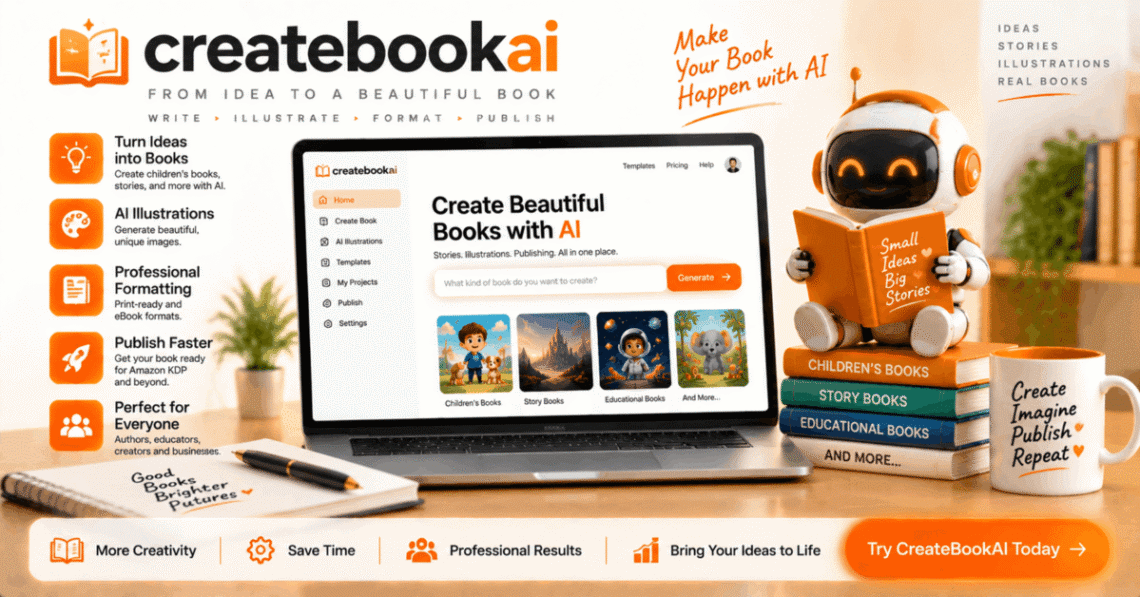
CreateBookAI generates a 24-page illustrated children’s book in about five minutes for $10. That part works as advertised, and the site is live and operating despite pages elsewhere claiming it shut down.
The part worth slowing down on is the ownership promise. CreateBookAI states you get full copyright and selling rights on every book. Under US law, that claim needs qualifying, and the difference matters most for the exact people the tool targets: anyone publishing to Amazon KDP.
What You Get for 50 Credits
You set the title, the main character and their companion, the characteristics of each, the time period, the moral of the story, and the page count. The AI writes the text and generates the illustrations.
For every page it produces four illustration options. You pick one, and the chosen image is upscaled to high resolution. A zoom function helps you compare them. If a paragraph reads badly you can edit it directly, and if an illustration misses you can regenerate it, with your text edits feeding into the new attempt.
Output is a square-format book exportable to PDF. That is the only format available. There is no landscape option, no portrait trim size, no EPUB.
The square-only constraint is a bigger deal than it sounds. Standard children’s picture book trim sizes at most print-on-demand services are not square by default, so you will be working within whatever square options your printer supports rather than choosing freely.
What It Actually Costs
Straight from CreateBookAI’s pricing page as of September 2026:
| Bundle | What it generates |
|---|---|
| 50 credits | One 24-page book |
| 500 credits | Ten 24-page books |
| 1000 credits | Twenty 24-page books |
The site’s FAQ states that 50 credits cost $10 and that larger bundles bring the per-book cost down. It also says you can generate your first book from 35 credits.
Ignore the pricing you find on tool directories. Several list an entirely different structure: 800 credits for $9, 1,800 for $16, 4,200 for $28, at 8 credits per image, producing 16-page books. Some quote those figures in pounds, others in dollars. None of it matches what the official page says today, and the per-image credit model is incompatible with a flat 50-credit book.
That is a common pattern with smaller AI tools. Directories scrape once, rank well, and never re-check. Always price from the vendor.
The Copyright Question
CreateBookAI’s homepage carries two claims side by side. One badge says the book is 100% AI created. Another says total ownership, including selling rights and copyright. The FAQ repeats it: you have all rights, even commercial, and you are free to sell.
The first claim is what complicates the second.
What US law requires
Copyright in the United States requires human authorship. The Copyright Office set this out formally in its March 2023 registration guidance, and reaffirmed it in Part Two of its AI report in January 2025. In March 2026 the Supreme Court declined to review the leading challenge to that requirement, leaving it in place.
The Office has already applied this to a book. In the Zarya of the Dawn case it registered the human-written text and the creative selection and arrangement of the comic, while refusing registration for the AI-generated images themselves.
What that means for your book
Two separate things are being conflated, and pulling them apart clears most of the confusion.
Ownership of the file is contractual. CreateBookAI is telling you it makes no claim on the output and will not stop you selling it. That is a real, meaningful commitment, and plenty of AI platforms do not offer it.
Copyright is not the platform’s to grant. It arises from law based on who authored the work. A vendor cannot assign a copyright that never existed.
So the practical position is layered. AI-generated illustrations you did nothing to alter are unlikely to be registrable. AI-generated text you meaningfully rewrote may carry your authorship in the rewritten parts. Your choices, which of four illustrations to use, how the pages sequence, how the narrative is arranged, can support a claim in the selection and arrangement as a compilation, which is precisely the ground Zarya of the Dawn was registered on.
If you register, the guidance requires you to disclose the AI-generated material and describe your own contribution. Do not list the tool as an author.
The blunt version: you can almost certainly sell the book. What you may struggle to do is stop someone else reproducing the illustrations. This is not legal advice, and if the commercial stakes are meaningful, a copyright attorney is worth an hour of your budget.
If You’re Publishing to Amazon KDP
Directories list bulk KDP publishing as a primary use case for CreateBookAI. If that is your plan, there is a compliance step you cannot skip.
Amazon requires KDP publishers to disclose AI-generated content, covering text, images, and translations. The disclosure appears as a checkbox during book setup. Amazon distinguishes AI-generated content, where the AI produced the material, from AI-assisted content, where AI only helped refine work you created. A CreateBookAI book is squarely the first category, on both text and images.
Three things worth knowing. Editing the output extensively does not reclassify it. The disclosure is internal to Amazon and is not shown to buyers, so it does not hurt your listing. And failing to disclose can get a title blocked or removed, with repeated violations risking account termination.
There is no upside to hiding it and real downside if you do.
Where It Falls Short
Square format only, as covered above.
Narrative consistency is the recurring complaint. The AI generates page by page, so character appearance and story logic can drift across a 24-page book. Regenerating a single illustration fixes one page and can make it match its neighbours less. Budget time for a full read-through rather than assuming the first output ships.
Regeneration also costs. Every image you redo eats credits, so the $10 headline is a floor, not a ceiling. A book you fight with can cost several times a book that lands first time.
And the obvious one: this is a template for a specific kind of story. Title, character, companion, period, moral. If your idea does not fit that shape, the tool has nothing to offer you.
Who Should Use It
Strong fit: parents and grandparents making a personalised gift, and teachers building custom classroom material. At $10 for a finished illustrated book with the child’s name in it, the value is obvious and the rights question is irrelevant because you are not selling anything.
Proceed carefully: anyone planning to sell. The economics look good until you factor in regeneration credits, print costs, and the reality that the children’s book market on Amazon is saturated with exactly this kind of output. If you are exploring this as income, read our breakdown of AI side hustle ideas before committing a budget.
Look elsewhere if you need a non-square format, chapter books, or non-fiction. General AI ebook generators handle longer text-led projects better. If it is the artwork you actually want control over, a dedicated art generator paired with your own writing gives you a stronger authorship position as well as better images.
Frequently Asked Questions
Did CreateBookAI shut down?
No. Some directory pages carry headlines suggesting it closed, but createbookai.com is live as of September 2026, with a working pricing page and signup flow. Treat those pages as SEO filler.
Can I really sell books made with CreateBookAI?
The platform grants you permission to, and that permission is real. Whether you hold enforceable copyright in the AI-generated illustrations is a separate legal question governed by the human authorship requirement, not by the vendor’s terms.
Is the first book free?
The site’s FAQ says you can generate your first book from 35 credits, which reads as a starting allowance rather than an unlimited free tier. Third-party pages describing a free first book date from an older pricing structure. Confirm at signup.
The Practical Call
For a personal gift, buy the 50 credits and enjoy it. Five minutes and $10 for a custom illustrated book with your child as the main character is a genuinely good trade, and nothing in the copyright discussion touches you.
For a publishing business, go in with clear eyes. The tool delivers a saleable artifact quickly and cheaply, and the platform will not come after you for selling it. What it cannot hand you is a defensible copyright in machine-made illustrations, and Amazon will require you to declare how the book was made. Both facts are manageable. Neither is optional.
Published: September 10, 2026


