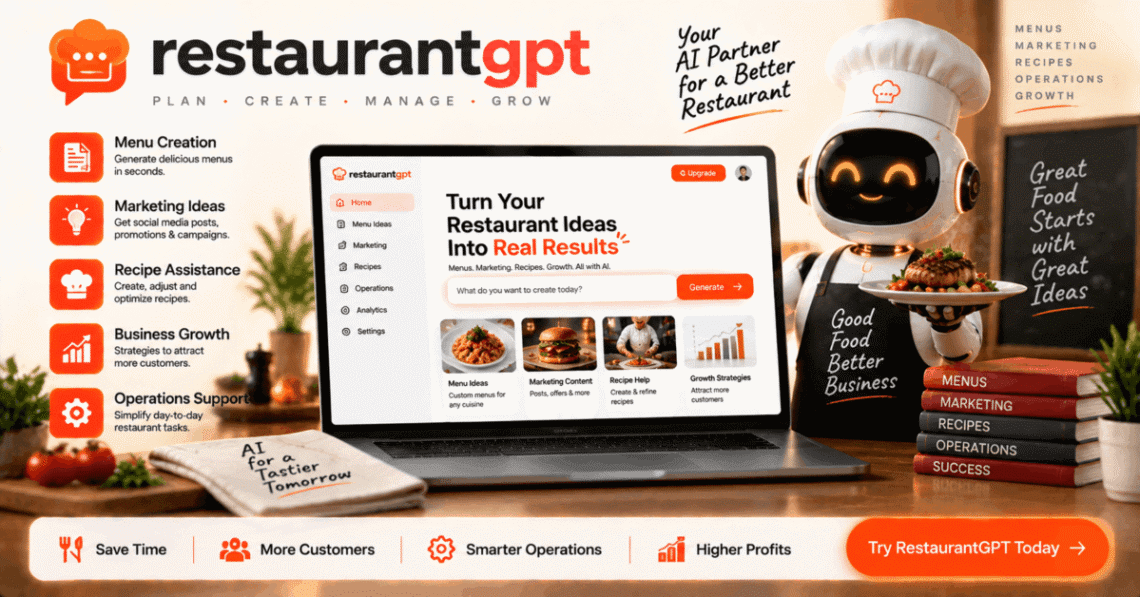
RestaurantGPT is not a restaurant management platform. It is a name shared by at least three unrelated things: a custom GPT for management planning, a separate custom GPT that recommends places to eat, and an open-source coding project that simulates a restaurant. None of them connects to a POS, an inventory system, or a reservation book.
That matters because most people typing this term are restaurant operators looking for software. What they will find is a free prompt wrapper inside ChatGPT. It has real uses, but they are narrower than the name suggests.
Three Different Things Called RestaurantGPT
| What it is | Who made it | What it does |
|---|---|---|
| Restaurant GPT (custom GPT) | Third-party builder | Drafts operating procedures, menus, staffing plans, marketing |
| RestaurantGPT (custom GPT) | Listed under Jaden Chen | Finds local restaurants, presents them in a table with review scores |
| RestaurantGPT (GitHub) | Piero Paialunga | Python multi-agent simulation where LLM customers, waiters, and entertainers interact |
The second one is consumer-facing. It helps a diner pick a place, not an owner run one. Its store listing shows only around 30 conversations, so treat it as a hobby build rather than a maintained service.
The GitHub project is a learning exercise. It runs a Tkinter window where simulated customers queue for tables, order from a CSV menu, and ask an entertainer agent how long their food will be. Interesting if you are studying multi-agent design. Useless if you own a diner.
Everything below is about the first one, since that is what restaurant operators are actually looking for.
What the Management GPT Is Genuinely Good At
It turns a messy operating question into a structured document. That is the whole value proposition, and within that lane it works.
Opening and closing checklists. Shift handover notes. Training outlines for a new server. Service-recovery scripts for when a table goes wrong. Seasonal menu concepts built around constraints you supply. A 30-day plan for fixing a specific problem.
It is also useful for thinking out loud. Give it your real numbers, your seating capacity, your labor constraints, and ask it to lay out three options for a staffing problem with the trade-offs of each. That is a legitimate way to use a language model, and it beats staring at a blank page.
The catch is that everything depends on what you feed it. Vague inputs produce generic hospitality advice you could get from any blog.
What It Cannot Do
The public listing documents no native integration with restaurant software. No POS connection. No inventory sync. No reservation system. No payroll.
This is the gap that trips people up. A tool named RestaurantGPT sounds like it should read your sales data. It cannot. Anything it tells you about your food cost is arithmetic performed on numbers you typed in, and it will not catch a wrong number.
Three more limits worth naming:
- It can be confidently wrong about operations. Portion yields, holding temperatures, and prep timings are the kind of specifics where a plausible-sounding answer is dangerous.
- Food safety, employment, tax, and licensing questions need local review. Health codes and labor law vary by jurisdiction, and a general model does not know which rules apply to your address.
- The builder can change it at any time. Custom GPT instructions are editable by whoever created them. The assistant you tested in March may behave differently in September, with no changelog.
Treat it as a thinking aid, not a system of record.
What It Costs
Nothing directly. There is no separate RestaurantGPT subscription.
You need a ChatGPT account, and OpenAI allows signed-in users on the free tier to use existing GPTs, subject to message and tool limits. Hit the free limit and GPT access pauses until it resets. File uploads and data analysis carry their own separate caps. Paid plans raise the ceilings but add nothing restaurant-specific.
If your workplace uses a ChatGPT business workspace, admin settings may block third-party GPTs entirely.
What to Use Instead, By Job
Here is the more useful framing. Match the tool to the actual problem rather than to the word “restaurant” in a product name.
| The job | What actually fits |
|---|---|
| Drafting SOPs, training docs, marketing copy | A custom GPT, or plain ChatGPT with a good prompt |
| Predicting how much to prep and order | A demand forecasting platform that reads your POS |
| Controlling food cost from invoices | Invoice-processing tools that sync with your POS |
| Counting and ordering stock | AI inventory software, with bar-specific options if you run a bar program |
| Answering the phone during a rush | Voice ordering systems, priced per completed order or annually |
| Building the schedule | Labor forecasting tied to your sales history |
The pattern is obvious once you see it. Every job that produces measurable savings requires access to your operating data. A chat assistant has none of it.
Industry guides name ClearCOGS for demand forecasting, MarginEdge and xtraCHEF for invoice and food-cost work, and Nory, MarketMan, WISK, and Supy across inventory depending on whether you run a bar, a group, or a single site. Lineup.ai publishes per-location pricing, which is rarer than it should be in this category. Verify current pricing directly with any vendor, since most of this market quotes rather than lists.
Voice ordering spans an enormous range, from roughly a dollar and a half per completed order on usage-based systems up to six figures annually for enterprise deployments. Get a quote before you get excited.
A Better Way to Use a Chat Assistant
If drafting is the job, you do not need a custom GPT at all. A well-built prompt in plain ChatGPT does the same work with more control, and you can reuse it. Our library of ChatGPT prompts for business covers the structure.
Four habits make the difference:
- Open with the concept, location, service model, capacity, price point, and the exact problem. Generic input, generic output.
- Ask for a named format. A checklist, a decision matrix, a comparison table, a 30-day plan. Not “advice.”
- Challenge the draft. Ask what it assumed, what would break the plan, and which input would change the recommendation most.
- Strip sensitive data before uploading anything. Employee records, guest details, and payment information do not belong in a chat window.
Then have the responsible manager review it before it touches food safety, labor, or pricing. For a broader view of where automation pays off in a small operation, see our guide to AI automation for small business.
Frequently Asked Questions
Is RestaurantGPT made by OpenAI?
No. All versions are third-party builds. The management assistant and the restaurant-finder are custom GPTs created by independent builders and hosted inside ChatGPT. The GitHub project is an unaffiliated open-source repository.
Can it calculate my food cost?
It can structure the calculation if you supply accurate recipe quantities, yields, and ingredient prices. It cannot pull those figures from anywhere, and it will not flag a bad input. Check every formula before pricing a menu off it.
Should I upload my sales data?
Only after removing anything personal. File upload availability depends on your plan and the GPT’s configuration. Even then, a spreadsheet dropped into a chat is not integration, and you will be repeating the upload every time you want an updated answer.
The Practical Call
Open it, spend twenty minutes drafting a closing checklist or a training outline, and see whether the output saves you time. It costs nothing and the drafting use case is real.
Then stop expecting more from it. The name promises restaurant software and delivers a conversation. If your actual problem is food waste, missed phone orders, or a schedule that never matches demand, none of those get solved in a chat window, and the money you would save fixing them dwarfs anything a better-worded SOP will earn you. Start with the leak you can measure, and buy a tool that plugs into the system where that leak shows up. Our breakdown of AI ROI examples covers how to size that before committing budget.
Published: September 10, 2026


