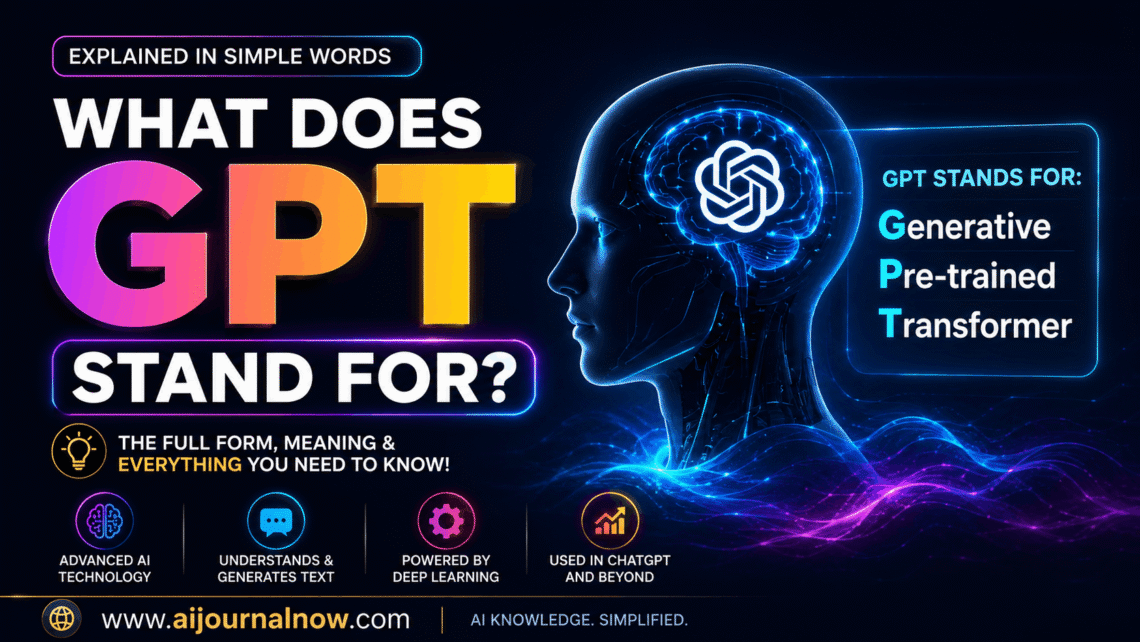
“What does GPT stand for?” is one of those questions that millions of people have typed into a search bar, but far fewer have received a genuinely clear answer. The brief version: GPT is short for Generative Pre-trained Transformer. The lengthier version, which truly helps you understand why this technology is important, deserves a few minutes of your time.
What Does GPT Stand For? Explaining all the terms
Three words. They each have actual importance, and going through them individually makes the whole concept click a lot quicker.
Creative
This step is the part that most people already get intuitively. “Generative” implies the model generates new stuff—like language, replies, ideas, code, and summaries—rather than simply pulling up stored information from a database.
When you pose a question to a GPT-based model, it doesn’t search for a pre-written answer. It generates a response based on patterns it learned during training. This is a key distinction from a search engine that detects and ranks pre-existing content.
Pre-trained
This term tells you how GPT models are trained. By the time you enter your first message, the model has already ingested a large amount of text, including books, articles, websites, academic papers, and forums. In that training it learns the language, facts, context, and reasoning patterns. “Pre-trained” is a term that distinguishes these models from previous AI systems, which were trained solely for certain, constrained tasks. The extensive pre-training of a GPT model is what allows it to debate cookery, law, history, and Python programming all in the same conversation.
Transformator
That’s the technical framework behind it all. Transformers are a neural network architecture first presented in a seminal 2017 paper titled Attention Is All You Need. The big breakthrough is something called the “attention mechanism”—a means for the model to weigh how relevant each word in a sentence is to every other word, rather than processing text strictly left to right.
This is perhaps quite important because it means that GPT is aware that the word “it” in a long paragraph relates to something referenced several sentences earlier. That contextual knowledge is what gives the result a sense of coherence, rather than a chopped-up one.
What Does GPT Stand For? Where did it come from
The first GPT model was released by OpenAI in 2018. Then in 2019, GPT-2 was followed up, which got much notice, as its results were unexpectedly fluent. GPT-3 in 2020 scaled the technology to the point where meaningful commercial applications were possible. GPT became popular with the release of ChatGPT in late 2022. Capability continued to be pushed forward by GPT-4 and its successors.
But since then, the moniker has become something of a generic term in public discourse, with people saying “GPT” to denote any giant language model—though officially it relates to OpenAI’s family of models.
What Does GPT Stand For? What it really does is
It’s good to know what GPT stands for, but the practical value is where you get to comprehend what you can do with it.
For students: You can use a GPT-based tool to summarize research, generate an outline for an essay, explain a difficult idea in layman’s terms, or work through an issue step by step. When used thoughtfully, it speeds up learning without replacing thinking.
For bloggers and writers, it can help you compose outlines, break through writer’s block, reword portions, and come up with ideas for angles or headlines. The trick is to think of the output as a first draft, not an end product.
For marketers: GPT models swiftly generate versions of ad copy, email subject lines, social media postings, and SEO-focused content. Teams use it to generate more in less time without growing staff.
For developers and freelancers, GPT is a coding assistant that explains unknown code, recommends improvements, generates boilerplate, and speeds up development in several languages.
For business owners It drafts customer service, takes meeting notes, writes internal documentation, and answers routine queries at scale that no human staff could equal without substantial cost.
What Does GPT Stand For? Limitations to be aware of
The GPT models are incredible, but the problem is when people accept them as infallible.
The most crucial limitation to understand is hallucinations. [21] GPT models can confidently produce false information, fabricating citations, misremembering facts, or filling knowledge gaps with plausible-sounding falsehoods. Always double-verify anything factual before employing it in a professional or academic situation.
Knowledge cutoffs mean that models trained to a particular point don’t know about things that happened after that. In fast-moving areas like medical, law, current events, and market data, this gap is important.
Context limits limit how much text the model may take in one session. Long documents or long chats may cause the model to forget earlier parts.
Training data bias: Because GPT models learn from online material, they can mirror the viewpoints, inaccuracies, and omissions in that text. It is vital to critically assess outputs, particularly on subjects that are nuanced or controversial.
None of these restrictions make the GPT tools worthless—but they do make thoughtful use much better than blind reliance.
Conclusion
What does GPT stand for? is a 3-word question that has a surprisingly profound answer when you break each bit off. “Generative” means it creates; “pre-trained” implies it was trained on tonnes of human-written material before you ever touched it. Transformer is the architecture that allows it to grasp language with genuine contextual awareness. Together, those three pieces helped create one of the biggest tech transformations of the last decade—a tool that is now woven into how millions of people write, learn, develop, and work every day. When you understand the story behind a name, you may deploy it more wisely and more successfully.
Frequently Asked Questions
Q1: What is GPT in basic terms?
GPT stands for Generative Pre-trained Transformer, “generative” meaning that it develops fresh stuff. Pre-trained meaning it was trained on a huge volume of text before being released. A transformer is a neural network design that can recognize the context and relationships between words over extended tracts of text.
Q2: Is GPT the same as ChatGPT?
Not quite. GPT is the model architecture developed by OpenAI. ChatGPT is a product developed on top of the GPT models. It provides a conversational interface, safety settings, and memory features for a back-and-forth interaction. Other applications, like Microsoft Copilot and several API-based tools made by developers, use GPT models beneath the hood.
Q3: What does GPT mean compared to other AI models like Claude or Gemini?
GPT refers to the family of models from OpenAI. Gemini (created by Google) and Claude (produced by Anthropic) are two huge native language models, constructed on different architectures and trained differently. They all fit under the general category of large language models. But GPT is the name of OpenAI’s particular variant.
Q4: Is GPT free for everyone?
There is a free tier of ChatGPT from OpenAI, which allows usage of GPT models with some limitations. Paid subscriptions offer faster performance, access to the latest model releases, and higher usage limitations. Developers can use GPT models using OpenAI’s API, which is priced on a pay-as-you-go basis. There are also several third-party programs that use GPT models, many of which have free tiers with different feature sets.