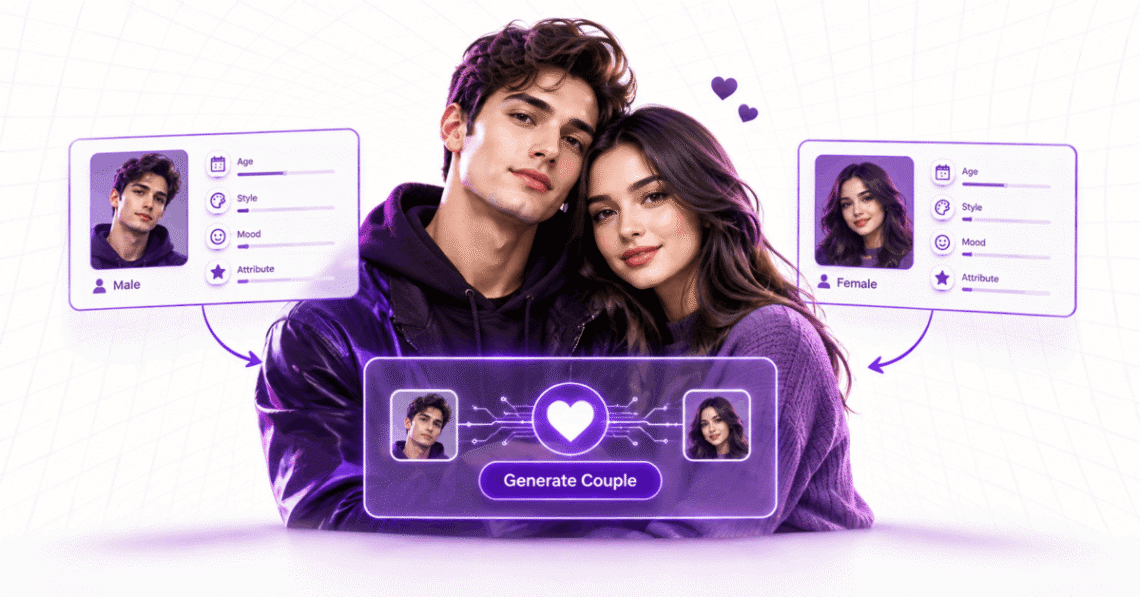
An AI couple generator takes two separate photos, usually two selfies, and turns them into one realistic picture of both people together. You pick a scene, such as a beach at sunset, a wedding or a vintage polaroid, and the result is ready in under a minute. For partners who have never had a good photo together, it is a genuinely nice idea.
The one rule that matters: only use faces of people who have agreed. These tools will accept any two photos you give them, and none of the major ones we looked at checks whether the second person consented. That gap is where a harmless novelty becomes a real problem.
How Couple Generators Work
The basic process is the same across almost every tool. You upload one clear, front-facing photo of each person, choose a style preset or write your own description, and the AI composes a single image where both people appear together, keeping their faces recognisable.
Most offer presets like cinematic, beach, wedding, vintage film, Korean studio or anime. Many also let you describe poses and settings in your own words, from holding hands to a mirror selfie.
One thing worth knowing: many of these sites are front-ends for the same large image models. Several openly name Google’s Nano Banana or OpenAI’s GPT image models as the engine underneath. So when you compare couple generators, you are often comparing price, presets and privacy terms rather than fundamentally different technology.
The Good Uses
There are plenty of legitimate reasons to use one.
- Long-distance couples who want a picture together while they are apart.
- Anniversaries and gifts, such as a stylised portrait or a keepsake image.
- Save-the-date cards or pre-wedding mock-ups before a real photoshoot.
- Matching profile pictures for social media or gaming accounts.
- Artistic styles, like turning the two of you into anime characters or a classic painting.
Stylised results, such as cartoons or paintings, carry the least risk because nobody mistakes them for real photographs. Photorealistic results are where you need to think a little harder.
What No Tool Checks: Consent
These tools cannot tell whether the second person agreed. Upload a photo of your partner and it works. Upload a photo of a coworker, an ex, a stranger or a celebrity and it works exactly the same way.
Some sites actively encourage the celebrity version. Fotor’s couple photo page, for example, suggests generating couple photos with your favourite idols to bring your dream pairings to life. Making a realistic romantic photo of yourself with a real person who never agreed to it is not a harmless fan edit. It puts that person in a fabricated moment they had no say in.
The marketing makes the problem sharper. One tool’s own FAQ states that most people can’t tell its results are AI-generated. That is presented as a selling point. For a photo of you and your partner, fine. For a photo involving someone who did not consent, realism is exactly what makes it harmful.
The same consent question comes up across AI tools built around real people’s likeness, which we looked at in our piece on AI models trained on a named artist’s work.
Where It Becomes a Legal Problem
For a private image of two consenting partners, there is no legal issue. The picture changes when a real person is involved without agreement, or when the image is shared publicly.
Disclosure in the EU. Since 2 August 2026, the EU AI Act requires anyone publishing AI-generated or manipulated images that resemble real people and could pass as authentic to label them clearly as AI-made. A realistic couple photo posted publicly can fall into that category.
Celebrity likeness. Many US states protect people’s control over commercial use of their likeness. Using a famous person’s face in a couple image you sell, promote or monetise can create legal exposure, separate from any AI rules.
Intimate content. If an image crosses into sexual or intimate territory with a real, identifiable person who did not consent, the law becomes much stricter in many places, and in the US non-consensual intimate imagery is a federal offence regardless of how it was made.
This is general information, not legal advice. The simple practical line is: consenting partners, private use, and a clear AI label if you post it publicly.
The Deception Risk
Realistic couple photos are also a tool for fooling people. A fabricated photo can fake a relationship that does not exist, whether to make someone jealous, to mislead family, or to build a fake dating profile. At least one tool markets its couple images as suitable for dating profiles.
If you are on dating apps yourself, it is worth knowing that a convincing couple photo proves nothing on its own. Our guide to AI tools for online dating covers the wider picture, and if you are worried your own photos are being used somewhere without permission, our look at PimEyes alternatives covers tools for finding where your face appears online.
Before You Upload Anyone’s Face
You are handing over two facial photos, and in Europe facial images count as sensitive biometric data. Check these points first.
- How long are uploads kept? Good practice looks like one tool that deletes uploaded photos within 24 hours and removes generated results after 30 days. Many sites do not say at all.
- Who processes them? Some tools state that photos are processed by contracted AI providers, meaning your faces leave the site you uploaded them to.
- Can you delete your results? Look for a clear way to remove images from your account.
- Is it your face to share? Your own photo is your decision. Your partner’s photo is theirs. Ask first.
Choosing a Tool
Since many couple generators run on the same underlying models, the practical differences come down to a few things.
Face likeness. Vendors make big claims here, such as 95 percent likeness. Test with your own photos, because results vary a lot with lighting and angle.
Price model. Most use credits or a free trial rather than being truly free. Check the credit cost per image before you start.
Privacy terms. Choose the tool that tells you clearly how long it keeps your photos. That matters more than a few extra presets.
If you mainly want general image creation rather than couple photos, our AI image generator comparison covers the leading models directly, and our look at Reve covers a model built for precise, editable images.
Looking for a Couple Name Generator?
Some people searching this term want something completely different: a tool that blends two names into one, often called a ship name. Those are simple word tools with none of the privacy or consent issues above, and any basic name combiner will do the job.
Frequently Asked Questions
How does an AI couple generator work?
You upload a photo of each person, choose a scene or style, and the AI combines them into one image where both appear together with their faces preserved. It usually takes under a minute.
Is it legal to make a couple photo with a celebrity?
It depends on where you are and what you do with it. Private novelty images are one thing, but sharing or monetising a realistic image of a real person without consent can raise likeness, disclosure and harassment issues.
Are AI couple generators free?
Most offer a free trial or a few free credits, then charge per image or by subscription. Check the credit cost before generating.
The Practical Call
Use a couple generator for what it does well: a picture of you and someone who wants to be in it with you. Stylised art styles are the safest choice, and a quick note that the image is AI-made avoids any confusion when you share it.
Skip the idol pairings and the photos of people who never agreed. The tools will not stop you, and they will even advertise how real the results look. That is exactly why the decision has to be yours.
Published: September 22, 2026