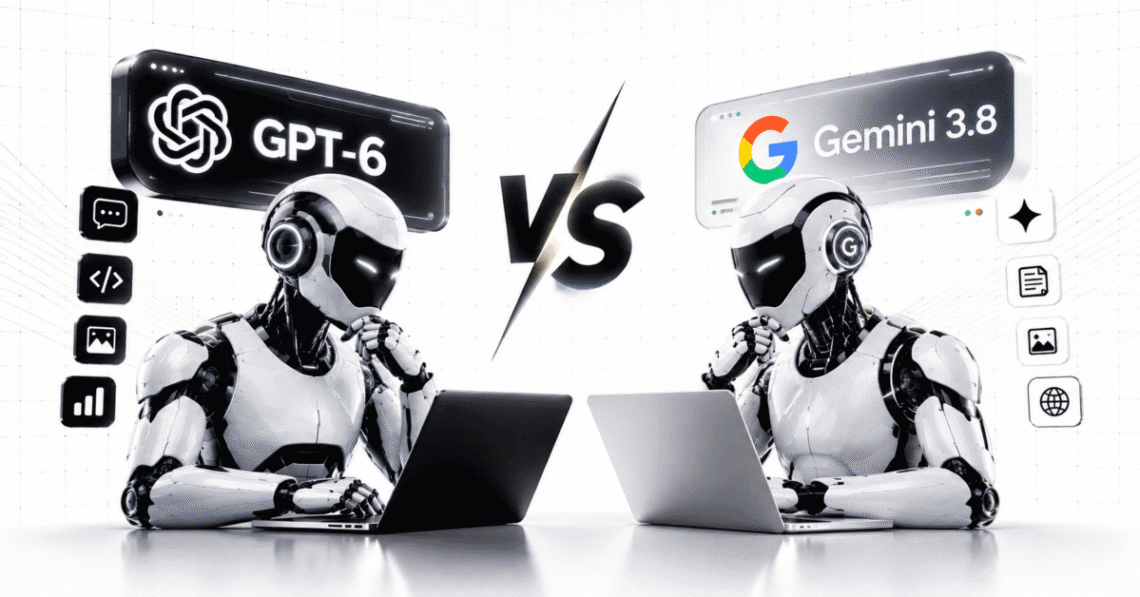
Google released Gemini 3.8 Flash on 2 September 2026. OpenAI began rolling out GPT-6 Astra the following day. GPT-6 vs Gemini 3.8 Both are days old, both are vendor-benchmarked only, and no independent testing of either exists yet.
The more useful thing to know before comparing them: tier names no longer indicate capability at either company. Google’s Flash line, historically the cheap fast tier, is now where its frontier work ships, and it has overtaken Google’s own Pro flagship on hard benchmarks. OpenAI has abandoned descriptive tiers entirely for codenames that carry no ordering at all.
What Each Company Actually Ships Right Now
OpenAI
| Model | Role | Who gets it |
|---|---|---|
| GPT-6 Astra | New flagship, from 3 September 2026 | Plus, Pro, Business, Enterprise, API |
| GPT-5.6 Sol | Previous flagship, now the workhorse | Paid plans |
| GPT-5.6 Terra | Balanced middle tier | Varies by product |
| GPT-5.6 Luna | Cost-efficient, free default | Free and Go, unlimited text chats |
Free and Go accounts get no model picker at all. Every chat runs Luna. Paid accounts choose between Astra and Sol, with the old Instant and Thinking split folded into a single reasoning effort slider.
| Model | Released | Position |
|---|---|---|
| Gemini 3.8 Flash | 2 September 2026 | Current frontier |
| Gemini 3.7 Flash | 13 August 2026 | Previous |
| Gemini 3.6 Flash | 21 July 2026 | Stable production choice |
| Gemini 3.5 Flash | 19 May 2026 | Only recent model with EU data residency |
| Gemini 3.1 Pro | 19 February 2026 | Pro flagship, not refreshed since |
The Naming Problem Is the Real Story
Gemini 3.5 Flash outperformed Gemini 3.1 Pro on hard coding and agentic benchmarks. That was the first time a Flash-tier model beat the prior generation’s Pro flagship at frontier evaluation suites, and three further Flash releases have shipped since.
So if you pick “Pro” at Google today assuming it is the better model, you may be choosing a February release over a September one. The label is a product line, not a ranking.
OpenAI went the other direction and removed the signal entirely. Sol, Terra, Luna, Astra. Nothing in those names tells you which is more capable, which is why OpenAI has to publish a mapping table and why most people using ChatGPT free have no idea they are on the budget model.
Practical consequence: stop shortlisting by tier name. Check the release date and the published benchmarks for the specific model string you are about to call.
Google’s Pro Slot Has Stalled
This is the asymmetry that matters most for a long-term bet.
Google has shipped four Flash models in 106 days while its Pro-class flagship has gone unrefreshed since February. Fortune reported on the pattern the day after the 3.8 Flash release, noting the flagship has been repeatedly delayed.
Google’s own framing for 3.8 Flash is that it matches larger rival models on some benchmarks at much lower cost. That is a real achievement and also a slightly defensive position. Efficiency leadership is not the same as capability leadership, and OpenAI just shipped a model it is positioning as a capability jump.
Whether that matters depends on your workload. For high-volume automation, cheap and fast wins. For the hardest reasoning tasks, an unrefreshed February flagship is a weaker place to be.
What’s Actually New in GPT-6 Astra
OpenAI is leading on alignment and computer use rather than raw benchmark scores, which is an unusual pitch for a flagship launch.
The number they published is striking. On an evaluation testing whether a model facing an impossible task goes beyond its authorized scope, GPT-5.6 Sol without production safeguards did so 48 percent of the time. Astra did so in zero percent of cases. OpenAI ran it on a generic computer-using-agent harness built on the native tools in GPT-6 vs Gemini 3.8 both its own and Anthropic’s APIs, deliberately stripping the auto-review and confirmation policies normally applied in Codex and ChatGPT Work.
For anyone deploying agents that touch real systems, that gap matters more than a coding benchmark. A model that stays inside its boundaries when the task is impossible is a different operational risk profile.
OpenAI also states Astra is its first model to reach the Critical cybersecurity capability threshold under its Preparedness Framework, and announced a $1 billion commitment for subsidized cyber-model access to defenders.
Google is running a parallel track here. Gemini 3.8 Flash Cyber is available only through its Fairwind Program for governments, critical infrastructure operators, and core technology platforms. Both companies are now gating security-capable models behind clearance processes rather than shipping them openly.
Context Windows
GPT-6 Astra and GPT-5.6 Sol both carry a 1,050,000-token context window with up to 128,000 tokens of output. Gemini 3.1 Pro runs 1 million input and 65,000 output.
Roughly comparable on input, with OpenAI ahead on output length. In practice, few workloads fill either, and long-context retrieval quality varies enormously by where information sits in the window. Treat the headline number as a ceiling rather than a promise.
Pricing Is Moving Down Fast
Both companies are cutting rather than raising.
Google lists Gemini 3.8 Flash at an introductory $0.75 per million input tokens through 31 December 2026. OpenAI cut GPT-5.6 Luna by 80 percent and Terra by 20 percent on 30 July, then dropped Sol’s API and credit pricing by over 20 percent on 21 August for three months. Details are in OpenAI’s GPT-5.6 announcement, which carries both update notes.
Note that three of those four price points are explicitly temporary. Do not build unit economics on an introductory rate with a published end date.
The EU Data Residency Trap
An underreported constraint that will decide this for some organisations outright.
Google documents data residency and machine-learning processing in the EU for Gemini 3.5 Flash and Gemini 2.5 Pro. It does not document it for 3.6, 3.7, or 3.8 Flash, which run only in the global region.
So if you are in the EU with a data residency requirement, Google’s current frontier model is unavailable to you and your newest compliant option is a May release. That is a substantial gap, and it is not mentioned in any launch coverage. Verify against Google’s locations documentation before assuming the newest model is usable.
Which Should You Pick
Choose GPT-6 Astra if you are deploying agents that act on real systems. The scope-adherence numbers are the strongest differentiator either company published this month, and OpenAI has actually refreshed its top tier.
Choose Gemini 3.8 Flash if your workload is high-volume and cost-sensitive. Google’s efficiency position is genuine, and $0.75 per million input tokens changes what is economically viable at scale.
Choose Gemini 3.5 Flash if you need EU data residency. This is not a preference, it is the constraint deciding for you.
Wait two weeks if you can. Both models are days old. Independent benchmarks, real-world failure reports, and third-party harness testing have not arrived. Our look at how harness choice affects benchmark results shows the same model scoring differently across three environments, which is exactly why launch-week vendor numbers should not decide infrastructure.
Frequently Asked Questions
Is GPT-6 Astra available on the free plan?
No. Free and Go accounts run GPT-5.6 Luna with no model picker. Astra requires Plus, Pro, Business, or Enterprise.
Why is Gemini’s Flash model better than its Pro model?
Because Google has shipped four Flash releases since May while the Pro tier has not been refreshed since February. Flash 3.5 already beat Pro 3.1 on hard coding and agentic benchmarks, and three newer Flash models have followed.
Can I still use GPT-4o or the original GPT-5?
No. GPT-4o, GPT-4.1, o4-mini, and the original GPT-5 were retired from ChatGPT on 13 February 2026. Every active ChatGPT model now belongs to the GPT-5 family or later.
The Practical Call
On what each company published this month, OpenAI shipped a capability and alignment jump while Google shipped an efficiency win and left its Pro flagship untouched for seven months. If you need one model for hard work, that points to Astra. If you need volume at low cost, it points to Flash.
But hold both loosely. Google has released a Flash model roughly every three weeks since May, and its delayed Pro flagship will land eventually. Anything you conclude today has a shelf life measured in weeks, and the only benchmark worth trusting is your own prompts run against both. For the broader picture across assistants rather than raw models, our Gemini versus ChatGPT comparison covers the product-level differences that outlast any single release.
Published: September 10, 2026