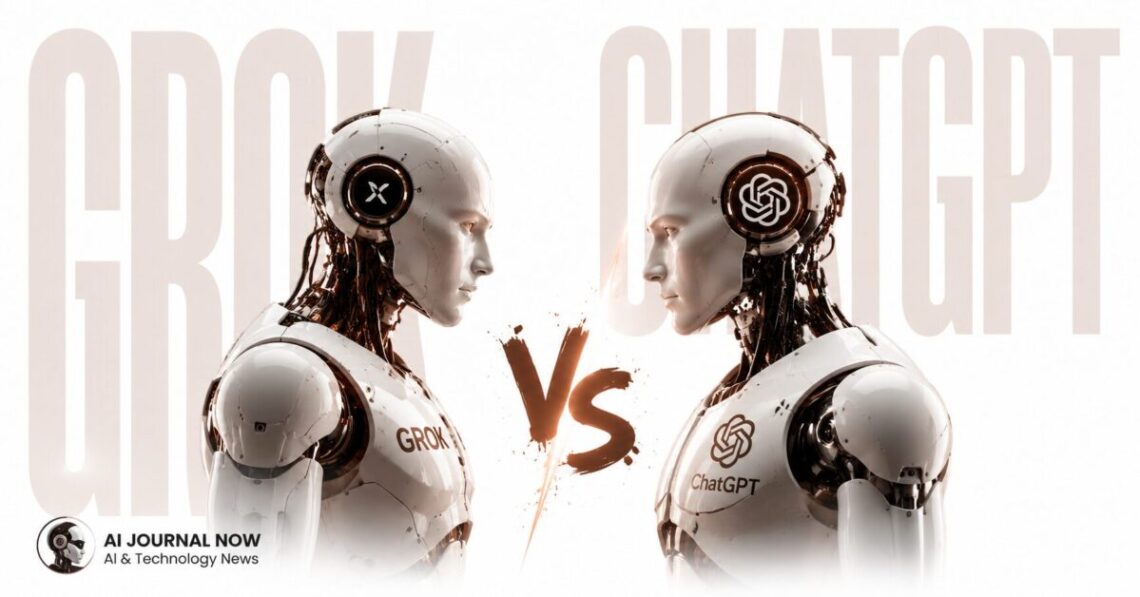
If you’ve been going back and forth on this decision, here’s the short version: Grok vs ChatGPT: ChatGPT is the better pick for most people, with more features and a cheaper subscription. Grok is the better choice if you want real-time X data and fewer content filters. But that one-liner skips a lot of nuance that actually matters depending on how you work.
Let’s get into it.
Grok vs ChatGPT: A Quick Snapshot Before the Details
ChatGPT still commands 64.5% global market share and 92% Fortune 500 adoption. But Grok’s US share jumped from 1.9% to nearly 18% in under a year. That kind of growth doesn’t happen because of hype alone. It happens because a tool is solving real problems that its competitor isn’t.
The gap between these two platforms is no longer about raw capability. It’s about ecosystems, pricing philosophy, and use-case fit.
Both run on serious frontier models. ChatGPT runs GPT-5.5, released to the API in April 2026. Grok runs Grok 4.3, with a December 2025 knowledge cutoff and native real-time X search. Both carry a 1M-token context window at their standard paid tiers, though Grok 4 Fast stretches to 2M.
Pricing: ChatGPT Is Cheaper at the Entry Level
This section is where the comparison gets concrete fast.
ChatGPT Free gives you GPT-5.5 with up to 10 messages every five hours (now ad-supported in the US). ChatGPT Plus is $20/month and unlocks 160 GPT-5.5 messages every three hours, aloProfoundith Deep Research, Sora video generation, Codex, and Agent Mode. Pro tiers run $100/month (5x Plus limits) and $200/month (20x limits plus a 1M context window).
On the Grok side, SuperGrok Lite launched in March 2026 at $10/month as a budget entry point. SuperGrok is $30/month and includes Grok 4 access, DeepSearch, Big Brain mode, and voice mode. X Premium+ bundles Grok with ad-free X browsing for $40/month. SuperGrok Heavy, which unlocks 16-agent parallel execution, runs $300/month.
At the consumer level, ChatGPT undercuts Grok at every comparable rung: $20 Plus versus $30 SuperGrok and a free tier Grok can’t really match. That said, the equation flips if you’re a developer. Grok 4.3 on the API costs $1.25 per million input tokens and $2.50 per million output tokens. GPT-5.5 runs $5 for input and $30 for output per million tokens. For teams running significant API volume, that gap is real money.
Real-Time Data: Grok’s Clearest Advantage
This is where Grok genuinely earns its place.
Grok’s X firehose provides a real-time perspective on reality that ChatGPT’s indexed search can’t match. When something breaks in the news, a market shifts, or a discussion goes viral on X, Grok surfaces that context in a way ChatGPT simply isn’t built to replicate. ChatGPT has web search, but it’s pulling from indexed pages, not live social signals.
In practice, this functionality matters most for journalists, social media researchers, trend-watchers, and anyone doing competitive intelligence that involves public discourse. For everyone else, it’s a nice feature rather than a dealbreaker.
One thing worth flagging, though: Grok’s real-time advantage is inseparable from the X platform. X outages (there were at least three notable ones in 2025) take Grok’s live features offline with them. It’s a dependency worth understanding before building workflows around it.
Coding: ChatGPT Still Leads, But the Gap Has Closed
ChatGPT leads on production coding benchmarks. SWE-Bench Verified: 74.9% vs Grok 4.3’s 69.1%. For day-to-day development, ChatGPT is more reliable. For competitive programming and algorithmic challenges, Grok has the edge, with HumanEval scores of 72-75% versus ChatGPT’s 67%.
What this translates to in practice: if you’re debugging production code, building multi-file projects, or doing code review for a real codebase, ChatGPT is the steadier tool. If you’re grinding competitive programming problems or need rapid algorithmic reasoning, Grok performs surprisingly well.
Grok also has a 2.5x larger context window than ChatGPT’s standard offering (1M vs 400K tokens at comparable tiers) and 33% faster inference speed. For tasks involving large codebases where you need the whole file structure in context at once, that matters.
Grok vs ChatGPT: Feature-by-Feature Comparison
| Feature | ChatGPT | Grok |
|---|---|---|
| Flagship model | GPT-5.5 | Grok 4.3 |
| Consumer price (core paid tier) | $20/month (Plus) | $30/month (SuperGrok) |
| Context window | Up to 1M tokens (Pro) | 1M standard, 2M on Grok 4 Fast |
| Real-time data | Web search (indexed) | Live X + web search |
| Image generation | GPT-Image-1.5, DALL-E | Aurora (Imagine) |
| Video generation | Sora 2 | Not available |
| Content tone | Safety-cautious | Fun Mode + Spicy Mode available |
| API pricing (input) | $5/M tokens | $1.25/M tokens |
| Ecosystem / integrations | 500+ third-party apps | Growing, smaller footprint |
| Enterprise readiness | SOC 2 Type II, SSO, admin console | Limited enterprise tooling |
| Coding benchmark (SWE-Bench) | 74.9% | 69.1% |
| Math benchmark (AIME 2025) | 86% | 95% |
Content Filters and Tone: A Real Philosophical Difference
Grok’s Fun Mode (also called Spicy Mode) deliberately relaxes safety guardrails. It’s sarcastic, opinionated, and willing to engage with topics other models typically refuse. ChatGPT takes the opposite approach, with multi-layered safety training governing every response: pre-training filters, supervised fine-tuning, and red-teaming built in.
In my experience, the practical difference for most users isn’t dramatic. Grok will roast you, engage with edgier political analysis, and swear casually. It won’t write explicit content on demand any more than ChatGPT will. The real distinction is Spicy Mode (available on Premium+ or SuperGrok), which permits partial nudity of fictional adult characters while maintaining strict blocks on real-person content and non-consensual scenarios.
It’s worth knowing the context behind these guardrails. In December 2025, a serious incident around Grok’s image generation led to regulatory pressure from the UK, EU, and parts of Asia. In January 2026, xAI shipped significant safety updates in response. So Grok’s “fewer filters” framing is real, but it’s also been tested and constrained in some areas after real problems.
Grok vs ChatGPT: Who Should Use Grok
It makes sense if
- You’re deeply embedded in X and want AI that understands live conversations on the platform
- You’re a developer who wants frontier-quality output at a fraction of the API cost
- You prefer a more opinionated, less hedging tone in responses
- Math-heavy tasks (olympiad problems, algorithmic work) are central to what you do
- You’re processing large documents and need the broader context window without paying $200/month
Grok vs ChatGPT: Who Should Use ChatGPT
ChatGPT makes more sense if:
- You need a mature ecosystem with 500+ integrations, custom GPTs, and repeatable business workflows
- Enterprise features like admin controls, SSO, and SOC 2 compliance matter to your organization
- You need video generation via Sora 2 (Grok doesn’t have an equivalent)
- Consistent, polished writing output is a priority
- You want to spend $20/month instead of $30 for similar daily utility
The Question Nobody Asks: Is Either One the Best?
Worth stating plainly: neither Grok nor ChatGPT is the most capable AI model available right now. As of mid-2026, that title belongs to Anthropic’s Claude Opus 4.8, which leads the Artificial Analysis Intelligence Index and tops coding benchmarks. If raw capability is your main priority, it’s worth comparing more than just these two.
That said, for most people the choice between Grok and ChatGPT isn’t really about which model scores better on leaderboards. It’s about workflow fit.
The smart approach in 2026 is multi-model routing: GPT-5.5 for the work that needs polish and reliability, Grok 4 Fast for the tasks that need to be cheap, with the flexibility to change what you’re using without rearchitecting everything. Power users already do this type of work. If you’re a casual user, just pick whichever one fits your budget and primary use case.
Grok vs ChatGPT: FAQs
Is Grok free? Grok has a free tier inside the X app, limited to roughly 10 prompts per two-hour window. SuperGrok Lite at $10/month is the cheapest standalone paid option.
Is ChatGPT better than Grok for writing? Generally yes. ChatGPT produces more structured, polished output. Grok can be more creative and conversational, but for professional writing tasks, ChatGPT is more consistent.
Which is better for math? Grok wins here, with 95% on AIME 2025 versus ChatGPT’s 86%. For research-level math and competitive problem-solving, tools like Gauthmath show how dedicated math AI can complement either chatbot for step-by-step problem breakdowns.
Can I use Grok without X Premium? Yes. SuperGrok is available as a standalone subscription at $30/month without requiring X Premium.
Which has better API pricing? Grok is the clear cost leader at $0.20 per million input tokens on its budget models, compared to several dollars per million for GPT-5.5. For high-volume API use, Grok’s pricing is very competitive. Teams looking to reduce AI operations costs will notice the difference quickly.