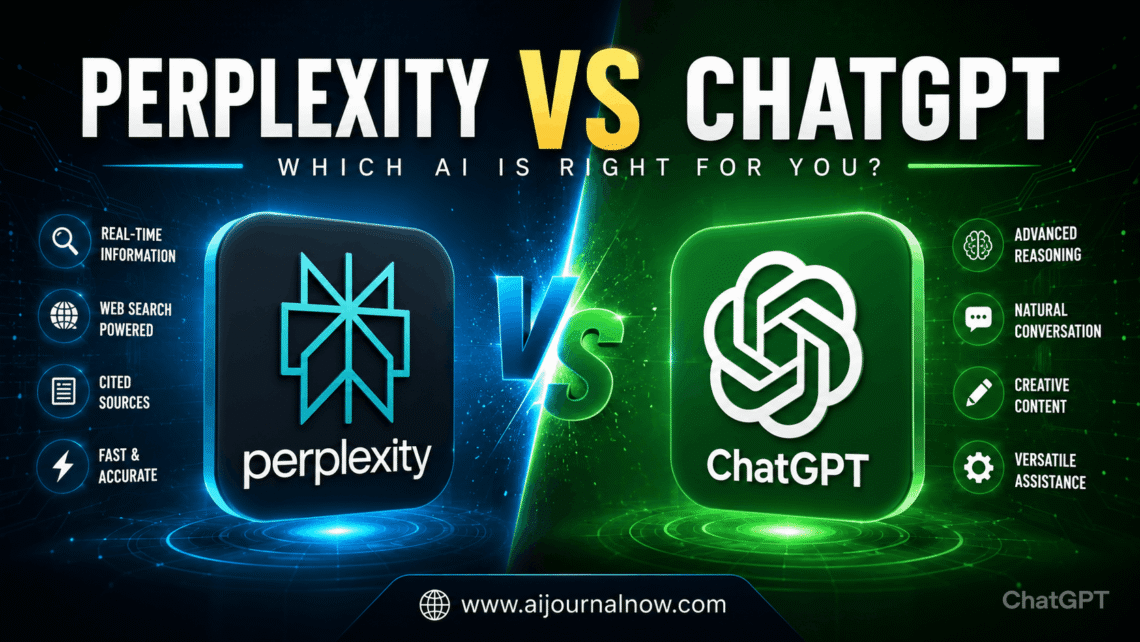
Perplexity vs ChatGPT keeps coming up in every AI conversation right now. And honestly, people are asking the wrong question. It’s not about which one is better. It’s about which one fits what you’re actually trying to do. These two tools are built differently, for different jobs. Once you see that, the choice gets a lot easier.
What Each Tool Is Actually Built For
ChatGPT is a conversational AI assistant. It generates text, writes code, analyses documents, and reasons through problems. It creates things.
Perplexity is an AI-powered search engine. It finds information, pulls from live web sources, and cites everything it returns. It retrieves things.
That’s the core difference. One thinks and creates. The other searches and cites.
So when people debate Perplexity vs ChatGPT, they’re often comparing tools that aren’t really competing. It’s a bit like arguing whether a calculator beats a word processor.
Perplexity vs ChatGPT: How They Handle Information
ChatGPT’s knowledge comes from training data. Its cutoff is fixed. Ask it about something that happened last week, and it might not know.
Perplexity pulls from the live web every time. Ask it about breaking news, recent earnings reports, or last month’s product launch – it goes and finds them.
I’ve noticed that this makes Perplexity my go-to for anything time-sensitive. Stock prices, current regulations, and recent research. ChatGPT gets it wrong on recent stuff more than people expect.
But ChatGPT now has web search too. So the gap has narrowed. Still, Perplexity was designed specifically for search. It shows.
Every Perplexity answer comes with numbered citations you can click. ChatGPT with search sometimes buries sources or skips them altogether. For research you need to stand behind; that citation habit matters.
A Quick Real-World Example
Say you’re writing a report on renewable energy trends. You need current data, not 2023 stats.
Perplexity pulls recent numbers with links to the original reports. You can verify every claim in two minutes.
ChatGPT might give you a beautifully written summary — but some figures could be outdated. You’d need to fact-check separately.
For research that needs sourcing, Perplexity wins that round cleanly.
Perplexity vs ChatGPT: What Each One Creates
Here’s where ChatGPT pulls ahead significantly. It’s a content machine.
Need a 1,000-word blog draft? Done. Need Python code debugged? No problem. Need an email rewritten in a warmer tone? Easy.
Perplexity isn’t built for any of that. Ask it to write a marketing email and you’ll get a factual summary insIt’s accurate and may be useful for research, but it’s — but not a finished draft.
ChatGPT adapts tone, mirrors style, and produces output across dozens of formats. That creative flexibility is something Perplexity simply doesn’t try to match.
So if your work involves producing things — content, code, plans, analyses — ChatGPT is the stronger daily driver.
Pricing: What You Actually Pay
Both tools offer free tiers. Both charge around $20/month for their paid plans.
ChatGPT Plus at $20/month gives you GPT-4o, image generation via DALL-E, voice mode, and advanced data analysis tools.
Perplexity Pro at $20/month gives you unlimited AI-powered searches; access to multiple models, including Claude and GPT-4o; and better handling of complex research queries.
Same price. The value you get for your $20 varies significantly based on your needs.
If you create content and need a generalist assistant, ChatGPT Plus is the better $20. If you’re a researcher, analyst, or journalist who lives in search, Perplexity Pro earns its keep faster.
One Thing Perplexity Does That ChatGPT Doesn’t
Perplexity Pro lets you switch between AI models — Claude, GPT-4o, Mistral, and others all underde one subscription. That model flexibility is genuinely useful.
ChatGPT is OpenAI-only. You get GPT variants, nothing else.
If you like the idea of choosing your model based on the task, Perplexity Pro gives you that in one place.
Who Should Use Which Tool
Here’s the honest breakdown. No hedging.
Perplexity is
- You do a lot of research and need sources
- You need current, real-time information regularly
- You want short, scannable answers fast
- You’re a student, journalist, analyst, or fact-checker
ChatGPT is:::
- You write, code, or create content regularly
- You need a conversational assistant for complex tasks
- You want to analyze documents, images, or data
- You need something that adapts its tone and style to you
Use both if:
- You research in Perplexity, then write in ChatGPT
- You need current facts plus polished output
That two-tool workflow is actually what a lot of productive people land on. Perplexity for the research phase. ChatGPT is used to turn that research into something usable.
Perplexity vs ChatGPT: The Search Question
People keep asking whether ChatGPT’s built-in web search makes Perplexity redundant. The short answer is no.
ChatGPT added search, but search is a feature of ChatGPT. It’s the entire product for Perplexity.
According to The Verge’s coverage of AI search tools, Perplexity has consistently iterated faster on search-specific features. Perplexity’s design deeply incorporates features like follow-up question suggestions, source quality filtering, and focused search modes.
In my experience, when I genuinely need to find something and trust the source, I still reach for Perplexity first. ChatGPT’s search is good. Perplexity’s search feels purpose-built.
The Workflow That Actually Works
Here’s a practical example of using both tools together.
You’re writing a competitive analysis for a client in the electric vehicle market.
Step one: open Perplexity. Ask for recent market share data, major players, and notable product launches from the last six months. Collect the sources. Save the key figures.
Step two: open ChatGPT. Paste your research notes. Ask it to write a structured competitive analysis in a professional tone. Edit and refine.
Total time: maybe 45 minutes for something that would have taken half a day before these tools existed.
Neither tool alone gets you there as cleanly. Together, they cover the full workflow.
Final Thought
The Perplexity vs ChatGPT debate will continue as both tools evolve. But chasing the “best” AI tool is less useful than figuring out which one solves your actual problem.
If you’re still on the free tiers of both, that’s actually a solid place to start. Use them side by side for a week. You’ll feel pretty quickly which one earns more of your time – and you might find, like a lot of people do, that they’re better together than either one is alone.