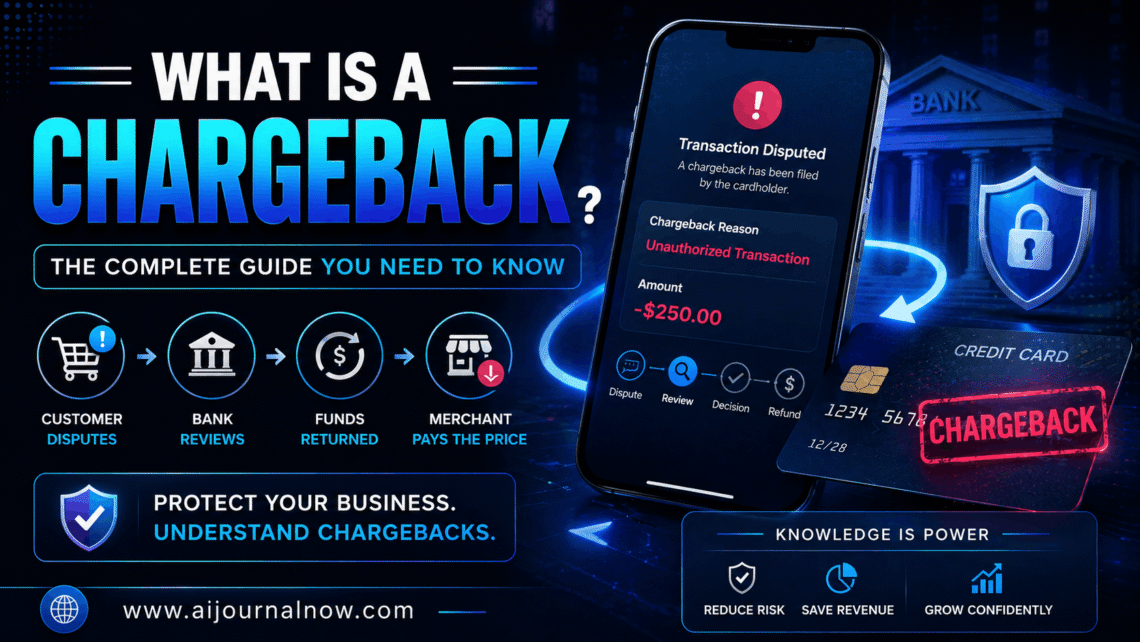
What is a Chargeback? It’s one of those queries that sounds easy, but the deeper you dig, the more you uncover a surprisingly complicated answer. If you’re a consumer, a freelancer taking payments, or a small business owner, understanding this process can save you real money and real stress.
What is a Chargeback: The Straight Definition
A chargeback is a payment reversal thatthe cardholder’s bank demandsk. When a client disputes a charge, the bank removes the money back from the merchant and returns it to the cardholder, frequently before the dispute is even entirely settled.
It’s NOT a refund. Refund is optional. It’s the merchant’s choice. A chargeback is not optional. The bank decides. The merchant has little control during this time.
Credit card networks like Visa, Mastercard, and American Express created chargebacks as a way to safeguard consumers. The objective was to give buyers recourse when something goes wrong, making electronic payments feel safe.
What is a Chargeback? The method
It’s a simple process, but it happens quickly and can seem a little unclear to the merchant.
A cardholder calls their bank up and challenges a charge. The bank temporarily reverses the charge and informs the merchant’s payment processor. The business subsequently gets an official chargeback notification—usually with a narrow response window of 20 to 45 days depending on the card network.
If the merchant wants to contest the chargeback, they present strong evidence such as delivery confirmation, signed receipts, records of correspondence, or terms of service contracts. The bank looks at both sides and decides. If the merchant wins, the money is sent back. If a bank decides with the customer, the reversal is final; the merchant eats the loss, plus a chargeback cost that normally ranges from $15 to $100 per dispute.
What is a Chargeback When to utilise it as a consumer
Charge-backs are for the right reasons. It matters for keeping a fair system that you know when to use one, not rushing to employ one.
Reasonable grounds for filing a chargeback are when an unauthorized transaction was made to your account, a merchant charged you twice for the same purchase, an item never arrived after a reasonable time of waiting, or a product arrived way off from the promised description.
But it is generally always the correct thing to do to contact the merchant first. Most disputes with payments are resolved quicker with a direct refund rather than a bank dispute. Chargebacks are also a matter of record. Use them wrong, and your bank/card network will flag your account, and you will have problems down the line.
What is a Chargeback: why it’s a problem for businesses
For merchants, chargebacks are among the more irritating realities of receiving card payments. Volume, if it is excessive, bears with it financial risk, administrative burden, and reputational consequences for every dispute.
Card networks keep a tight eye on chargeback rates. Merchants exceeding a specific threshold, usually 1% of monthly transactions for Visa, are put into monitoring programs that have costs and limits. Too many chargebacks and the business may lose the ability to process card payments altogether.
Friendly fraud exacerbates that problem. This is where customers submit chargebacks not because something went wrong but because they want something for free—retain the goods and get their money back. Friendly fraud is one of the more expensive problems e-commerce enterprises face. Studies indicate that friendly fraud constitutes a large percentage of all chargebacks.
So businesses in high-risk categories like travel, digital goods, and subscription services invest extensively in chargeback avoidance—clear billing descriptors, delivery confirmation systems, proactive customer communication, and detailed transaction logs.
What is a Chargeback examples in real life in different scenarios
Examples in tangible terms help us understand the subject.
The unauthorized charge. Someone sees a $240 charge from a vendor they don’t recognize. They submit a chargeback right away. The bank checks, finds no authorization, and refunds the charge. This is precisely why the system was developed.
The controversy on subscriptions. A customer signs up for a trial of software, forgets to cancel, and is invoiced for a full year. They contact the vendor, who refuses to give a refund according to the terms of service. The customer requests a chargeback. It depends on whether the merchant can show the client agreed to the invoicing conditions and was made aware of them.
The delivery fight. A freelancer sends a finished design project in a digital format. The client gets it, utilizes it, and then files a chargeback saying they never got the job. The freelancer wins the dispute with email records, the digital file’s time stamp, and a screenshot of the customer confirming receipt.
The instance of the friendly fraud. Customer orders a pricey item online. Gets it. Claims they never received it. Files a chargeback. The seller gives tracking information that shows delivery and signature. The bank ruled in favor of the businessman.
Summary
At its foundation, a chargeback is a consumer protection tool, and it’s most effective when it’s used honestly and as a last resort. For buyers it is a real safety blanket. For organizations, it is a procedure to take seriously—to defend against when disputes are unfair and to prevent by clear communication and good documentation. Knowing both sides of the equation puts you in a stronger position no matter what side of a transaction you are on.
COMMON QUESTIONS
Q1: What is a Chargeback fee? Who pays it?
If the customer wins or loses the chargeback, the merchant’s payment processor will incur a dispute fee—usually between $15 and $100, depending on the situation. The cardholder pays nothing to put in a dispute. That’s part of the reason chargebacks are so financially costly for firms, even when they win a dispute over a bogus transaction.
Q2: How long does the chargeback process take?
Most chargebacks are resolved in 60 to 120 days, although the time frame varies per card network. The first reversal is done swiftly—usually within a few days of the customer’s complaint. But the complete inquiry and final decision can take many months. That’s particularly true in complex instances with lots of documentation from both parties.
Q3: Can a merchant win a chargeback?
Yes. Merchants who provide compelling proof—delivery confirmation, signed agreements, communication logs, IP address data for digital sales, and unambiguous terms of service—win a large percentage of claims. The important thing is to react within the time frame and include documents that specifically address the reason code the bank issued for the dispute.
Q4: Does submitting a chargeback damage my credit score?
A chargeback doesn’t immediately affect your credit score. This is a dispute process, not a credit event. However, if a bank finds you’ve exploited chargebacks multiple times, they might close your account—and a closed account might have indirect credit score consequences. Use chargebacks wisely and lawfully to prevent yourself from this result.