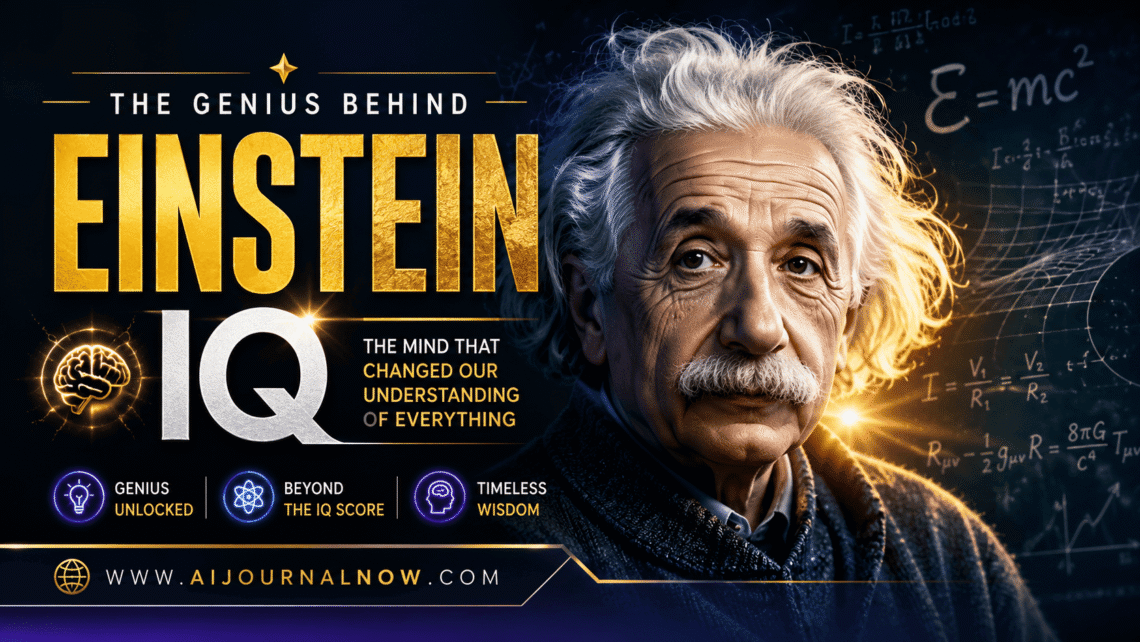
Few numbers in popular culture carry as much weight as the Einstein IQ—and yet, surprisingly, Albert Einstein never took a formal IQ test in his lifetime. What we know about his intelligence comes from estimates, biographical accounts, and the sheer scope of what he accomplished scientifically. That gap between myth and reality is exactly what makes this topic so fascinating.
People throw around the number 160 constantly when discussing Einstein’s IQ, treating it as established fact. But where did that figure come from? What does it actually mean? And does a number on a scale even begin to capture what made Einstein the thinker he was?
This article works through all of it — the estimates, the context, the comparisons, and the honest limitations of reducing a mind like Einstein’s to a single score.
What Is Einstein IQ Estimated to Be?
The most commonly cited Einstein IQ estimate is around 160. Some sources place it slightly higher, between 160 and 180, depending on the estimation method used. To put that in perspective, an IQ of 100 is considered average. Scores above 140 are typically classified as “genius” level and occur in roughly 0.25% of the population.
So an estimate of 160 places Einstein comfortably in the top fraction of a fraction of human intelligence, at least as IQ attempts to measure it.
But here’s the important caveat: these are estimates, not measurements. Einstein was born in 1879 and died in 1955. The Stanford-Binet IQ test wasn’t widely standardized until 1916, and there is no record of Einstein ever sitting one. Historians and psychologists have retrospectively estimated his IQ based on his academic performance, problem-solving capacity, the complexity of his theories, and his documented cognitive abilities.
Retrospective IQ estimation is an imprecise science, to say the least. The numbers are informed guesses — educated ones, but guesses nonetheless.
How Does Einstein IQ Compare to Other Geniuses?
Putting Einstein’s IQ in context helps clarify what the number represents. For comparison, here’s how various historically estimated IQs stack up:
Isaac Newton is often estimated between 190 and 200, placing him above Einstein on most retrospective scales. Newton’s breadth—calculus, optics, gravity, and mechanics—contributes to that high estimate.
Stephen Hawking, who was frequently asked to comment on Einstein IQ comparisons, reportedly had an estimated IQ of around 160—the same as Einstein’s common estimate. Hawking famously deflected the question whenever it came up, saying people who boast about their IQ have nothing to boast with.
Terence Tao, a living mathematician often called the smartest person alive by some researchers, has a tested IQ reported around 225–230—far above historical Einstein IQ estimates.
Marilyn vos Savant holds the Guinness World Record for the highest recorded IQ at approximately 228.
These comparisons highlight something important: by the numbers, Einstein’s IQ isn’t the highest ever estimated. What made Einstein remarkable wasn’t necessarily raw cognitive processing speed—it was the specific type of thinking he excelled at and how he applied it.
What Made Einstein’s Intelligence Unique?
Understanding Einstein’s IQ requires looking beyond the number. Einstein himself offered insight into his own mind. He attributed his breakthroughs not to exceptional memory or processing speed, but to persistent curiosity, the ability to think in visual and spatial terms, and a willingness to question assumptions that others accepted without scrutiny.
His famous thought experiments — imagining riding alongside a beam of light, picturing what a falling elevator would feel like — weren’t feats of mathematical calculation. They were acts of creative visualization. Einstein could construct detailed mental models of physical scenarios and reason through them intuitively before a single equation was written.
This kind of thinking doesn’t map neatly onto IQ tests, which primarily measure logical-mathematical reasoning, verbal comprehension, and processing speed. Einstein’s particular cognitive gifts—spatial reasoning, sustained abstract thought, and creative pattern recognition—were genuine and extraordinary. But they were also specific. By his own admission, he was a slow reader and had no particular gift for rote memorization.
The Limitations of Using Einstein IQ as a Benchmark
The Einstein IQ figure gets used constantly in popular culture as a shorthand for ultimate intelligence. That usage has real problems worth acknowledging.
IQ measures a narrow slice of cognition. It captures certain reasoning abilities reasonably well. It doesn’t capture creativity, emotional intelligence, wisdom, practical problem-solving, artistic ability, or social intelligence. Einstein’s contributions required all of these in combination.
Retrospective estimates aren’t reliable. Estimating someone’s IQ from historical records introduces enormous uncertainty. Different researchers applying different methods arrive at different numbers. The 160 figure for Einstein’s IQ is a reasonable estimate, not a verified measurement.
High IQ doesn’t guarantee great achievement. There are people with measured IQs well above 160 who have made no notable contribution to science, art, or society. Motivation, environment, opportunity, and persistence matter enormously — arguably more than raw intelligence in many cases.
Einstein had academic struggles too. He failed his entrance exam to the Swiss Federal Polytechnic School on his first attempt. He spent years working as a patent clerk before his ideas gained traction. His path wasn’t the straight-line ascent that genius mythology usually implies.
None of this diminishes what Einstein achieved. It complicates the simple narrative that Einstein’s IQ equals Einstein’s genius equals Einstein’s success—and that complication is valuable.
Einstein IQ and What It Means for Understanding Intelligence
One of the more productive things the conversation around Einstein’s IQ opens up is a broader question: what do we actually mean when we talk about intelligence?
Howard Gardner’s theory of multiple intelligences, developed at Harvard, proposed that human intelligence isn’t a single capacity but a cluster of distinct abilities—linguistic, logical-mathematical, spatial, musical, bodily-kinesthetic, interpersonal, intrapersonal, and naturalistic. Under this framework, Einstein’s spatial and logical-mathematical intelligence was off the charts, while other dimensions were more ordinary.
Robert Sternberg’s triarchic theory breaks intelligence into analytical, creative, and practical components. Standard IQ tests measure analytical intelligence reasonably well. Einstein’s genius was arguably most visible in his creative intelligence—his capacity to generate novel solutions and reframe problems in unexpected ways.
These frameworks suggest that Einstein IQ, as a single number, is a crude summary of something genuinely complex. It points in the right direction but doesn’t tell the full story.
Einstein IQ in Pop Culture and Why People Are Obsessed With It
The fascination with Einstein’s IQ isn’t really about neuroscience or psychometrics. It’s about aspiration and comparison. People want to know where they stand relative to the most famous mind of the modern era.
That’s why online “Einstein IQ tests” proliferate endlessly. Most of them are not legitimate psychometric assessments — they’re engagement tools designed to make you feel smart and share your results. A real IQ test is administered by a trained psychologist, takes several hours, and draws from standardized, peer-reviewed instruments like the WAIS or Stanford-Binet.
For students curious about their own intelligence, this matters. Taking a free online test that claims to measure your “Einstein IQ equivalent” tells you very little. If you genuinely want to understand your cognitive profile, a formal assessment with a qualified professional is the only meaningful route.
Einstein IQ vs. Modern Geniuses: A Realistic Comparison
The honest answer is that Einstein’s IQ—estimated at around 160—is exceptional but not unique among documented high-IQ individuals. What distinguished Einstein wasn’t that his IQ was higher than everyone else’s. It was that his particular combination of curiosity, imagination, spatial reasoning, and scientific intuition intersected perfectly with the most important unsolved problems in physics at the turn of the twentieth century.
Timing, domain, and disposition mattered as much as raw intellect. A person with identical cognitive abilities born in a different era, without access to the right education or scientific community, might never have produced anything comparable.
That’s not a cynical point. It’s actually a more interesting one. Genius isn’t just a number — it’s the right mind meeting the right problem at the right moment.
Frequently Asked Questions
Q1: Was Einstein’s IQ ever officially tested? No. Einstein never took a formal IQ test. The commonly cited estimate of around 160 is a retrospective figure calculated by researchers based on his known abilities, academic record, and scientific achievements — not a measured score.
Q2: What IQ score is considered on par with Einstein’s IQ? Scores of 160 and above are generally considered in the same range as the commonly cited Einstein IQ estimate. These scores place individuals in the top 0.003% of the population, though the exact threshold varies by the test used.
Q3: Did Einstein struggle in school despite his high IQ? Yes. Einstein failed his first university entrance exam and didn’t always thrive in the traditional academic environment. His thinking style — visual, intuitive, non-linear — didn’t always align with the rote learning that conventional schooling emphasized.
Q4: Are online Einstein IQ tests accurate? No. Online tests claiming to compare your intelligence to Einstein’s IQ are not validated psychometric tools. They’re designed for entertainment. For a legitimate IQ measurement, you need a standardized test administered by a qualified professional.
Q5: Is IQ the best way to measure genius? Most psychologists would say no. IQ captures certain cognitive abilities but misses creativity, practical wisdom, emotional intelligence, and domain-specific talent. Einstein’s genius involved all of these, which is why reducing it to a single number, however impressive, always falls a little short.
The Number Isn’t the Point
Einstein’s IQ will keep circulating as a cultural reference point for extraordinary intelligence—and that’s understandable. But the more interesting takeaway from studying Einstein’s mind is what the number doesn’t capture.
His curiosity was relentless. His willingness to sit with difficult problems for years without forcing premature answers was rare, and his ability to think visually and intuitively, rather than just formally, gave him angles on physics that pure calculation alone couldn’t have reached.
Those qualities aren’t measured on any IQ scale. And they’re far more worth thinking about.
Also Read: Sierra AI: What It Is and Why Businesses Are Betting Big on It