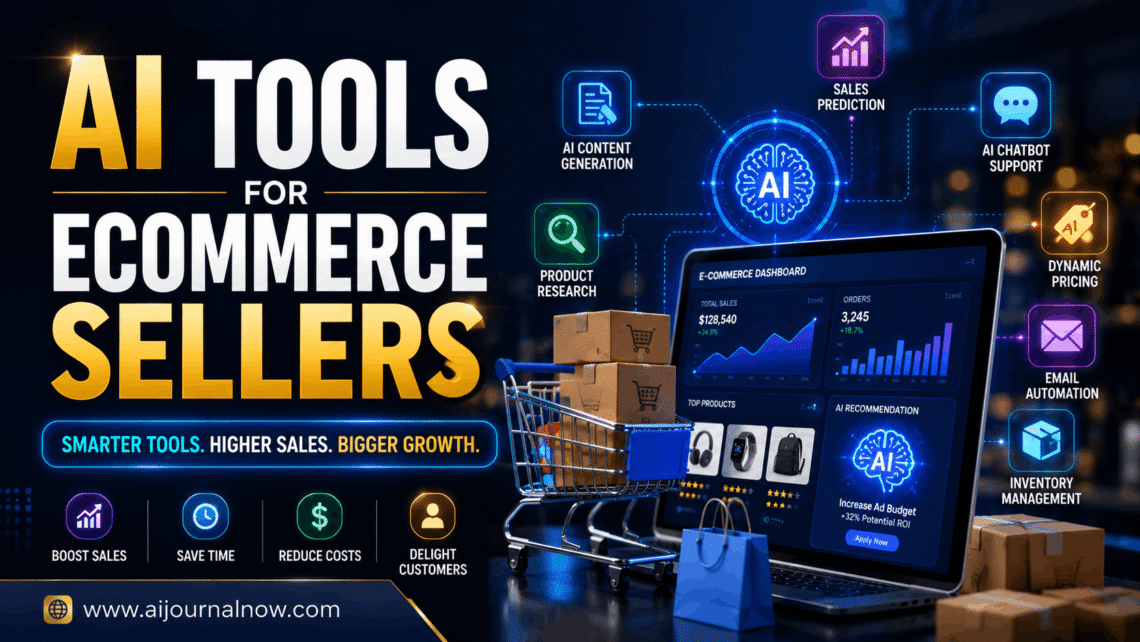
What are the top AI Tools for Ecommerce Sellers?
They’re software apps that employ artificial intelligence to automate, optimize, or otherwise improve tasks unique to running an online store. They do everything from creating product descriptions to estimating inventory demand. Plus, many solutions will analyze your customer behavior and alter your strategy in real-time based on what they uncover.
With traditional e-commerce, you have to do everything yourself—write the material, run the advertisements, reply to consumers, and track inventory. But these days, AI technologies for e-commerce retailers do much of the job for you automatically. That means vendors can handle bigger catalogs, contact more customers, and react more quickly without burning out.
These tools work by taking in a lot of data and applying algorithms to make outputs or recommendations. For example, a pricing solution that analyzes competitor prices and automatically updates your own so you’re always competitive. Tools may also look at which product photos are getting the most clicks and propose better ones.
Why AI is Needed in Ecommerce Today
The volume is heating up across every major platform. Buyers also want faster response times, greater product content, and a more personalized experience. No way solitary sellers or small teams can keep up the old-fashioned way.
So AI technologies for e-commerce merchants offer an advantage that only huge firms with full-time workers previously had. As a solo Amazon seller, you can now conduct automatic marketing campaigns, build optimized listings, and respond to customer messages—all in a few minutes a day. Also, these tools get wiser over time, so the longer you use them, the better your findings tend to be. If you want a deeper look at the data side of things, e-commerce analytics tools can help you make sense of what your store data is telling you.
Top AI Tools for Ecommerce Sellers in 2025
1. Jungle Scout – For Amazon Product Research
Jungle Scout helps Amazon sellers locate profitable products and monitor competition. Its AI-powered demand forecasting tells you how many units you need to order so you don’t run out of stock. It also looks at keyword trends so you can write listings that rank higher in Amazon search results.
For new sellers the product database alone can save weeks of painstaking research. It also keeps you in the know—tracking your competitors’ pricing and sales volume. Paid plans start around $49 a month, which most active Amazon sellers earn back quickly.
Best for: Amazon product research and inventory control.
2. Jasper AI – For Copy and Product Descriptions
Writing product descriptions by the hundreds is a killer. Jasper AI can produce great copy at scale. You give it the product info and tone, and it generates ready-to-publish descriptions in seconds. It also helps with ad text, email marketing, and even blog entries that attract organic traffic to your shop.
Jasper is especially useful for Shopify and WooCommerce retailers with vast catalogs. On the other hand, the quality of output has a lot to do with the quality of your input. So take a few minutes to write a great prompt, and the outcomes will be much stronger. For more on how AI text generators can speed up content production, it’s worth exploring your options before committing to one platform.
Best for: Ad copy, product descriptions, email content
3. Tidio – For Automation of Customer Service
Tidio is a live chat software featuring an AI chatbot that can automatically reply to consumer questions. It addresses questions about shipping, returns, and product availability—even at 2 a.m. This means that the customers feel looked after without you having to be online 24/7.
It interfaces easily with Shopify, WooCommerce, and BigCommerce. Plus, if the query is too difficult for the bot, it will seamlessly pass the conversation to you or a team member. Tidio saves a lot of support time for e-commerce retailers with big order volumes.
Best for: Cart abandonment recovery and customer care automation.
4. Prisync – To Track Competitor Prices
Pricing is one of the most potent levers in e-commerce. Monitor competitor pricing for thousands of products with Prisync and get alerts when they change. And you may create rules that automatically change your own prices in response. That way you never lose a sale to a competitor who discreetly decreased their price overnight.
It works with all major e-commerce systems and is suitable for both small and large catalogs. Pricing, though, starts about $99 a month and is perfect for sellers who are already making money.
Best For: Competitive pricing and dynamic pricing.
5. Canva AI – For Product Images and Store Graphics
Strong visuals sell. Canva AI makes it easy to produce excellent product banners, promotional images, and social media posts without employing a designer. Remove backdrops from product shots, create lifestyle images, and scale assets for diverse platforms in minutes.
Visual branding consistency generates trust rapidly for both Etsy sellers and DTC businesses. Canva’s AI picture tools continue to become better, making it easier to create scroll-stopping content on a small budget. The free plan covers most of the fundamental needs, while the subscription plan unlocks more powerful AI functions.
Best for: Product photos, banner ads, social media graphics.
6. Klaviyo with AI Features – For Email & SMS Marketing
Klaviyo is one of the most powerful email solutions for e-commerce. Its AI capabilities can forecast customer lifetime value, recommend the optimal time to send advertising, and intelligently segment your audience by purchasing behavior. As a consequence, your communications get to the appropriate individuals at the right time.
Plus, Klaviyo’s automated processes (including abandoned cart sequences and post-purchase follow-ups) run automatically when they’re created, with zero manual involvement. If you are an online vendor that wants to get more repeat purchases, this solution provides a consistently excellent ROI. Pairing it with the right AI marketing tools can take your campaigns even further.
Best for: Email automation, SMS marketing, and segmentation.
7. Helium 10 – For Amazon SEO and Listing Optimisation
Helium 10 is a full-fledged tool built for Amazon sellers. It harnesses AI to drive its keyword research to discover terms real buyers are using. Its listing analyzer also rates your product pages and advises some modifications to make. Therefore, your listings rank higher and convert better.
It also has options for inventory management, refund tracking, and competition monitoring. Helium 10 is one of the most complete sets of tools available for Amazon. The UI, on the other hand, can be daunting at first, so new sellers should stick to one or two features.
Best for: Amazon keyword research and listing optimisation
AI Tools for Ecommerce Sellers: Comparison Chart
| Tool | Primary Use | Platform Focus | Free Plan |
|---|---|---|---|
| Jungle Scout | Product research | Amazon | No (trial) |
| Jasper AI | Copywriting | All platforms | Trial only |
| Tidio | Customer support | Shopify, WooCommerce | Yes |
| Prisync | Price monitoring | All platforms | No (trial) |
| Canva AI | Visual design | All platforms | Yes |
| Klaviyo | Email and SMS marketing | Shopify, WooCommerce | Yes |
| Helium 10 | Amazon SEO | Amazon | Limited free |
AI Tools for Ecommerce Sellers: The Pros and Cons
Benefits
- Time savings: Automating repetitive processes saves you hours each week, every single week.
- Scalability: You can take on more goods and more clients without hiring more people.
- Better data: AI systems can analyze patterns and buyer behavior far faster than any human.
- Higher conversions: Better copy, optimized listings, and personalized mailings lead to more purchases.
- Reduced operational costs: AI typically eliminates the need for freelancers or extra team members.
Drawbacks
- Learning curve: Some tools need to be configured correctly before they can produce results.
- Monthly costs: Having several tools at the same time can add up to considerable recurring costs.
- Accuracy problems: AI-generated material and recommendations need human evaluation.
- Risk of over-automation: Eliminating the human touch altogether can harm customer relationships.
- Data dependency: Tools tend to operate best when there is a lot of historical data to work with. New sellers may not have that yet.
The Way AI Ecommerce Seller Tools Work Together in Real Life
Here is an actual example. Let’s say you offer home decor products on Shopify and Amazon.
You start using Jungle Scout to find a hot product that has good demand with low competition. Then, Jasper AI produces optimized product descriptions for your Shopify store and Amazon listing. Canva AI develops tidy product banners and lifestyle photographs for your store site and Instagram feed. In the meantime, Tidio will take care of your customers’ questions on your Shopify store 24/7. Klaviyo sends automated abandoned cart emails that recover lost revenue every day. Finally, Prisync keeps an eye on competitor prices so you remain correctly positioned in the market.
Each tool covers a particular element of the business. Together they form a system that operates mostly on autopilot. And the overall monthly spend on all these products probably costs less than one part-time employee.
Alternative AI Tools to Popular Ones for E-commerce Sellers
Not every tool is for every seller. There are various possibilities to look at.
- Seller Sprite – Amazon seller tool similar to Jungle Scout with powerful keyword and listing features.
- Copy.ai – An affordable alternative to Jasper for product copy and marketing content.
- Freshdesk – Alternative to Tidio for customer assistance, better help desk and ticketing functionality.
- Wiser—Another Prisync alternative for price information, especially for larger catalogs.
- Adobe Express – A Canva competitor for vendors who are already in Adobe’s ecosystem.
- Omnisend – A Klaviyo option for multichannel marketing using push alerts.
- Viral Launch—Good split-testing tools for Amazon listings, an alternative to Helium 10.
So if there’s a tool that’s not quite right for your budget or workflow, there’s usually always a decent option out there.
AI Tools for Ecommerce Sellers: Frequently Asked Questions
Q1: Are AI Tools for Ecommerce Sellers good for beginners?
Yeah, most of them are made for non-technical people. Tools like Tidio, Canva, and Klaviyo have simple interfaces that a newbie can pick up quickly. Also, most platforms have lessons and onboarding guides. So you don’t need any technical skills to get started and get results.
Q2: What is the cost of AI Tools for Ecommerce Sellers?
The cost varies a lot. Some tools like Tidio and Canva have quite good free plans. Others like Prisync and Jungle Scout start at roughly $49-$99 per month. But most premium products will pay for themselves in no time if you use them regularly. Start with free alternatives, then upgrade as revenue grows.
Q3: What AI tools for e-commerce businesses can be used for Amazon specifically?
Definitely. Tools like Jungle Scout, Helium 10, and Seller Sprite are made exclusively for Amazon. They do keyword research, listing optimization, inventory forecasting, and competitor tracking. Additionally, products such as Jasper AI and Canva AI function across all platforms, including Amazon shopfronts.
Q4: Do AI technologies for e-commerce sellers eliminate the need for marketing agencies?
Yes, for many small and mid-sized sellers. Tools include Klaviyo for email automation, Jasper for copywriting, and Canva for design. Altogether, they comprise most of what a marketing agency would charge you thousands every month to manage. But larger brands with complex needs may still benefit from expert agency support.
Q5: How can I discover top AI Tools for Ecommerce Sellers for my business?
The first step is to determine your biggest bottleneck. Jasper is first if you struggle with writing. If you find your customer service is taking too long, try Tidio. If you’re having trouble ranking on Amazon, check out Helium 10. Plus, most tools include free trials, so you can try them out before you buy a plan. You can also explore how AI data analytics can help you pinpoint which part of your funnel needs the most attention.
Final thoughts
The greatest AI Tools for Ecommerce Sellers are those that you actually use often. The selection of the proper ones is a function of your platform, your shortcomings, and your growth ambitions. Start with the basics and master one tool before moving on.
Those sellers that introduce AI strategically, not arbitrarily, will find it much simpler to scale, compete, and stay profitable. The tools exist. The opportunity is real. The next step is just figuring out where to begin.


