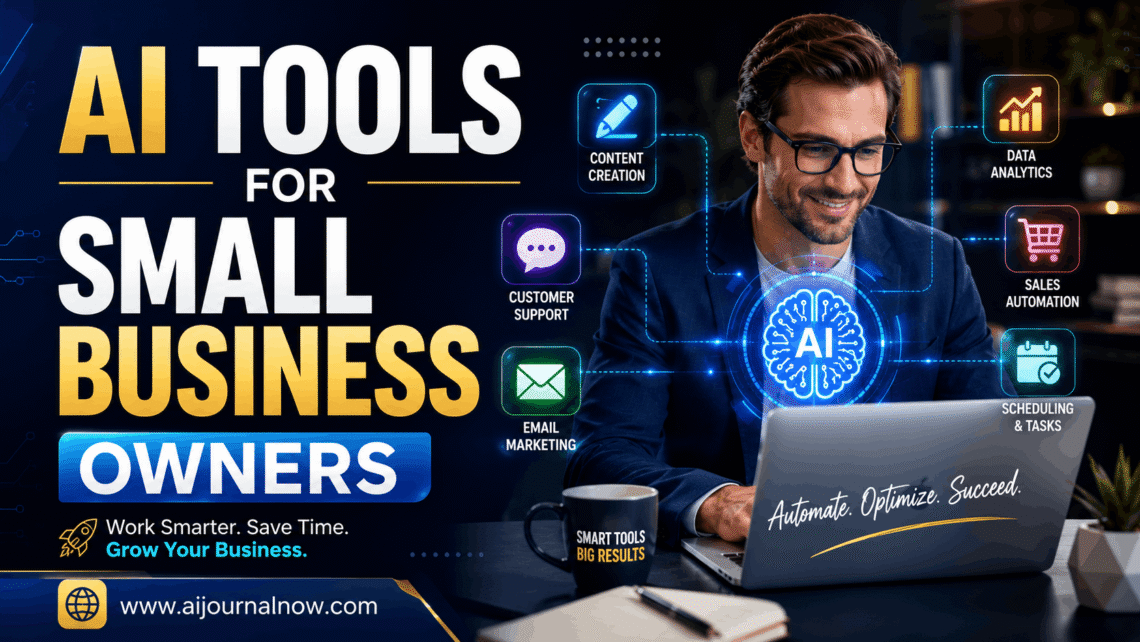
It’s hard to run a business without a big crew, which is why AI tools for small business owners have become so valuable so quickly. This software does jobs that used to require additional workers or pricey agencies. They are also mostly inexpensive, easy to learn, and can be applied in minutes. So, if you’re wondering where to begin, this tutorial is for you.
Best AI tools for small business owners?
They are, in a word, apps that run on artificial intelligence. They automate, aid, or improve jobs including writing, customer service, bookkeeping, scheduling, and marketing and they also learn from patterns and inputs to generate smarter results over time.
Software is static; AI tools evolve. A customer support chatbot, for example, learns typical inquiries and becomes more accurate in its responses as it processes more chats. The more you utilize these tools, the better they tend to function.
Small business entrepreneurs get the biggest benefit since they wear several hats. This means that an AI assistant doing the repetitive work frees up time for strategic decisions.
Why Small Business Owners Are All In On AI
It isn’t simply about automation. It’s about keeping competitive. Big companies have whole departments for marketing, finance, and customer service. But AI tools for small business owners do assist in leveling that playing field a lot.
Imagine a bakery proprietor who also runs Instagram, takes orders, and answers customer questions. That’s sixty hours a week without assistance. On the other hand, a lot of those chores can be automated with the correct AI tools. It lets the entrepreneur concentrate on baking and building relationships with customers.
The other thing is that the entry fee has been cut drastically. Most of the best tools have free plans or cheap monthly memberships (around $30). Even bootstrapped companies can access considerable capabilities. If you’re looking for digital product ideas to grow your revenue alongside these tools, there are plenty of options worth exploring.
Top AI Tools for Small Business Owners in 2025
1. ChatGPT — For Writing & Communication
ChatGPT is capable of several writing jobs. You can use it to write emails, make social media captions, write product descriptions, or create FAQ material for your website. Plus, it answers consumer inquiries, comes up with marketing ideas, and even helps you get ready for uncomfortable client talks.
It runs using a simple chat interface. You give it a prompt, and it reacts immediately. Which requires no technological skills. The free version is good for most ordinary chores, but the subscription plan has more complex capabilities. To better understand what GPT stands for and how the technology works, it’s worth a quick read.
Best for: Content creation, customer emails, and brainstorming.
2. Jasper AI – For Marketing Copywriting
Jasper AI is built specifically for marketing content. It helps small businesses write blog entries, ad copy, landing page copy, and product listings. It also has templates for particular formats, such as Facebook advertising or email subject lines.
Jasper saves small business owners running paid ads hours a week in copywriting. Plus, once you choose your preferences, it maintains a consistent brand voice. But it works best if you give clear, explicit prompts and not ambiguous instructions.
Best for: Blog posts, email marketing, and ad text.
3. Tidio – For Customer Support
Tidio is a live chat & AI chatbot tool for small enterprises. It automatically responds to frequent consumer queries, even while the firm is closed. This means that customers feel cared for without you having to be online all the time.
It works with Shopify, WordPress, and other popular platforms. It also escalates complex inquiries to a human agent as necessary. Especially for e-commerce enterprises, Tidio cuts cart abandonment by reaching out to customers at the correct time. For a broader look at e-commerce analytics tools that can complement Tidio, that guide is a good starting point.
Best for: Lead gen and customer support automation.
4. QuickBooks with AI Features – For Accountancy
It has introduced AI-powered features that speed up bookkeeping and make it less error-prone. It automatically categorizes spending, alerts you to suspicious transactions, and creates financial reports on demand. Consequently, small business owners have less time for manual data entry.
It links directly to your bank account and syncs transactions in real time. This means your books stay current, but you don’t have to update them every day. But if you’ve never used accounting software before, the learning curve can feel rather steep.
Best for: Expense monitoring, billing, and financial reporting.
5. Canva AI – For Visual Contents
Canva has built AI features to bring graphic design to the masses. You can describe an image, and the tool will generate it. Or you may use AI to scale designs automatically, remove backgrounds, or recommend layout changes.
Canva saves a lot of time and money for small businesses that need frequent graphic content such as social media updates, posters, menus, or presentations. Plus, you don’t need to employ a designer for every little project. The free plan is generous and the subscription edition throws even more AI-powered capabilities into the mix.
Best For: Social media graphics, flyers, and branding graphics. Tools like Canva pair well with the broader set of social media apps small business owners use daily.
6. Otter.ai—For Meetings and Notetaking
Otter.ai automatically records and transcribes meetings. After a call with a client or vendor, it provides a written report with salient points underlined. So that you always know what has been agreed or promised.
It also works with Zoom, Google Meet, and Microsoft Teams. This tool is highly useful for service-based organizations that have a lot of discovery calls or consults. The search option also allows you to easily find any part of a former conversation.
Best for: Transcription of meetings and follow-up notes.
7. AI-driven Mailchimp – For Email Marketing
Mailchimp is now so much more than just email newsletters. Its AI capabilities now help recommend the best time to send, offer suggestions for subject lines, and even anticipate which consumer segments will engage the most. So your email campaigns get smarter with every send.
The drag-and-drop builder also makes creating campaigns fast. No computer skills needed; small business owners may set up automated welcome sequences, abandoned cart notifications, and re-engagement emails. The free plan comes with up to 500 contacts and is perfect for enterprises in their early stages.
Best for: Email campaigns, automation, and audience segmentation.
Comparison Table Of AI Tools For Small Business Owners
| Tool | Primary Use | Free Version | Ease of Use |
|---|---|---|---|
| ChatGPT | Writing & communication | Yes | Very easy |
| Jasper AI | Marketing copy | Trial only | Easy |
| Tidio | Customer support chatbot | Yes | Easy |
| QuickBooks AI | Accounting & finance | No (trial) | Moderate |
| Canva AI | Visual design | Yes | Very easy |
| Otter.ai | Meeting transcription | Yes | Very easy |
| Mailchimp AI | Email marketing | Yes | Easy |
Advantages and Disadvantages of AI Tools for Small Business Owners
Pros
- Time savings: Automate repetitive jobs and get back hours each week.
- Cost efficiency: AI tools typically require fewer freelancers or personnel.
- Consistency: Your marketing, communication, and content will always be consistent without you having to do anything.
- Scalability: These tools expand with your firm as it scales, without much extra cost.
- Ease of use. Nearly all tools do not require any technical knowledge to use.
Downsides
- Accuracy problems: AI tools can produce false information. Read the output before emailing or publishing.
- Impersonal tone: Automated responses may sound robotic and impersonal if not customized appropriately.
- Privacy concerns: If you upload important company or clients’ data, check the data policy of each tool carefully. This is especially relevant given growing cyber risk quantification challenges facing small businesses today.
- Over-reliance risk: Relying too much on AI can degrade your own talents over time.
- Subscription fatigue: The price of using five or six tools at the same time in a month adds up.
AI tools for small business owners: How they work in practice
Here’s a realistic example Let’s say you own a tiny online clothing business.
First, you use Canva AI to make your weekly Instagram posts in less than 20 minutes. Next, ChatBot writes the captions and product descriptions. Meanwhile, Tidio handles client questions on your website overnight. At the conclusion of the week, Mailchimp will send a promotional email to your list of subscribers automatically. Finally, QuickBooks will organize your costs without you touching a spreadsheet.
Each tool takes care of one piece of the puzzle. Together they do the work that used to be done by a small crew. Also, the tools boost your output quality since they handle the execution while you take care of creative direction and consumer connections.
Alternatives to the Popular AI Tools for Small Business Owners
The most popular option might not be the greatest option for you. Here are some options to think about.
- Google Gemini – A great ChatGPT alternative if you use Google Workspace every day. See our Google Gemini vs ChatGPT comparison for a side-by-side breakdown.
- Zoho One — Business suite with AI features including a CRM, email, accounting.
- Writesonic – A Jasper alternative with good marketing copy at a cheaper pricing point. It’s one of several capable AI text generators worth trying.
- Freshdesk — Better ticketing features, Tidio option for customer help.
- Wave Accounting — A fully free QuickBooks alternative, best for extremely tiny or early-stage firms.
- Adobe Express – An alternative to Canva for users who are currently utilizing Adobe products.
Each choice has a different view. “So it pays to try two or three before settling on your stack.
Frequently Asked Questions about AI Tools for Small Business Owners
Q1: Are AI tools for small business owners costly?
Not necessarily. There are some great tools that have rather liberal free plans. For example, free versions of tools such as ChatGPT, Canva, Otter.ai, and Mailchimp have many of the functionalities you need. They normally run between $10 and $50 each month. Also, even paid subscriptions are generally much less expensive than paying someone to do the same job. Investing in the right tools is one of the most valuable high-income skills a small business owner can develop.
Q2: Is technical knowledge needed for small business owners to employ AI tools?
Most of these programs are targeted for non-technical users. They function via simple interfaces, drag-and-drop builders, or basic text prompts. So you may start using them the same day you join up, no setup help needed. Many of these tools also rank among the top productivity apps available today for that exact reason.
Q3: Can AI tools for small business owners replace workers?
They can substitute for some jobs, but not for people. AI is great at repeated, systematic labor. It does need human control for quality, innovation and relationship building. Think of these tools as your helpers doing the hard work while you focus on strategy.
Q4: What are the finest AI tools for marketing for small business owners?
Jasper AI and Mailchimp are good beginning places for marketing. Jasper does copy and content; Mailchimp does clever automation email marketing. Canva AI is also involved in creating graphic material. Together they handle most of the marketing demands for a small firm. For a broader view of what’s available, our roundup of AI marketing tools covers the full landscape.
Q5: Is it secure for small business owners with client data to use AI tools?
Generally yes, but always check the privacy policy before uploading critical material. Many tools include business or corporate plans with enhanced data safeguards. Also, do not copy sensitive financial or legal papers into general-purpose AI tools on free plans.
Summary
The best AI tools for small business owners don’t only save time; they actually change what’s achievable for a small workforce. You can now compete with 3 times the size of your business, create consistent marketing, and keep your clients pleased 24/7.
Start with 1 or 2 tools that tackle your main impediment now. Learn these first. Then, as your needs and funding develop, slowly build out your AI toolkit. We’re not looking to automate everything overnight. Instead, it’s about working smarter, day by day, with the necessary support in place. Keeping up with AI search engine news and edge AI news can help you spot new tools before your competitors do.


