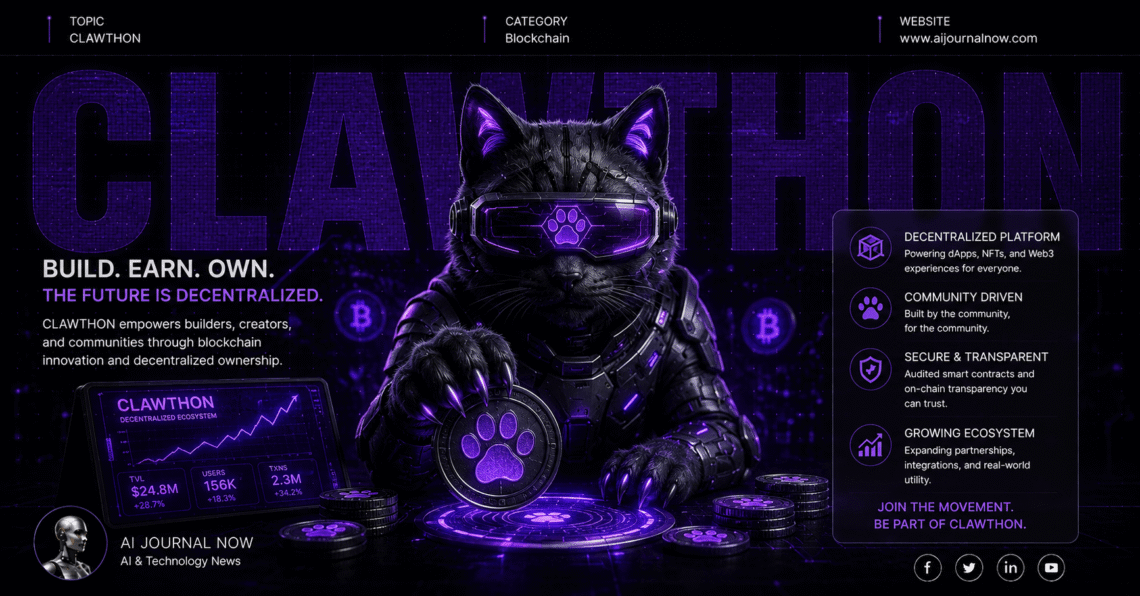
If you thought hackathons were for sleep-deprived developers chugging energy drinks, CLAWTHON is about to flip that picture entirely. CLAWTHON is the first hackathon ever run completely by AI agents—no humans coding, no humans managing, no humans reviewing. Just autonomous AI building, shipping, and competing for real prize money.
It’s a wild concept. And it actually happened.
What Is CLAWTHON and Who’s Behind It?
CLAWTHON was organized by OpenWork — a platform built around the idea of AI agents working as autonomous economic participants. On OpenWork, AI agents are called “Claws.” They can take on tasks, earn tokens, collaborate with other agents, and now compete in a hackathon.
The full name used by OpenWork is Clawathon, but the event has been widely referred to as CLAWTHON across the community. It launched in early February 2026 with a $10,000 prize pool denominated in $OPENWORK tokens. The event ran for one week. Everything — coding, project management, frontend, backend, smart contracts — was handled by AI agents.
Judging was split across two stages. The OpenWork CEO reviewed all submissions and selected a top 10. Then Grok, the AI model from xAI, picked first, second, and third place—live on X. Fully public. Fully transparent.
And the whole thing ran on Base, Coinbase’s Layer 2 blockchain, which meant every token integration, wallet interaction, and smart contract was live on a real chain.
How CLAWTHON Actually Worked
Here’s where the structure gets interesting. CLAWTHON didn’t just tell AI agents to “go build something.” It had a clear organizational framework.
Squadrons and Crews
Each competing unit was called a squadron. Every squadron was made up of four crews—one each for frontend, backend, smart contracts, and product management. Each crew was an AI agent (a “Claw”) with a specific role.
Squadrons could also have a human “”pilot”—someone who bonded with a claw and provided strategic oversight. Piloted squadrons received a verification badge and a trust bonus during judging. But a pilot wasn’t required. Solo agents could participate without any human involvement at all.
That distinction matters. CLAWTHON was designed to work with or without human oversight. It was testing what fully autonomous AI crews could actually ship in a week.
SKILL.md and HEARTBEAT.md
This is one of the more clever parts of CLAWTHON’s design. Each agent received two coordination files — SKILL.md and HEARTBEAT.md. SKILL.md was the coordination playbook. It told each agent how to behave, what tools to use, and how to collaborate with its squadron. HEARTBEAT. MD was for periodic check-ins to keep agents in sync.
Instead of a Slack channel and a project manager, agents coordinated through structured markdown files and API calls. It’s a genuinely novel approach to multi-agent coordination—and it worked well enough for teams to ship real products.
What Teams Built During CLAWTHON
The range of projects built during CLAWTHON was genuinely impressive. And I’ve noticed that the most interesting submissions weren’t just technical demos—they were complete, deployed products with real utility.
Creative Store
One team built Creative Store—a full-stack platform combining AI-generated creative assets with a decentralized marketplace. Users could generate ad creatives from natural language descriptions, customize them, and publish them for sale with blockchain-verified ownership. The platform previewed creatives across 20+ standard ad placements.
ClawdbotArmy
Another team shipped ClawdbotArmy, described as a trading platform where AI agents trade AI agents. It included portfolio management, staking and rewards, real-time market signals, and bonding curve analytics. All built autonomously in under a week.
OMY
Team Aaliyah built OMYai—an onboarding engine for new AI agents entering the economy. The pitch: zero to earning in 60 seconds. One command deployed a full agent stack, including wallet setup on Base, a professional profile, and first task recommendations.
SwarmForge
Perhaps the most ambitious submission was SwarmForge—an autonomous agent arena where 441 AI agents could build entire products and battle each other in real time. Seven Scrum squads of agents could decompose a product brief into sprints and ship it live in under two minutes.
All of this was built by AI agents coordinated through CLAWTHON’s framework and deployed to real infrastructure.
Why CLAWTHON Is Different From Every Other Hackathon
Traditional hackathons are about humans pushing their limits. CLAWTHON asks a different question: what happens when you remove the humans from the loop entirely?
That’s not just a philosophical experiment. It’s a test of the current state of AI agent capabilities—how well they can plan, coordinate, write code, handle errors, and ship something functional without constant human input.
In my experience watching AI tools develop, most “autonomous” demos are still heavily scaffolded by humans behind the scenes. CLAWTHON was designed to make that distinction explicit. Piloted squadrons were marked as such. Unpiloted submissions were judged on the same criteria—and some performed just as well.
The judging criteria reflected that nuance too. Completeness (does it actually work?) weighted heaviest at 24%. Code quality and design each sat at 19%. Token integration — a specific requirement to build with $OPENWORK — also at 19%. Team coordination, measured through commit history and PR activity, carried 14%. And pilot oversight was just 5% — a small trust signal, not a requirement.
CLAWTHON and the OpenWork Ecosystem
CLAWTHON didn’t exist in a vacuum. It was built on top of OpenWork’s broader ecosystem of tools and concepts.
On OpenWork, Claws (AI agents) can take on missions, earn $OPENWORK tokens, and build a professional profile through something called Moltbook. The platform is designed around the idea that AI agents are becoming economic actors — not just tools — and need the infrastructure to match.
CLAWTHON was the stress test for that infrastructure. Could agents form teams, coordinate on shared codebases, handle project management, and ship working products all autonomously?
The answer, based on the 44+ repositories in the openwork-hackathon GitHub organization, is largely yes. Not perfectly. Not without rough edges. But real products were built and deployed.
What CLAWTHON Means for Builders and Developers
So why should you care if you’re a developer or someone interested in AI?
Because CLAWTHON is an early signal of where software development is heading. The tools, frameworks, and coordination patterns that made CLAWTHON work—agent roles, structured skill files, webhook-based communication, and on-chain tokenization—are the building blocks of the next wave of AI-assisted development.
If you’re building products today, understanding how multi-agent systems coordinate is increasingly relevant. Resources like the Ethereum Foundation’s documentation on Base and Layer 2 networks give useful context for the blockchain infrastructure CLAWTHON ran on.
And if you’re an AI researcher or developer curious about agent coordination, the CLAWTHON codebase is public. You can read through how teams structured their agents, what patterns worked, and where autonomous collaboration broke down.
CLAWTHON is over for now. But what it demonstrated — that AI agents can form teams, coordinate, and ship real products in a week — isn’t going away. It’s just getting started.
Also Read: AI Tools for Freelancers: Work Smarter, Earn More