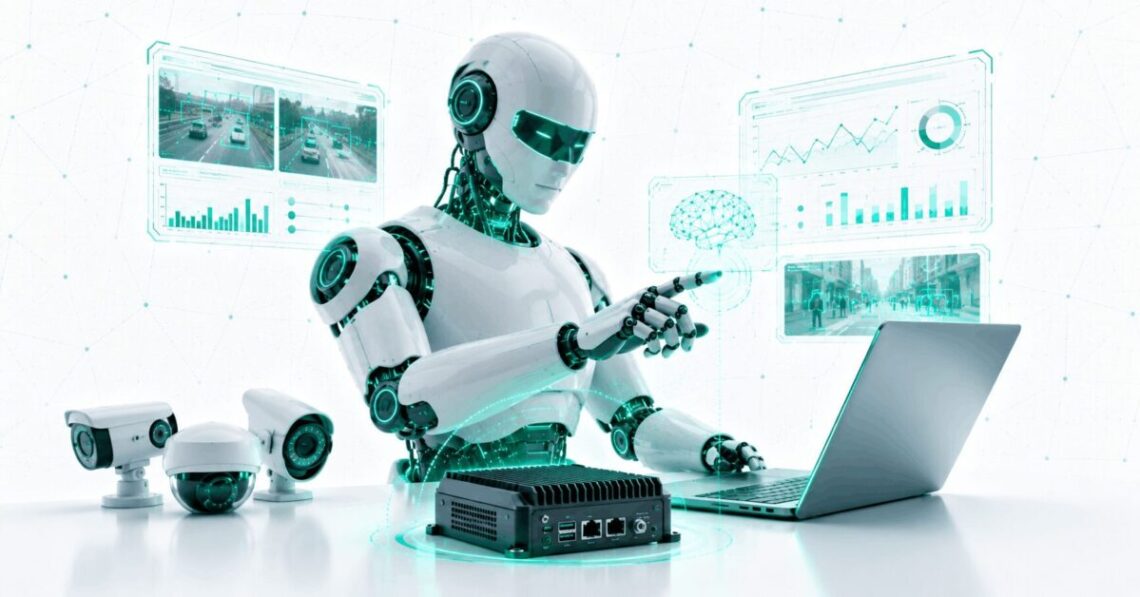
Edge AI for real-time analytics means processing sensor, video, audio, or machine data close to where it is generated, then using an AI model to detect patterns and trigger decisions without waiting for a full cloud round trip.
A factory camera might detect a defective component before it leaves the production line. A utility system might identify an abnormal voltage pattern and alert an operator. A vehicle can evaluate camera and radar data while it is moving, even when its internet connection is limited.
The main advantage is not simply that edge AI is “faster.” A well-designed system can continue operating during network interruptions, reduce the volume of raw data sent to the cloud, and keep sensitive information within a local environment.
But edge analytics also creates new responsibilities. Organizations must manage models across distributed hardware, monitor performance drift, secure physically accessible devices, and define what happens when the model or device fails.
What Is Edge AI for Real-Time Analytics?
Edge AI combines two capabilities:
- Edge computing, which processes data near its source rather than sending everything to a centralized data center.
- AI inference, which applies a trained machine learning model to new data to classify, predict, detect, or recommend an action.
The National Institute of Standards and Technology describes edge AI as a range of systems in which edge nodes can run AI functions created elsewhere or participate more directly in developing and adapting those functions. (NIST Edge AI) commercial deployments, model training still happens in the cloud or a central data center because training requires larger datasets and more computing power. The trained model is then optimized and deployed to an edge device, gateway, industrial computer, local server, smartphone, camera, or vehicle.
AWS IoT Greengrass follows this pattern. Its official documentation says organizations can train or store models in the cloud and perform inference locally on data generated by edge devices. (AWS IoT Greengrass ML inference) lytics does not mean the cloud disappears. Most production systems use a hybrid model:
- The edge handles time-sensitive processing and immediate actions.
- The cloud manages training, fleet visibility, historical analysis, dashboards, and model distribution.
- Selected events, summaries, or exceptions move between the two.
“Real-Time” Does Not Always Mean Instant
Real-time analytics should be defined by a deadline, not a marketing phrase.
A safety system on industrial equipment may need to react within milliseconds. A retail queue-monitoring system may remain useful if it updates every few seconds. Predictive maintenance might only need to identify an emerging pattern within several minutes.
The correct question is:
How quickly must the system produce a reliable decision for that decision to remain useful?
End-to-end response time includes more than model inference. It can include:
- Sensor capture.
- Data transmission to the local processor.
- Decoding and preprocessing.
- AI inference.
- Rule or policy evaluation.
- Communication with equipment or an operator.
- The physical response of the machine.
A model that produces a prediction in 10 milliseconds does not create a 10-millisecond system if camera decoding, message queues, or control equipment add another second.
This is why edge AI teams should measure complete decision latency rather than reporting only accelerator or model benchmarks.
How a Real-Time Edge Analytics Architecture Works
A practical architecture usually contains seven connected layers.
1. Data Sources
The system begins with devices that observe a physical or digital environment.
These may include:
- Video cameras.
- Microphones.
- Temperature and vibration sensors.
- Medical monitoring devices.
- Vehicle cameras and radar.
- Point-of-sale systems.
- Smart meters.
- Industrial controllers.
- Mobile devices.
The quality of these inputs sets the ceiling for the AI system. A poorly positioned camera, damaged sensor, inconsistent sampling rate, or incorrectly calibrated device can produce unreliable predictions even when the model itself performs well.
2. Local Ingestion and Normalization
The edge platform receives data from one or more devices and converts it into a consistent format.
This layer may:
- Validate messages.
- Add timestamps.
- Convert units.
- Align readings from multiple sensors.
- Remove corrupted records.
- Decode video or audio.
- Apply local privacy filters.
- Route events to the correct application.
Microsoft’s Azure IoT Operations uses edge-hosted data services, connectors, data flows, and an MQTT broker to collect, transform, contextualize, and route industrial data. (Azure IoT Operations architecture) similar event-driven patterns are useful because devices and applications can publish events to defined topics while analytics services subscribe only to the data they need. Microsoft describes this as a core pattern for processing sensor data in real time. (Azure IoT terminology) reprocessing and Feature Extraction
Raw data is often too large or noisy to send directly into a model.
The edge system may resize images, isolate audio frequencies, aggregate sensor readings, calculate moving averages, or select a short time window for analysis.
This step can have a major effect on both speed and accuracy. Reducing image resolution may improve inference speed but remove small visual details. Increasing the sensor window may make a pattern easier to detect but delay the decision.
The model and preprocessing pipeline should therefore be evaluated as one system.
4. Local AI Inference
The optimized model runs on local hardware and generates a prediction.
Depending on the application, it might:
- Classify a product as acceptable or defective.
- Detect a person entering a restricted area.
- Identify abnormal machine vibration.
- Estimate vehicle or pedestrian movement.
- Recognize a spoken command.
- Predict whether a component is beginning to fail.
Hardware may include CPUs, GPUs, neural processing units, AI accelerators, or microcontrollers.
Intel’s OpenVINO toolkit is designed to optimize and run inference across supported hardware while reducing model size and improving latency and throughput. (Intel OpenVINO) LiteRT provides an on-device runtime and optimization framework for deploying machine learning and generative AI models on edge platforms. (Google LiteRT) ecision and Action Layer
A prediction is not automatically a decision.
A policy layer determines what should happen after the model produces an output.
For example:
- A low-confidence defect prediction may be sent to a human inspector.
- A high-confidence safety violation may stop a machine.
- An unusual temperature pattern may create a maintenance ticket.
- A suspected shoplifting event may alert staff without automatically accusing a customer.
- A health-monitoring anomaly may notify a clinician rather than making an autonomous diagnosis.
This separation matters because model confidence, business risk, safety requirements, and human-review rules differ across use cases.
High-risk actions should have stricter thresholds, redundant signals, and a safe fallback state.
6. Local Storage and Cloud Synchronization
The edge system may temporarily store:
- Recent raw data.
- Model outputs.
- Alert events.
- Device logs.
- Selected images or video clips.
- Health and performance metrics.
It can then send only useful information to the cloud.
Instead of uploading every second of factory video, a system might send:
- A defect count.
- A short clip around each detected defect.
- Model confidence.
- Machine and production-line identifiers.
- A timestamp.
- An operator’s final decision.
Azure Stream Analytics on IoT Edge is designed for near-real-time local processing, including filtering, aggregation, command and control, and continued operation during limited cloud connectivity. (Azure Stream Analytics on IoT Edge) loud Control and Edge MLOps
The cloud or central platform usually manages the wider fleet.
Its responsibilities may include:
- Registering edge devices.
- Distributing model versions.
- Monitoring device health.
- Comparing model performance across locations.
- Rolling back a faulty release.
- Retraining models.
- Reviewing historical events.
- Managing security policies.
- Tracking data and prediction drift.
An edge AI project is not finished when the model is installed. Edge Impulse describes the edge AI lifecycle as data collection, cleaning, feature extraction, training, testing, deployment, and ongoing maintenance. (Edge AI lifecycle) AI vs. Cloud Analytics
Neither architecture is automatically better. The choice depends on response deadlines, data volume, model complexity, connectivity, and operational risk.
Requirement |
Edge AI is usually stronger |
Cloud analytics is usually stronger |
|---|---|---|
| Immediate local response | Yes | Network delay may be unacceptable |
| Operation without internet | Yes | Usually limited |
| Processing high-volume video locally | Often | Upload costs and bandwidth can become significant |
| Training large models | Usually no | Yes |
| Combining data from many locations | Limited local view | Yes |
| Centralized governance and updates | More difficult | Easier |
| Local handling of sensitive data | Can reduce transfers | Data must normally leave the site |
| Access to large compute capacity | Hardware-constrained | Flexible and scalable |
| Simple fleet maintenance | More complex | Fewer distributed endpoints |
| Historical analysis across years | Limited local storage | Better suited |
Many useful systems use both.
The edge makes the immediate decision. The cloud studies long-term patterns, retrains models, and coordinates the full deployment.
Readers who need a broader introduction to centralized analytics can review AI Journal Now’s guide to AI data analytics and practical business use cases. AI Real-Time Analytics Use Cases
Manufacturing Quality Inspection
Cameras placed beside a production line can inspect each item as it passes.
An edge vision model may detect:
- Missing components.
- Surface damage.
- Incorrect labels.
- Assembly problems.
- Size or alignment errors.
- Packaging defects.
Local inference allows the production system to remove or flag the item before it moves farther down the line.
The system still needs a process for uncertain results. Borderline cases may require human review, while confirmed defects can trigger an automatic rejection mechanism.
Microsoft lists real-time edge data processing, equipment effectiveness monitoring, anomaly identification, and predictive analytics among Azure IoT Operations use cases. ictive Maintenance
Sensors can monitor vibration, sound, pressure, heat, or electrical behavior.
The edge model looks for patterns that differ from normal operation. It can generate a warning before the condition becomes severe enough to trigger a traditional fixed threshold.
This approach can be useful where:
- Equipment operates in remote locations.
- Connectivity is unreliable.
- Sensor data is produced at high frequency.
- A local shutdown may be necessary.
- Uploading every raw measurement would be inefficient.
The model should support maintenance teams, not replace engineering judgment without validation. A false alarm can interrupt production, while a missed warning can damage equipment.
Video Analytics for Safety and Operations
Edge cameras can analyze video without continuously transmitting every frame to a central server.
Potential applications include:
- Restricted-zone monitoring.
- Personal protective equipment detection.
- Traffic-flow analysis.
- Queue measurement.
- Occupancy estimation.
- Warehouse movement.
- Emergency-event detection.
NVIDIA Metropolis is an edge-to-cloud platform for developing and deploying visual AI systems across manufacturing, logistics, retail, and smart infrastructure. (NVIDIA Metropolis) alytics should be designed with privacy, employee monitoring rules, data retention, false-positive handling, and human verification in mind.
Energy and Utility Monitoring
Power infrastructure generates continuous operational data.
Edge AI can help analyze:
- Voltage and frequency changes.
- Equipment temperature.
- Load patterns.
- Distribution faults.
- Abnormal consumption.
- Asset condition.
Intel identifies real-time grid monitoring, anomaly detection, load balancing, demand response, and predictive maintenance as supported edge use cases for utilities. (Intel edge computing solutions) ocessing is particularly valuable when a remote site must respond even if its connection to a central platform is interrupted.
Transportation and Autonomous Systems
Vehicles and transport infrastructure produce streams of camera, radar, location, and equipment data.
Edge AI can support:
- Driver monitoring.
- Pedestrian detection.
- Collision warnings.
- Traffic-signal optimization.
- Rail-equipment monitoring.
- Fleet diagnostics.
- Passenger counting.
These systems have strict timing and safety requirements. The acceptable latency, accuracy threshold, backup behavior, and regulatory obligations must be established before selecting hardware or a model.
Remote and Clinical Monitoring
Edge devices can analyze signals from wearable or clinical equipment and alert a caregiver when a predefined pattern appears.
Possible signals include:
- Heart rate.
- Movement.
- Oxygen saturation.
- Temperature.
- Device operation.
- Fall indicators.
Processing data locally may reduce the amount of sensitive raw information transmitted. But local processing alone does not prove that a system is private, secure, clinically accurate, or approved for diagnosis.
Medical applications require appropriate validation, security, human oversight, and regulatory review for the intended use.
Benefits of Edge AI Analytics
Lower Decision Latency
Local inference removes much of the delay caused by sending data to a distant service and waiting for a response.
The actual improvement depends on the local hardware, workload, network, preprocessing pipeline, and action mechanism.
Continued Operation During Network Problems
A properly designed edge system can continue evaluating local data when its cloud connection is unavailable.
AWS says Greengrass devices can collect and analyze local data, react autonomously to events, communicate with nearby devices, and synchronize with AWS services when needed. (AWS IoT Greengrass overview) ced Data Transfer
Video, audio, and high-frequency sensor feeds can create large data volumes.
Filtering and analyzing data locally allows the system to send alerts, summaries, or selected evidence rather than every raw input.
This can reduce network usage, cloud ingestion, and storage requirements. It does not guarantee lower total cost because edge hardware, maintenance, and fleet management create their own expenses.
Better Data Minimization
Keeping raw data on-site can reduce unnecessary transfers of personal, operational, or proprietary information.
The organization must still protect:
- The edge device.
- Local storage.
- Logs.
- Model outputs.
- Network connections.
- Cloud synchronization.
- Administrative access.
Edge processing can support privacy, but it does not create privacy automatically.
Faster Automated Workflows
The system can connect a local prediction directly to a local action.
For example:
Sensor reading → anomaly model → risk policy → machine slowdown → operator alert
This makes edge analytics closely related to AI automation. The model detects the condition, while the workflow decides what action is permitted.
The Main Limitations
Edge Hardware Has Resource Limits
Local devices have finite processing power, memory, storage, cooling, and energy.
A model that works well on a cloud GPU may be too large or inefficient for an industrial gateway or battery-powered device.
Optimization methods can reduce the model’s footprint, but teams must verify that compression or quantization does not reduce accuracy below an acceptable level.
Distributed Devices Are Harder to Manage
A cloud model may run in a controlled data center. An edge model may run across hundreds of factories, stores, vehicles, or remote sites.
These devices may have different
- Hardware versions.
- Operating systems.
- sensor configurations.
- Network conditions.
- Model releases.
- Maintenance schedules.
Deployment inventory and version tracking are essential.
Model Drift Can Be Hard to Detect
Real-world inputs change.
A factory might install different lighting. A camera may move. A sensor may be replaced. Seasonal temperatures can change normal operating patterns. A new product design may look different from the model’s training examples.
Microsoft identifies data drift, prediction drift, data quality, and model performance as important production-monitoring signals. (Azure Machine Learning model monitoring) loyments need a plan for collecting representative feedback without transferring more data than necessary.
Physical Access Creates Security Risk
Edge devices may be installed in stores, factories, vehicles, outdoor cabinets, or customer locations.
Attackers or unauthorized employees may be able to access hardware directly. The system should use controlled administrative access, encrypted communication, signed software or model updates, device identity, and safe rollback procedures.
A Fast Wrong Decision Is Still Wrong
Low latency has little value if the model is unreliable.
Teams must test:
- False-positive rates.
- False-negative rates.
- Performance across locations.
- Performance under poor lighting or noise.
- Sensor failures.
- Rare events.
- Adversarial or unusual inputs.
- The consequences of an incorrect action.
Automated shutdowns, safety alerts, identity decisions, and medical notifications need different risk thresholds.
A Deadline-First Deployment Framework
Many edge projects begin by choosing hardware. A stronger process begins with the decision that must be made.
Define the Operational Deadline
State the maximum acceptable time from data capture to action.
Do not define “real time” as “as fast as possible.”
Use a measurable requirement such as:
- 100 milliseconds for an emergency stop signal.
- Two seconds for a worker-safety alert.
- 15 seconds for a retail queue update.
- Five minutes for a maintenance warning.
Define the Cost of Each Error
Document what happens when the system:
- Misses a real event.
- Flags a normal event.
- Produces no result.
- Loses connectivity.
- Uses an outdated model.
- Sends an action to the wrong device.
This determines confidence thresholds and human-review rules.
Decide Which Data Must Remain Local
Separate data into:
- Data needed only for immediate inference.
- Evidence needed for audits.
- Data needed for retraining.
- Aggregated operational metrics.
- Data that must never leave the site.
- Data that can be deleted after processing.
Select the Edge-to-Cloud Split
Run functions at the edge when they require fast response, offline operation, or local data handling.
Keep functions in the cloud when they need:
- Large-scale training.
- Long historical context.
- Cross-location comparison.
- Heavy compute.
- Central reporting.
- Organization-wide model management.
Build a Safe Fallback
Define what the system does when:
- The model crashes.
- The sensor fails.
- Confidence is too low.
- The device overheats.
- The connection is lost.
- A model update fails.
The safest fallback may be human review, a fixed control rule, reduced operating speed, or a controlled stop.
How to Measure an Edge Analytics System
Do not evaluate the deployment with model accuracy alone.
| Metric | What it reveals |
|---|---|
| End-to-end latency | Time from data capture to completed decision or action |
| P95 and P99 latency | Whether occasional slow responses miss the deadline |
| Deadline-miss rate | Percentage of events completed too late |
| False-positive rate | Frequency of unnecessary alerts or actions |
| False-negative rate | Frequency of missed real events |
| Uptime during disconnection | Whether local operation remains dependable |
| Data sent to cloud | Bandwidth and data-minimization effect |
| Device resource use | CPU, accelerator, memory, storage, power, and temperature impact |
| Model drift indicators | Whether production inputs are changing |
| Human override rate | How often operators reject the model’s recommendation |
| Business outcome | Defect escapes, downtime, response time, waste, safety events, or another relevant result |
Compare these metrics with a baseline process.
A faster prediction is not a successful deployment unless it improves the actual operational outcome.
When Edge AI Is the Wrong Choice
Cloud or centralized analytics may be better when:
- Decisions do not have strict time limits.
- Connectivity is reliable.
- Raw data volume is manageable.
- The model is too large for local hardware.
- The analysis requires data from many sites.
- The organization cannot maintain a distributed device fleet.
- Batch reports are sufficient.
- Local processing does not materially improve privacy.
- The cost of edge hardware exceeds the value of faster decisions.
Some teams adopt edge AI because it sounds advanced, then discover that a cloud endpoint responding within one or two seconds already meets the business requirement.
The architecture should follow the decision deadline and operating conditions, not the trend.
AI Journal Now’s Edge AI news and deployment coverage tracks current hardware, software, and industry developments for readers following the wider market. ently Asked Questions
How does edge AI support real-time analytics?
It runs an AI model on or near the device producing the data. This removes much of the network round trip and allows the system to classify events, detect anomalies, or trigger actions locally.
Is edge AI always faster than cloud AI?
Not always.
A weak local device running a large model may be slower than a nearby cloud service. Performance depends on hardware, model size, network conditions, preprocessing, and the complete decision pipeline.
Does edge AI work without internet access?
It can, provided the application, model, required data, and control logic are available locally.
Cloud dashboards, model updates, centralized logs, or cross-site analysis may remain unavailable until the connection returns.
Is edge AI more private than cloud analytics?
It can reduce the transfer of raw data, which may support privacy and data minimization.
Privacy still depends on local storage, retention rules, device security, access controls, model providers, logs, and any information later sent to the cloud.
What industries benefit most from real-time edge analytics?
The strongest use cases appear where decisions are time-sensitive, data volumes are high, connectivity is uncertain, or information should remain local.
Common examples include manufacturing, utilities, transportation, logistics, retail operations, smart infrastructure, and selected healthcare systems.
Final Takeaway
Edge AI for real-time analytics is most valuable when a decision must happen near the source of the data.
It can reduce response time, maintain local operation during connectivity problems, and prevent large volumes of raw sensor or video data from being transferred unnecessarily.
The stronger architecture is usually hybrid. Edge devices handle immediate inference and approved local actions. Central systems manage training, historical analytics, model distribution, fleet health, and governance.
Start by defining the operational deadline, error cost, fallback behavior, and measurable business outcome. Then select the model, hardware, and cloud platform that can meet those requirements.
Without that discipline, edge AI may produce fast predictions without producing dependable decisions.