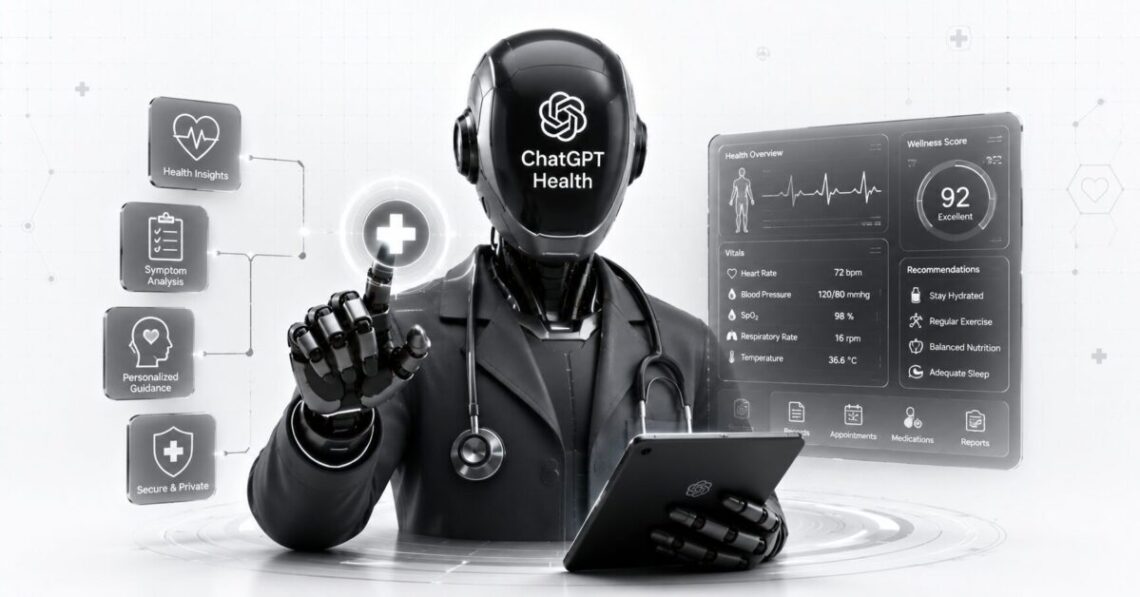
ChatGPT Health, officially called Health in ChatGPT, is a consumer health feature that lets eligible users connect medical records and Apple Health data to ChatGPT.
With permission, ChatGPT can use information such as medications, lab results, previous visits, activity, sleep, and workouts to provide more personalized explanations and help users prepare for conversations with healthcare professionals.
OpenAI began testing a separate ChatGPT Health experience in January 2026. On July 23, it started a wider U.S. rollout that allows connected health information to be used across ordinary ChatGPT conversations rather than only inside a dedicated health space. The Health tab remains the main place for connecting accounts, reviewing records, and managing permissions. (OpenAI)
ChatGPT Health is designed to support people in understanding and organizing health information. It is not intended to diagnose conditions, prescribe treatments, or replace medical care. OpenAI explicitly advises users to verify important information and discuss medical decisions with qualified professionals. (OpenAI Help Center)
ChatGPT Health Availability
Health is currently rolling out gradually to logged-in ChatGPT users who meet all of the following requirements:
| Requirement | Current Availability |
|---|---|
| Country | United States |
| Minimum age | 18 |
| Plans | Free, Go, Plus, and Pro |
| Platforms | Web and iOS |
| Apple Health connection | Requires an iPhone |
| Android support | Not currently listed |
| Voice mode | Connected Health data is not supported |
| Codex | Not supported |
| Rollout status | Gradual, so eligible users may not see it immediately |
OpenAI says the feature may take several weeks to reach every eligible account. On iOS, the official help documentation currently requires ChatGPT version 1.2026.188 or later. (OpenAI Help Center)
There is no separate ChatGPT Health subscription. Free and paid individual plans receive access, subject to rollout availability and the normal limits of each plan. OpenAI says GPT-5.5 Instant powers improved health responses for free users, while paid users can access GPT-5.6 Sol, which the company describes as its strongest model for complex health questions. (OpenAI)
What Can You Connect to ChatGPT Health?
ChatGPT Health currently supports several types of data sources.
Apple Health
Users with an iPhone can allow ChatGPT to read selected Apple Health categories.
The available information may include:
- Activity and workouts
- Heart-rate information
- Sleep data
- Body measurements
- Mobility information
- Other health categories the user approves
The user selects which Apple Health categories ChatGPT can access. ChatGPT cannot write information back to Apple Health. (OpenAI Help Center)
Supported Medical Records
Users can connect supported U.S. healthcare provider portals and import information such as:
- Medical conditions
- Medications
- Lab and test results
- Previous visits
- Procedures
- Clinical records made available by the provider
Not every hospital or provider portal is available. Users can search for their provider during setup and request support for a missing organization without including medical information in the support request. (OpenAI Help Center)
One Medical and Function Health
OpenAI currently lists One Medical and Function Health as supported direct sources.
The exact information available depends on the connected account and the data that the provider makes accessible. (OpenAI)
Wearables and Fitness Apps
ChatGPT does not necessarily connect directly to every wearable.
Apps such as Whoop, Oura, Garmin, Strava, and MyFitnessPal may share selected information through Apple Health. Once Apple Health is connected, ChatGPT can use the information those apps make available, subject to the user’s permissions.
Some proprietary measurements may not transfer. An Oura sleep score, for example, may be calculated differently from the underlying sleep information Apple Health shares. (OpenAI Help Center)
How ChatGPT Health Works
The setup process is relatively straightforward:
- Open Health from the ChatGPT sidebar or More menu.
- Select Get started or Connect Health.
- Choose Apple Health, Medical Records, One Medical, Function Health, or another available source.
- Complete the provider’s sign-in and consent process.
- Choose which information ChatGPT may access.
- Wait for the data to sync.
- Review current medications, conditions, and family history.
- Ask questions anywhere in ChatGPT.
Large health histories may take longer to sync. Users can connect more than one account and remove an account later from the Health tab. (OpenAI Help Center)
By default, ChatGPT asks before using connected health information in a conversation. The user can approve access once or select an option that allows future access without repeated prompts.
Adding @Health to a message explicitly tells ChatGPT to consider connected health information when answering. (OpenAI Help Center)
What Can ChatGPT Health Help With?
ChatGPT Health is most useful when the user already has information but needs help understanding, organizing, or discussing it.
Explain Lab Results in Plain Language
A user can ask ChatGPT to explain unfamiliar terms, summarize what a measurement generally represents, or compare a new result with previous tests.
A useful request might be:
Compare my latest cholesterol results with my previous tests. Explain what changed, what each measurement means, and which questions I should ask my doctor.
The response should be treated as an educational summary, not an independent diagnosis.
Prepare for an Appointment
ChatGPT can organize symptoms, medication changes, test results, and questions into a shorter summary.
This can help a patient arrive with a clearer timeline rather than trying to remember every detail during a short appointment.
Review Changes Over Time
Connected records can make it easier to ask questions such as:
- Which lab values changed most during the last year?
- When was this medication first added to my record?
- What has changed since my previous visit?
- How has my activity varied since an injury?
- Are there gaps in the information I should confirm with my provider?
The answers depend on the completeness and accuracy of the connected data.
Understand Visit Notes
Clinical notes often contain abbreviations and unfamiliar language. ChatGPT can restate a note in simpler terms and produce a list of questions for a follow-up appointment.
It should not be trusted to infer a diagnosis that the clinician did not document.
Explore Sleep, Activity, and Exercise Patterns
Apple Health data may help ChatGPT compare activity, sleep, and workout patterns.
For example, a user could ask it to summarize whether their weekly activity has changed or help design questions for a trainer or physician after an injury.
The feature is not a substitute for professional exercise guidance when a person has a medical condition, unexplained symptoms, or recovery restrictions.
Account for Allergies and Dietary Restrictions
With permission, ChatGPT may consider known allergies or dietary restrictions while helping with meals or restaurant choices.
OpenAI says early users frequently raised health questions outside the dedicated Health space. More than 70% of health-related conversations among early testers occurred elsewhere in ChatGPT, which influenced the decision to make connected context available across conversations. (OpenAI)
What ChatGPT Health Cannot Do
The feature has meaningful limits.
It Cannot Diagnose or Treat You
OpenAI states that Health is not intended for diagnosis or treatment.
ChatGPT may explain possibilities or identify information that deserves professional attention, but it cannot perform a physical examination, order a test, confirm a disease, or make a clinical decision. (OpenAI Help Center)
This is the same distinction that matters with consumer tools such as an AI dermatologist. An AI-generated explanation may help someone decide what to ask next, but it should not become the final medical answer.
It Cannot Update Your Medical Records
ChatGPT Health has read-only access to connected medical records and Apple Health data.
Correcting a medication inside the Health interface may improve ChatGPT’s understanding of the user’s current situation, but it does not change the official record stored by the healthcare provider. (OpenAI Help Center)
It May Receive Incomplete or Outdated Information
A connected record might still show a discontinued medication or omit care received from another provider.
OpenAI advises users to review their conditions and medications after connecting an account. Important details should be checked against the original provider portal, test report, medication label, or clinician’s instructions. (OpenAI)
It Can Still Make Mistakes
OpenAI reports improvements in health reasoning and says its models have been evaluated with physician-written criteria. HealthBench contains realistic, multi-turn health scenarios that assess accuracy, safety, communication, context awareness, completeness, and appropriate escalation. (OpenAI)
These evaluations do not guarantee that every personal answer is correct.
A model may misunderstand a timeline, overlook missing information, confuse similar medical terms, or give an explanation that sounds more certain than the underlying evidence supports.
It Is Not an Emergency Service
Urgent symptoms should not be handled by waiting for a chatbot response.
OpenAI’s help documentation instructs users to seek immediate professional help for urgent symptoms or emergencies. (OpenAI Help Center)
ChatGPT Health Privacy: What Happens to Your Data?
Health information is unusually sensitive, so the privacy design deserves close attention.
Is Health Data Used to Train OpenAI’s Models?
OpenAI says connected medical records, Apple Health information, and conversations that use connected Health data are not used to train its foundation models or target advertisements.
This rule applies regardless of the user’s normal ChatGPT model-training setting. Conversations that do not use connected Health information continue to follow the user’s standard Data Controls settings. (OpenAI Help Center)
The Health Privacy Notice also says a limited number of authorized OpenAI personnel and trusted service providers may access Health data for safety-related purposes, unless the user has opted out of the applicable access setting. (OpenAI)
Does OpenAI Sell ChatGPT Health Data?
OpenAI’s Health Privacy Notice states that it does not sell users’ personal data, including information collected through Health features. (OpenAI)
The notice says information may be processed by service providers supporting functions such as hosting, cloud infrastructure, customer service, security, and safety monitoring. It may also be disclosed when legally required or when needed to protect users, OpenAI, or the public. (OpenAI)
Is the Data Encrypted?
OpenAI says ChatGPT conversations are encrypted at rest and in transit, while information connected through Health receives additional encryption protections. (OpenAI Help Center)
Encryption reduces the risk of unauthorized access, but it does not remove every privacy risk associated with placing medical information in a cloud service.
Users should still connect only the accounts and categories needed for their intended use.
What Happens When You Disconnect an Account?
When a user disconnects Apple Health or a medical-record account, OpenAI says the synced data from that source is deleted from its systems within 30 days.
Information already included in a ChatGPT conversation remains in the conversation history until the user deletes that chat. (OpenAI Help Center)
This distinction matters.
Disconnecting the original source does not automatically erase a lab result or medication detail that was quoted in an earlier conversation.
Can Health Conversations Create Memories?
Yes.
When ChatGPT memory is enabled, information discussed in a Health conversation may become a memory and influence future chats. OpenAI says memories are not created directly from synced medical records or Apple Health information.
Users can turn memory off, delete memories, or use Temporary Chat. Someone who wants stronger separation can create a separate ChatGPT project with project-specific memory for health discussions. (OpenAI Help Center)
Is ChatGPT Health HIPAA Compliant?
Consumer ChatGPT Health is not intended for clinical or covered-entity use, and OpenAI does not offer a Business Associate Agreement for this feature.
Doctors, hospitals, insurers, and other HIPAA-covered organizations should not assume that the consumer Health feature is an approved environment for protected health information. (OpenAI Help Center)
It separately offers ChatGPT for Healthcare, an enterprise product that can include a Business Associate Agreement, access controls, audit logs, customer-managed encryption keys, data residency options, and controls designed to support HIPAA-compliant use. (OpenAI)
This is also different from tools such as Freed AI, which are built around clinician workflows such as medical documentation.
| Product | Intended User | Main Purpose | HIPAA-Oriented Clinical Use |
|---|---|---|---|
| Health in ChatGPT | Individual consumers | Understand and organize personal health information | No BAA |
| ChatGPT for Healthcare | Healthcare organizations | Clinical, research, and administrative workflows | Designed to support HIPAA compliance |
| ChatGPT for Clinicians | Verified healthcare professionals | Clinical evidence and professional tasks | Separate professional offering |
The similar names make this distinction easy to miss.
A Safer Way to Use ChatGPT Health
The feature is most useful when it helps the user communicate better with a professional rather than encouraging independent medical decisions.
A responsible workflow looks like this:
- Check the source data. Confirm that medications, conditions, and test dates are current.
- Ask for explanation, not diagnosis. Request plain-language summaries and questions for a professional.
- Separate facts from possibilities. Ask ChatGPT to identify which points come directly from the record and which are general interpretation.
- Request uncertainty. Ask what information is missing or could change the explanation.
- Verify critical details. Compare medication doses, test values, and clinician instructions with the original record.
- Do not delay urgent care. Use emergency and professional services when symptoms require them.
- Review privacy settings. Decide whether ChatGPT should ask every time before using Health data.
- Delete sensitive chats when appropriate. Disconnecting an account does not remove information already copied into conversations.
- Avoid using someone else’s records in your account. OpenAI says the connected experience is intended for the account holder’s own information. (OpenAI Help Center)
ChatGPT Health Strengths
- Available across Free, Go, Plus, and Pro plans
- Can combine information from several supported sources
- Helps organize scattered medical information
- Can compare results and records over time
- Produces plain-language explanations
- Helps users prepare questions for appointments
- Asks permission before using connected data by default
- Does not use connected Health data to train foundation models
- Allows connected accounts to be removed
- Cannot write changes back to medical records
- Keeps the user in control of account connections and data categories
ChatGPT Health Limitations
- Currently limited to eligible adults in the United States
- Web and iOS are the only supported platforms listed
- Apple Health requires an iPhone
- Provider availability varies
- Connected records may be incomplete or outdated
- Voice mode cannot currently use connected Health data
- Codex does not support Health
- ChatGPT can still produce incorrect explanations
- The consumer feature does not offer a HIPAA Business Associate Agreement
- Disconnecting a source does not automatically delete details already placed in chat history
- Wearable-specific scores may not transfer through Apple Health
- It cannot diagnose, treat, prescribe, or replace a clinician
Confirmed Facts About the July 2026 Launch
The following points are confirmed in OpenAI’s current launch announcement and help documentation:
- The wider U.S. rollout began on July 23, 2026.
- Eligible users must be 18 or older.
- Health is available on Free, Go, Plus, and Pro plans.
- The supported platforms are currently web and iOS.
- Users can connect Apple Health, supported U.S. medical records, One Medical, and Function Health.
- Connected Health data can be used across ChatGPT conversations with permission.
- Health data is not used to train foundation models or target ads.
- ChatGPT asks for permission before using connected data by default.
- ChatGPT cannot write back to Apple Health or provider records.
- The feature is not intended for diagnosis or treatment.
- It is not intended for HIPAA-covered clinical use.
- Voice mode and Codex do not currently support connected Health data. (OpenAI)
What Remains Unclear
OpenAI has not yet publicly confirmed:
- When Health will launch outside the United States
- When Android support will arrive
- Whether Voice mode will gain Health access
- How quickly additional provider portals will be added
- Whether every plan receives identical sync and usage limits
- Whether future paid plans will receive additional Health-specific features
- How model behavior will differ across large, complex medical histories
- How often connected records refresh
- Whether additional direct wearable integrations will be offered
- When the legacy isolated ChatGPT Health project will be fully retired
These details may change as the rollout expands.
Final Takeaway
ChatGPT Health turns ChatGPT from a general health-information assistant into a tool that can reason over information the user chooses to connect.
Its most practical value is not automatic diagnosis. It is reducing the work involved in gathering records, reviewing changes, translating medical language, and preparing better questions for healthcare professionals.
The privacy design includes meaningful protections. Connected medical records and Apple Health data are not used to train OpenAI’s foundation models or target advertisements, access requires user permission, and connected sources can be removed. Users still need to understand that information copied into chat history remains until those conversations are deleted.
The largest limitation is also the most important one: ChatGPT can make mistakes. A personalized answer may feel more authoritative because it refers to real lab results or medications, but personalization does not turn the model into a doctor.
ChatGPT Health is best used as an organizer, explainer, and appointment-preparation tool. It should not become the final decision-maker for diagnosis, medication, treatment, or urgent care.