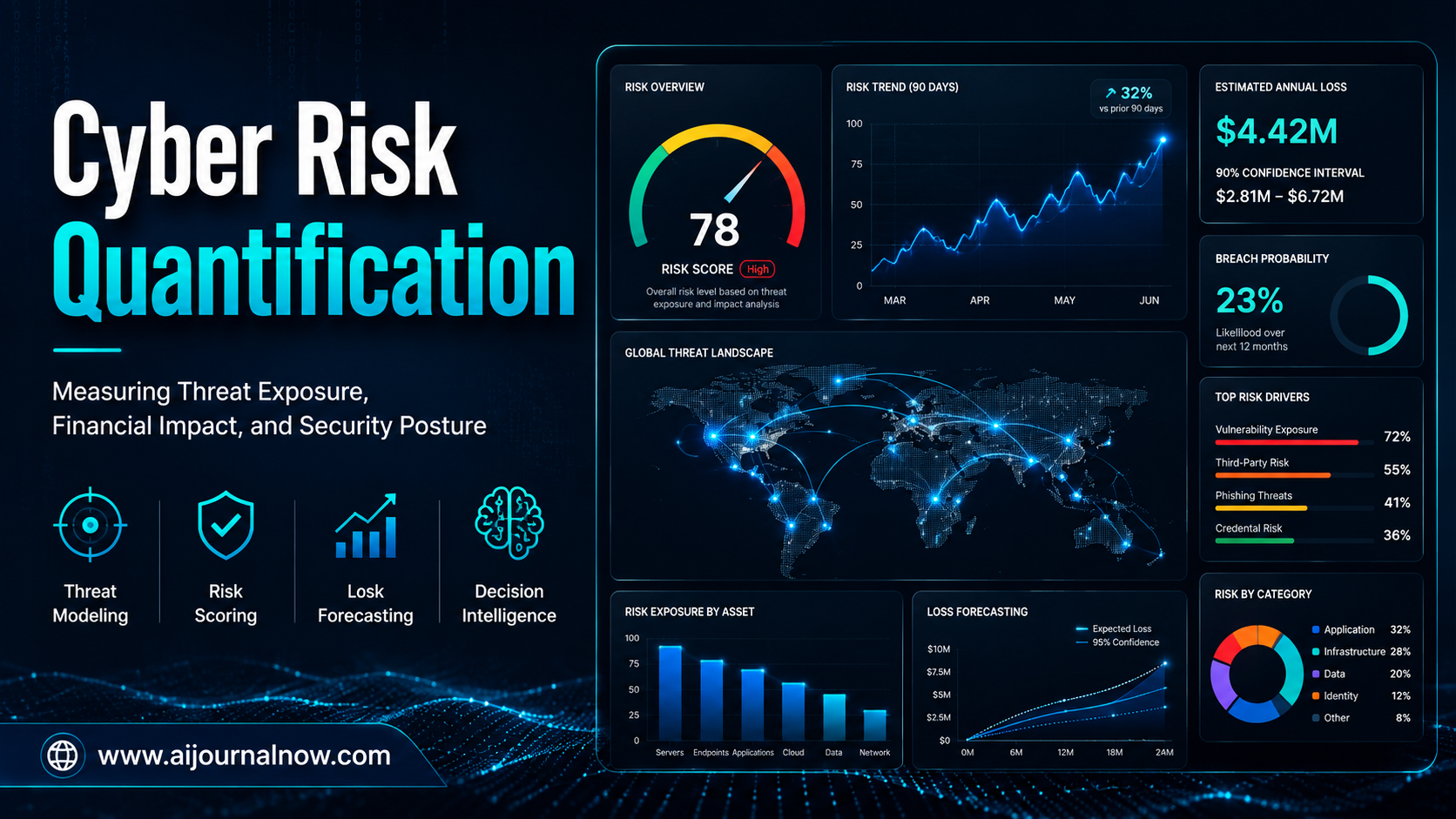
Most security teams will inform you they have dangers. Fewer can tell you precisely what those risks are worth in dollars; That gap – between “we have a problem” and “here’s what it could cost us” – is precisely what cyber risk quantification is meant to bridge.
If you’ve been to a board meeting where cybersecurity was discussed in nebulous words like “medium risk” or looked at a red-yellow-green heatmap that was really no assistance in making a decision, you already understand the problem. There are cyber risk quantification tools and systems that can replace that guesswork with solid numbers.
Let’s cut through the hype of how this really works — and what tools are assisting companies to do so in 2026.
What is Cyber Risk Quantification?
Cyber risk quantification (CRQ) is the technique of expressing cybersecurity concerns in financial terms. CRQ doesn’t claim a vulnerability is “high risk” – it warns you that if you don’t fix it, it may cost your organization $4.2 million if exploited. That’s a whole new conversation.
It’s like vehicle insurance. Your insurance doesn’t merely say your car is “risky to drive.” They analyse the odds of an accident, how much repairs will probably run, and your specific risk factors, and then they issue you a premium. CRQ uses the same approach for your digital assets.
“Corporate boards and leadership teams are being increasingly held liable for cybersecurity breaches, data losses and compliance violations. This has turned cybersecurity into a strategic business matter like it never has been before. CRQ provides security teams with the language to get into those strategic conversations in language CEOs actually respond to.
The Main Models Used to Cyber Risk Quantification
Before diving into platforms, it’s good to understand the underlying models they use. There are some that keep coming back.
The FAIR Model
FAIR is Factor Analysis of Information Risk. It’s the most widely used benchmark for measuring cyber risk in financial terms. FAIR helps to quantify and monetise cyber risks in monetary terms. It estimates loss event frequency, loss size, threat event frequency, susceptibility, primary and secondary losses and annual loss exposure.
FAIR takes a risk and breaks it down into parts, assigns likelihoods to each part, and then calculates a financial estimate for what a specific danger scenario would cost you in a year.
Monte-Carlo simulation
This is a technique from statistics and finance. Instead of giving you one “best guess” number, Monte Carlo conducts thousands of simulated scenarios to show you a range of potential outcomes. The probability of a threat is determined statistically by model-based simulations ( e.g., Monte Carlo ) . This is often done for a given time period ( business quarter , calendar year , etc . ) .
It’s not just “this breach could cost $3M.” It’s “there’s a 10% chance this breach will cost more than $8M, and a 50% chance it will cost more than $2M.” That sort of distribution is significantly more beneficial for decision making than a single number.
Annualised Loss Expectancy (ALE)
ALE is a simpler computation . It takes the likelihood of a threat and multiplies it by the projected financial damage . It’s not as elegant as Monte Carlo, but it’s a good starting point for organisations new to quantification.
Why Cyber Risk Quantification Platforms Matter
FAIR computations can be performed manually in a spreadsheet – but it’s painful, error-prone and difficult to defend in front of an auditor. Dedicated platforms for cyber risk quantification models can be of help here.
These platforms do several things at once: they ingest data from your existing security tools, apply quantification models automatically, and produce outputs that executives can actually read and act on. CRQ-enabled technologies populate risk registers with modelled loss projections, scenario-specific probability and control effectiveness assessments using external market intelligence – assessing risk accurately and quickly.
The other major benefit? Before you spend a dollar, a quantification platform can estimate that when your CFO asks, “What’s the ROI of this new security tool?”
A Look at the Best Platforms in 2026
RiskLens is the leading FAIR based cyber risk quantification technology that helps organisations quantify cyber risks in financial terms such as Annualised Loss Expectancy. It provides the ability to develop extensive risk models, Monte Carlo simulations, and to roll up risks at portfolio, program, or enterprise levels to make prioritised decisions. It is commonly considered the gold standard for FAIR quantification.
Best for organisations that demand rigorous methodological rigour and board-ready reporting.
Kovrr
Kovrr’s platform enables CISOs, GRC and finance professionals to transform complicated cybersecurity and AI-related data into financially quantifiable insights to make wiser decisions about budgeting, insurance, regulatory compliance and strategic investment. Its Decision Simulator feature — allowing you to model the effect of control changes before committing funds — is a very strong feature.## Safe Security (SAFE)
SAFE is AI-driven, constantly measuring cyber risk and updating estimations as your environment evolves. It is especially known for quickly translating technical weaknesses into financial terms so it’s a great alternative for organisations that require real-time risk visibility.
Axios
Axio is focused on helping organisations model ransomware and other specific threat scenarios financially. It’s a realistic tool for security teams looking to simulate “what-if” scenarios – what would a ransomware attack cost us if we have these safeguards in place vs if we don’t?BitSight Technologies
Bitsight combines external attack surface management, cyber threat information and third party risk management into one proven data model. Its quantification engine turns security ratings into projected financial loss, making it particularly valuable for organisations with many vendor ties.
The Benefits Of Cyber Risk Quantification
There is a compelling justification for models and platforms to quantify cyber risk. You get improved budget rationale, better board communication, more defensible security decisions and a means to assess your exposure against industry peers.
But it is also important being pragmatic.
These platforms need appropriate input data. Garbage in, garbage out applies here as anywhere. If you don’t have an up-to-date inventory of your assets or your threat intelligence is old, your financial models will reflect that.
CRQ implementation involves effective collaboration and coordination between enterprise cybersecurity teams and corporate business leaders, with clear expectations, regular touchpoints and well-defined protocols. It’s not a plug-and-play solution — there’s organisational work required to make it meaningful.
And it costs. Enterprise-grade platforms can run to hundreds of thousands of dollars each year, outside the reach of smaller organisations without dedicated security budgets.
Who Should Care?
If you’re a CISO attempting to sell your budget to a CFO who talks ROI, CRQ gives you that common language. For board members wondering if their organization has “enough” cybersecurity, quantification provides a standard. As a risk manager making choices on cyber insurance, your underwriters will want to see financial loss modelling.
For mid-sized firms entering this field for the first time, the approach of starting with the FAIR methodology and a lighter platform like as Axio before advancing to full-blown enterprise tools such as RiskLens or SAFE is a good approach.
Summary
The move away from “high, medium, low” risk classifications to actual dollar amounts isn’t simply a trend – it’s becoming the expectation from boards, regulators and insurers alike. It’s the infrastructure that makes that change possible: cyber risk quantification methods and platforms.
The technology is so much better.” The models are time and proven. Today, the question for most organisations is not whether they should use quantification, but which platform is right for their size, maturity, and budget. It’s a decision that most teams are not prepared to spend enough time to get correctly.
Frequently Asked Questions
Q1: How does cyber risk quantification vary from traditional risk assessment?
Conventional risk assessments rank risks as high, medium or low, relying heavily on expert judgement. Statistical techniques and financial modelling are applied in cyber risk quantification models to convert risk scenarios into tangible dollar values. That makes it more specific, more defensible and much more valuable when you’re having budget conversations with non-technical leadership.
Q2: Do I need a big enterprise budget to work with CRQ platforms?
Not necessarily . RiskLens and Safe Security are enterprise-scale platforms but there are lighter-weight choices. Some organisations piloted the open FAIR architecture manually before committing to a dedicated platform. The methodology itself is free. The expense is the tooling and the analyst time to run it successfully.
Q3: What is the function of Monte Carlo simulation in cyber risk?
Monte Carlo simulation performs thousands of randomised scenarios depending on your input variables—threat frequency, vulnerability levels, predicted loss values—and spits back a probability distribution of outcomes. You get the whole spectrum of costs, from best case to worst case and everything in between, not just a single estimate. This is far more beneficial for planning than a single point estimate.
Q4: Will these systems connect with the tools my security team already uses?
Most major platforms are built to consume data from standard security sources such as vulnerability scanners, cloud security posture management tools, threat intelligence feeds, and GRC systems. The level of integration varies from vendor to vendor, therefore it is worth checking to see if they are compatible with your existing stack before you commit to a platform.
Q5: Is FAIR the sole cyber risk quantification model?
The most common standard used is FAIR, however it is not the only one. MetricStream also supports ISO 27005, NIST SP 800-53, CMU OCTAVE and COBIT 5. Many corporate platforms include both Monte Carlo simulation and FAIR together which tends to generate the most defensible and nuanced output.