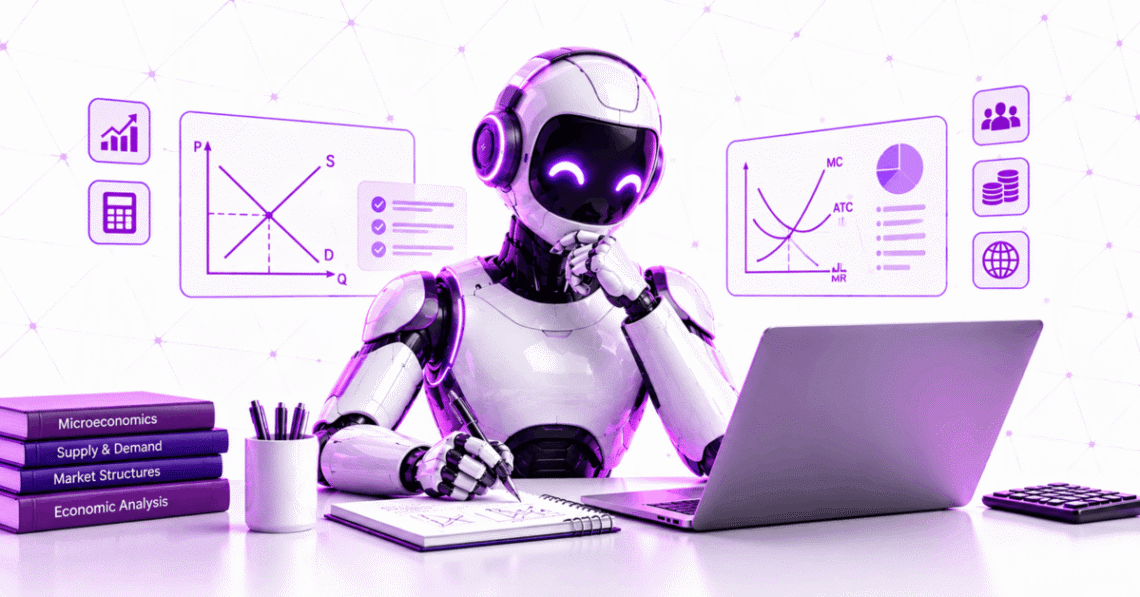
For Best AI to Solve Microeconomics Problems, a frontier reasoning model like GPT-5.3 or Claude will get you a correct answer and a usable explanation, and on standardised economics testing GPT-5.3 has been reported at around the 91st percentile on the microeconomics Test of Understanding in College Economics and the 99th on macro. For anything involving symbolic derivation, elasticity algebra, or a graph you need to be exactly right, Wolfram Alpha beats all of them. That is the short version, and if you are mid-problem set it is probably what you came for.
The longer version matters more, because there is now peer-reviewed evidence that using these tools the obvious way makes you worse at the subject.
The study you should read before your next problem set
Bastani and colleagues published work in PNAS in 2025 titled “Generative AI without guardrails can harm learning: Evidence from high school mathematics.” The design was a field experiment with students who had AI tutor access during practice, then took exams without it.
Students with unrestricted access to a standard chatbot performed substantially better during practice and then worse on the unaided exam than students who had no AI at all. The version with pedagogical guardrails, a tutor configured to withhold final answers and prompt the student through steps, did not produce that damage.
The mechanism is not mysterious. If the model produces a worked solution, you read it, it makes sense, and you feel you understand it. That feeling of comprehension is not the same cognitive event as generating the solution yourself, and only one of them transfers to an exam.
The finding was in mathematics, not economics specifically, but microeconomics problem sets are mathematics with a story attached. I would not assume you are exempt.
Which tool for which problem
Models differ more than people expect, and a peer-reviewed comparison of four chatbots on economics questions found that the performance gap between them widens as problem complexity increases. On simple questions they converge. On multi-step problems they diverge sharply.
| Problem type | Best option | Why |
|---|---|---|
| Conceptual explanation (why does a price ceiling cause shortage) | Claude or ChatGPT | Natural language explanation is the core strength; both are reliable here |
| Elasticity calculation, marginal analysis, algebraic solving | Wolfram Alpha | Symbolic computation rather than prediction, so the arithmetic is not a guess |
| Graph construction and shifting | Wolfram Alpha, then verify by hand | Chatbots describe graphs accurately and draw them badly |
| Multi-step derivation (deriving a demand curve from utility maximisation) | Frontier reasoning model, checked line by line | They usually get there, and they sometimes skip a step silently |
| Game theory payoff matrices | ChatGPT or Claude | Discrete and well-represented in training data |
| Course-specific problems with your professor’s notation | Publisher tutor bundled with your textbook | It knows the notation your grader expects |
The pattern across all of it: chatbots are strong at explanation and weak at guaranteed arithmetic. Wolfram is the reverse. Using both, and treating disagreement between them as a signal to slow down, is more effective than picking a favourite.
Where they specifically fail
Three failure modes show up repeatedly in microeconomics work.
Silent step-skipping in derivations. Ask for a Marshallian demand function from a Cobb-Douglas utility function and the model will often produce the right final answer with one algebraic step compressed or omitted. If you are learning, the omitted step is usually the one you needed. If you are submitting, a grader marking for method will take points.
Graph reasoning. Models handle “what happens to equilibrium if supply shifts left” fine in words. They are noticeably less reliable when a question depends on the relative magnitude of two shifts, or on where exactly two curves intersect. This is a known weak area and it overlaps heavily with exam questions.
Sign errors in comparative statics. Small, frequent, and easy to miss because the surrounding explanation reads as confident. Always check the direction of the effect against your own intuition before you write it down.
Using AI without wrecking your own learning
Adapted from what the guardrail condition in the PNAS study actually did:
- Attempt the problem first, badly if necessary. Ten minutes of genuine struggle before you open a chatbot. The struggle is the part that sticks.
- Ask for a hint, not a solution. “What concept does this problem test?” or “what is the first step here?” rather than “solve this.”
- Ask it to check your work instead of doing it. Paste your attempt and ask where it went wrong. This is the single highest-value use of these tools for a student.
- Redo the problem from scratch, closed-book, the next day. If you cannot, you did not learn it, you read it.
- Verify every number in Wolfram Alpha. Especially elasticities, where a decimal error propagates through the rest of the answer.
- Ask for a variant problem and solve that one alone. “Give me a similar problem with different numbers and do not show the solution.” Free unlimited practice, which is the genuinely new capability here.
Step three is worth repeating. There is a real difference between a tool that produces answers and a tool that grades your reasoning, and the second one does not appear to damage exam performance.
The institutional rules problem
Before any of the above, read your course’s actual AI policy, because the range is wide. Some economics departments now permit AI for concept explanation and prohibit it for graded problem sets. Some require disclosure. Some treat any use as academic misconduct.
Separately, and more seriously: there is a category of “homework solver” product that installs as a browser extension and integrates directly with Canvas, Blackboard, or Moodle, reading quiz questions off the page and returning answers in an overlay. I am not naming the vendors. What you should know is that these integrate with the learning management system your institution administers and monitors, which means the detection surface is not the text you submit, it is the extension’s activity in a system your school controls. Several institutions have run exactly that audit.
Vendor claims in this category also do not hold up. Figures like “98% accuracy” and “+0.6 GPA improvement” appear on these sites with no study, no sample size, and no methodology attached. I could not trace either claim to a source. Treat them as marketing copy.
Adilov and Cline published relevant work in Studies in Microeconomics in 2026 (volume 14, issue 1, pages 95 to 117) under the title “The Carrot or the Stick?”, looking at incentive structures in academic settings. Worth a read if you are on the teaching side of this and deciding on policy rather than on the student side deciding on tools.
What to actually install
If you are studying microeconomics this term, a defensible setup is a frontier chatbot for explanation and error-checking, Wolfram Alpha for every calculation, and whatever tutor came with your textbook for notation matching. That covers the real work and it is all disclosable if your course asks.
For a broader comparison across subjects and study workflows, our roundup of the best AI tools for students goes wider than economics. If you are building revision material rather than solving problems, an AI cheat sheet maker is a better fit for condensing a textbook chapter into something you can actually memorise. And if your institution runs submissions through detection software, our breakdown of Winston AI explains what those systems are and are not capable of measuring.
The honest summary
The best AI to solve microeconomics problems is whichever one you use to check your own reasoning rather than to replace it. That sounds like a moral lesson and it is actually the measured result: unrestricted chatbot access during practice produced worse unaided exam performance in a controlled study, and guardrailed access did not.
Your exam will not have a chatbot in it. Optimise for that.