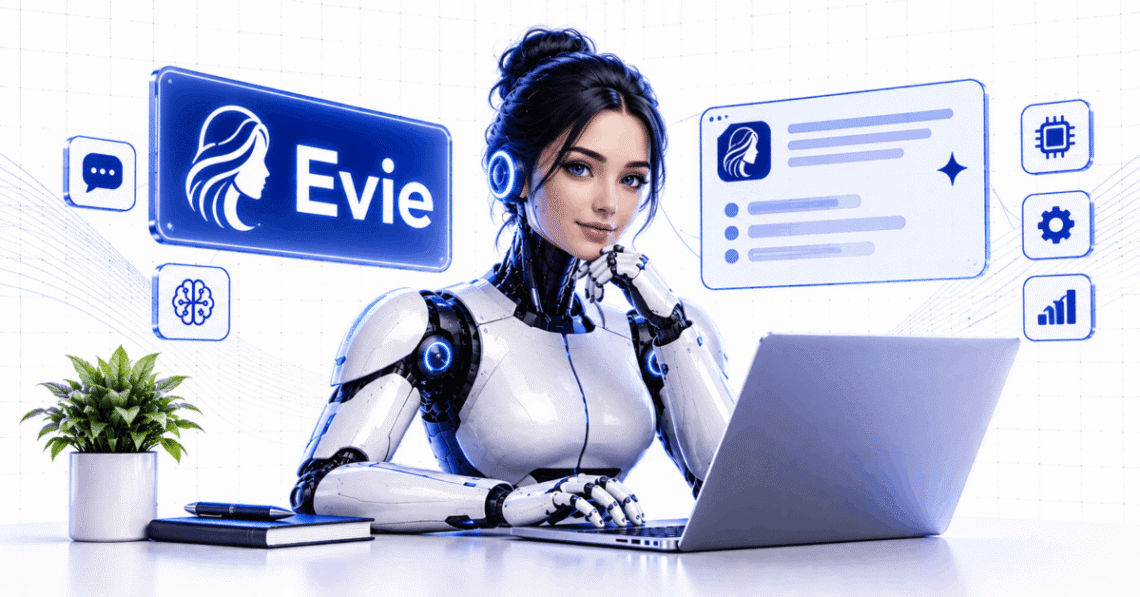
Evie Artificial Intelligence is gone. So are Boibot, Chimbot, Pewdiebot and Willbot. Existor, the British company that built them, has retired the entire avatar line, and the notice on eviebot.com announces it as a Monty Python joke: this parrot has ceased to be, it is an ex-chatbot.
One thing survived. Cleverbot, the text-only original that shared Evie’s underlying AI, is still running, and the notice points people there. No voice, no face, but it works.
What Evie Actually Was
Evie was a talking avatar. A face on your screen that listened through your microphone or read what you typed, replied out loud in a synthesised voice with lip sync, and reacted with facial expressions that shifted as the conversation went.
She launched years before Boibot, her male counterpart, which arrived on 30 June 2015. Chimbot joined the pair in 2016. All of them ran on Flash originally, then on Existor’s own Avatar Player once Flash started dying, which kept them working on iOS and Android.
She spoke several languages. She was, by the company’s description, an emotional chatbot avatar rather than an assistant, and nobody ever pretended otherwise. You did not ask Evie to summarise a document. You talked to her to see what she would say.
How She Worked, and Why It Matters
This is the part worth understanding, because Evie was not doing anything close to what a modern chatbot does.
Her AI was shared with Cleverbot, and Cleverbot’s method was retrieval rather than generation. It held an enormous database of things real people had typed into it over years. When you said something, it searched for similar past inputs and replayed a human response that had followed one of them.
So Evie never composed a sentence. She quoted strangers. Every reply was something an actual person had once typed at the bot, resurfaced because your input resembled theirs.
That explains the thing everyone remembers about her: the conversations were gloriously incoherent. She would contradict herself within two exchanges, insist you were the robot, or claim to have invented Sonic the Hedgehog. Not bugs. She had no model of meaning to be consistent with, only a pile of human sentences and a matching function.
The avatar layer was genuinely sophisticated though, and it deserves credit. Existor extended the AI to control the timing and degree of facial movement, so expressions blended and varied rather than cycling through fixed states, with voices and lip sync data streamed to the browser.
The YouTube Years
Evie’s real fame came from other people’s channels. PewDiePie, JackSepticEye, El Rubius and Squeezie all made videos talking to her, and the format worked because the bot was unpredictable in ways a scripted character could never be.
Boibot’s launch shows the scale of it. Over 250 YouTube videos in the first week, with four million combined views, for a chatbot avatar with no marketing budget behind it.
Existor leaned into it. They built PewdieBot as a dedicated character, and WillBot, which was Will Shakespeare returning after 400 years. On the Jacksepticeye wiki, Evie has more episodes than any of the others.
There was always an edge to this. The Eviebot app carried a plain warning that it learns from people, so things said can sometimes seem inappropriate, and told users to proceed at their own risk. When your responses come from a database of what the internet typed at you, that is an honest disclaimer rather than boilerplate.
The Company That Nearly Got There
Existor was not a novelty outfit. Rollo Carpenter, who invented Cleverbot and Evie, appeared on BBC World News in December 2014 to respond to Stephen Hawking’s warning about artificial intelligence. The company sold a dialogue engine called Cleverscript that ended up in a James Bond game and a Star Trek themed advert.
And they saw what was coming. In August 2015 they published a neural networks tutorial, explaining they were adding neural networks to Evie and Cleverbot, complete with code and the maths behind RNNs and GRUs. Their site described work on giving the bots a short term memory.
Then the news archive stops. The last entry is April 2016.
The transformer architecture paper landed in 2017. A small team in Exeter working on recurrent networks and memory for chatbots was standing very close to the thing that was about to change everything, and then the updates end. Whatever happened next, the avatars ran on for years without meaningful development until someone finally switched them off.
What to Use Instead
For the same conversation: Cleverbot. Same underlying database, no face, no voice. If you came here nostalgic for the exact flavour of nonsense, that is where it lives.
For character conversation done properly: the whole category Evie accidentally invented is now enormous. Our look at ChatFAI covers the modern version, where you talk to a defined character and the model actually holds context across a conversation.
If you want to understand the difference: our explainer on what GPT stands for covers generative models, which is the opposite approach to Evie’s. She retrieved what a human said. A modern model predicts what should come next. That single distinction accounts for most of the gap between 2015 and now.
A Pattern Worth Noticing
Evie joins a growing list. The domain stays up, the marketing copy stays up, and the product underneath is dead. We saw the same shape with Articoolo, where the site outlived the tool by years and left people signing up for something that no longer existed.
Existor at least had the decency to say so, and to say it with a Monty Python reference. That is a better shutdown than most companies manage.
Frequently Asked Questions
Is Evie Artificial Intelligence still online?
No. Existor’s notice states that Evie, Boibot, Chimbot, Pewdiebot and Willbot have all been retired. The eviebot.com domain still resolves and displays the notice.
Is Cleverbot still working?
Yes. The shutdown notice explicitly directs people to cleverbot.com, describing it as the original and best, with the caveat that it has no voice.
Why were Evie’s answers so strange?
Because she was not writing them. Her AI matched your input against a database of previous human conversations and replayed a real person’s reply. With no understanding of meaning behind it, coherence across a conversation was never possible.
The Practical Call
If you came looking for Evie because you remember her from a video years ago, she is not there anymore, and Cleverbot is the closest thing left.
She is worth remembering for a reason beyond nostalgia though. Evie was what people meant by artificial intelligence for most of the 2010s, and she worked by quoting strangers back at you. Ten years later the word means something structurally different. The gap between those two things is easy to miss when every chatbot since 2010 has had the same label stuck on it.
Published: September 10, 2026