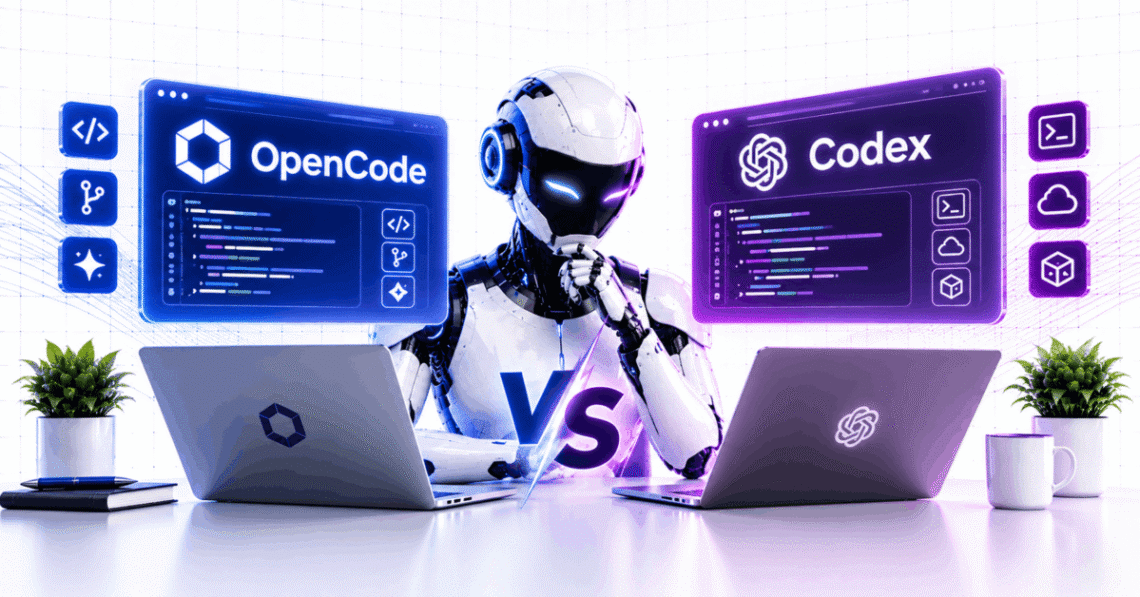
OpenCode vs. Codex are both terminal coding agents, and both ship as open-source CLIs. The difference is not open versus closed. It is that Codex only talks to OpenAI models and meters your usage against a subscription, while OpenCode talks to more than 75 providers and charges nothing for the tool itself.
The cost gap is larger than the sticker prices suggest. Codex comes bundled with ChatGPT Plus at $20 a month, but OpenAI’s own rate card documentation estimates real Codex usage at $100 to $200 per developer per month. That is the vendor’s number, not a critic’s.
Quick Decision
Take OpenCode if you want to choose your own models, run local or self-hosted ones, or keep your tooling independent of any single provider’s pricing decisions.
Take Codex if you already pay for ChatGPT, want cloud sandbox execution and automated code review without configuring anything, and are comfortable that your coding agent and your model provider are the same company.
Both CLIs Are Open Source
This surprises people, and most comparisons get it wrong.
OpenCode is MIT licensed, built by Anomaly, with the full codebase public. It runs as a terminal interface, a desktop app, a VS Code extension, or a web UI, and it connects to whichever provider you configure, according to OpenCode’s documentation.
Codex CLI is also free, open-source software. You can read it, fork it, and run it with your own API key without any ChatGPT subscription at all.
So the axis is not transparency. It is reached. Codex CLI is an excellent client for exactly one vendor. OpenCode is a client for the market.
What Codex Actually Costs
There is no standalone Codex subscription. It is bundled into ChatGPT plans.
| Plan | Price | Note |
|---|---|---|
| Free | $0 | Limited Codex cannot buy credits |
| Go | $8/mo | Cannot buy credits |
| Plus | $20/mo | Web, CLI, IDE extension, iOS |
| Pro | $100/mo (5x) or $200/mo (20x) | Higher allowances |
| Business | $25/user/mo, $20 annual | Minimum 2 users, replaced team on 2 April 2026 |
| Enterprise / Edu | Custom | Workspace credits available |
Billing changed fundamentally in 2026. Before 2 April, Codex charged per message or per pull request. Since then it bills token-based credits on Plus, Pro, and Business, extended to Enterprise on 23 April. One credit costs four cents.
Allowances run on five-hour rolling windows rather than daily or monthly caps. On Plus, the published figures give 10 to 100 local messages per window on GPT-5.6 Sol, 25 to 200 on Terra, and 250 to 2,000 on Luna. Those ranges are wide because token consumption varies enormously with task size.
Cloud tasks add a container fee on top of token costs, and Fast Mode raises credit consumption further. Neither appears in the headline price.
That is how $20 becomes $100 to $200. Not hidden fees, just metered usage that a fixed subscription price does not describe.
The Credit Card on Free and Go
Worth knowing before you pick a cheap tier to test with.
Free and Go users cannot buy additional credits at all. Hit your limit halfway through a refactor, and you wait for the window to reset. Plus, it is the practical floor for anyone doing real work, which makes the $8 Go plan a poor place to evaluate the tool.
The five-hour window cuts both ways too. It is generous if you code in short bursts across a week and unforgiving if you sit down for one long session, because you can exhaust the entire allowance in two hours.
One more thing that catches people out: GPT-5.4 and GPT-5.4 mini left Codex for ChatGPT sign-in users on 31 August 2026. Both remain reachable through the API and in Codex sessions authenticated with an API key, so if a workflow depended on them, the fix is switching authentication rather than switching tools.
What OpenCode Costs
Nothing for the agent. Your only expense is model access, and you control it entirely.
Bring your own API key from any provider and pay that provider directly. Or use OpenCode Zen, its pay-as-you-go gateway, which charges per token at rates OpenCode says it passes through at cost. There is also OpenCode Go at $5 for the first month and $10 after, bundling curated open-weight models like GLM, Kimi, and DeepSeek under monthly caps.
Neither gateway is required. Point it at a cheap model for routine work, a frontier model for hard problems, or something running locally through Ollama for nothing at all.
The comparison that matters is not $0 against $20. It is a bill you set against a bill that is set for you.
Model Access Is the Real Divide
OpenCode supports over 75 providers. Anthropic, OpenAI, Google, DeepSeek, GitHub Copilot, Azure, Amazon Bedrock, and local models through Ollama or LM Studio. Switching between them is a configuration change.
Codex runs OpenAI models. That is the entire proposition, and it is a reasonable one if OpenAI’s coding models suit your work.
But it means every pricing change, deprecation, and capability shift at one company lands directly on your workflow, with no route around it. The GPT-5.4 removal in August is a small illustration of exactly that. If you want to weigh which models are actually worth pointing an agent at right now, our comparison of GPT-6 against Gemini 3.8 covers where the current frontier sits.
What Codex Does That OpenCode Doesn’t
Bundling is not the only argument for Codex, and it would be unfair to pretend otherwise.
Cloud execution is genuinely useful. You delegate a task, Codex works in an isolated sandbox for minutes or hours, and reports back with a diff, logs, and test citations. Building that yourself around OpenCode means assembling your own infrastructure.
The surface coverage is broader too: web, CLI, a VS Code extension with roughly 9.8 million installs, iOS, and Amazon Bedrock since June 2026. Automated code review runs on its own allowance separate from your message limits.
And if you already pay for ChatGPT, the marginal cost of trying Codex is zero. That is a real advantage over configuring provider keys before you write a line of code.
Who Should Choose Which
Choose OpenCode if you need self-hosted or air-gapped models, want to route cheap models to routine tasks, work across multiple providers, or want to audit the tool. It is also the better evaluation choice, because trying it costs only the tokens you actually spend.
Choose Codex if you already hold a ChatGPT subscription, want cloud sandbox execution without building it, work primarily in OpenAI models anyway, or need one invoice covering coding and general assistant use.
Consider running both. Codex CLI works with an API key and no subscription, so nothing stops you keeping it alongside OpenCode and calling whichever suits the task. Both are free software.
Look elsewhere if you want an AI-native editor rather than a terminal agent. Our comparison of OpenCode against Cursor covers that trade-off, and Claude Code versus GitHub Copilot looks at the same question from the Anthropic side.
Frequently Asked Questions
Is Codex free?
The CLI is free open-source software, and Codex is included at limited capacity in the free ChatGPT tier. Meaningful usage requires a paid plan or an API key, and OpenAI’s own estimate for real-world use is $100 to $200 per developer monthly.
Can I use OpenCode with OpenAI models?
Yes. OpenAI is one of more than 75 supported providers. You can point OpenCode at the same models Codex uses, paying OpenAI’s API rates directly rather than through a subscription.
Which is cheaper?
OpenCode, in almost every scenario, because the tool is free and you choose the model. The exception is someone already paying for ChatGPT who would otherwise leave that subscription unused.
The Practical Call
If you are already a ChatGPT Plus subscriber, open Codex tonight. It costs you nothing extra, the cloud sandbox is genuinely good, and you will know within a week whether the five-hour windows fit how you work.
If you are choosing fresh, OpenCode is the lower-risk starting point. Free tool, your choice of model, no vendor whose pricing decisions become your problem. Point it at whatever model you want and compare the monthly spend honestly against $20 plus metered credits. And remember that the model matters as much as the agent wrapped around it, a point our look at SWE-1.6 makes concrete, where the same model scored differently across three harnesses. Whichever you pick, the benchmark that counts is your own repository. Our roundup of the best AI for coding covers the wider field if neither fits.
Published: September 14, 2026