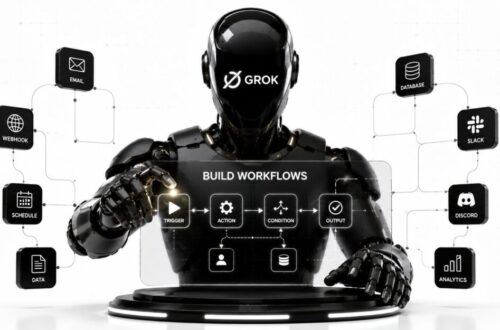
AI automation for small business works best when it removes repetitive work from a process without handing important decisions entirely to software.
A practical setup might read an incoming customer message, identify what the person needs, create or update a CRM record, draft a response, assign the request to the correct employee, and record what happened. The AI handles tasks that require interpreting messy language, while conventional automation handles predictable actions such as moving data or triggering notifications.
Small businesses are already experimenting heavily with this technology. An April 2025 Intuit QuickBooks survey of more than 2,200 US businesses with up to 100 employees found that 68% reported using AI regularly, compared with 48% in July 2024. Among respondents using AI, 74% said it was improving productivity.
But adoption by itself does not make a workflow useful.
The better question is: Which parts of your business are repetitive enough to automate, measurable enough to evaluate, and safe enough to run with limited human intervention?
That is where a small business should start.
What AI Automation Actually Means for a Small Business
Traditional automation follows predefined rules.
For example:
New website form → create CRM contact → notify salesperson
The workflow does not need AI if every input is structured and every next step is already known.
AI becomes useful when a step requires interpreting information that can vary:
New website inquiry → AI determines intent → summarizes the request → workflow routes it to sales or support
The strongest systems often combine both approaches.
Rules handle predictable work. AI handles language, classification, extraction, summarization, drafting, or other tasks where the input is less structured. A person remains involved where a mistake could affect a customer, payment, employee, contract, or important business decision.
This is also why AI automation is broader than simply opening ChatGPT and asking it to perform a task. The useful part is connecting AI to a repeatable business process.
For a broader look at operational applications, AI Journal Now’s guide to AI operations automation explains how AI can fit into ongoing business processes rather than isolated prompts.
What Should a Small Business Automate First?
The best first automation is usually not the most technically impressive one.
Look for work that is:
- Repeated frequently
- Easy to define
- Currently performed manually
- Measurable
- Relatively low-risk
- Reversible if something goes wrong
Here are several common candidates.
| Business process | Possible AI role | Automation potential | Human review point |
|---|---|---|---|
| Incoming lead handling | Classify and summarize inquiries | High | Review unusual or valuable leads |
| Customer support triage | Categorize tickets and draft answers | High | Complaints, refunds, exceptions |
| Meeting follow-up | Summarize notes and extract actions | High | Confirm commitments and deadlines |
| Document processing | Extract and classify information | High | Validate important financial or contractual data |
| CRM administration | Summarize interactions and suggest updates | High | Review sensitive or ambiguous changes |
| Marketing drafts | Draft emails, posts, or variations | Medium | Approve claims and publication |
| Hiring decisions | Organize information | Low for autonomous decisions | Human decision required |
| Payments and refunds | Prepare or route requests | Low for autonomous execution | Human authorization required |
This distinction matters.
Generating a first draft of a support reply is very different from allowing an AI system to decide that a customer should receive a $2,000 refund.
A Simple Test Before You Automate Anything
AI Journal Now recommends evaluating a proposed workflow against five questions before building it.
This is an editorial decision framework, not an industry standard.
The five-factor automation test
Give the workflow 0, 1, or 2 points for each factor.
1. Frequency
- 0: Rare
- 1: Occasional
- 2: Frequent
2. Process clarity
- 0: Different every time
- 1: Partly standardized
- 2: Clear repeatable process
3. Reversibility
- 0: Mistakes are difficult to undo
- 1: Some actions can be reversed
- 2: Errors are easy to correct
4. Data sensitivity
- 0: Highly sensitive
- 1: Moderately sensitive
- 2: Low sensitivity
5. Measurement
- 0: No clear success metric
- 1: Partially measurable
- 2: Clear result can be measured
A score of 8 to 10 suggests a strong pilot candidate.
A score of 5 to 7 means the workflow may be useful but probably needs tighter controls.
A score below 5 suggests that another process may be a safer place to begin.
The purpose of this framework is not to prove that a process should be automated. It helps prevent a common mistake: selecting a workflow because the AI technology looks impressive rather than because the business problem is suitable.
Useful AI Automation Use Cases for Small Businesses
Lead intake and routing
A small business receiving inquiries from forms, email, chat, or advertising campaigns can use AI to interpret each message before a normal workflow processes it.
A system might:
- Receive an inquiry.
- Check that required contact information is present.
- Classify the inquiry as sales, support, partnership, spam, or another approved category.
- Summarize what the prospect wants.
- Add the information to the CRM.
- Assign the appropriate employee.
- Draft an initial response.
- Escalate uncertain requests for human review.
The important part is not removing humans from the workflow. It is reducing the administrative work surrounding the human decision.
Customer support triage
AI can examine incoming support requests, identify their subject, retrieve relevant information, and prepare a response.
Routine requests may eventually need little intervention if the answers come from controlled information.
Exceptions should remain human-reviewed.
A cancellation dispute, refund request, angry complaint, legal threat, account-security issue, or unclear customer record should not be treated like a routine password-reset question.
Meeting and CRM administration
Meeting notes are another practical automation target.
AI can summarize a transcript or set of notes and identify proposed tasks, customer concerns, follow-up questions, or CRM updates.
The person who attended the meeting should still verify commitments before those outputs become official records.
An AI system can misinterpret whether someone suggested a deadline or actually agreed to it.
Document and data processing
Invoices, applications, PDFs, forms, and emails often contain information employees manually copy into another application.
AI can help extract and structure that information before automation moves it elsewhere.
For important records, extraction should be followed by validation rather than assuming the model interpreted every field correctly.
Research and internal knowledge retrieval
An AI assistant connected to approved company information can retrieve documents, summarize past discussions, and prepare internal briefs.
A read-only workflow is often a sensible first experiment because the AI can retrieve and summarize information without changing a business system.
AI Journal Now’s guide to Zapier MCP use cases shows this pattern across email, calendars, CRM systems, project management, support, and other connected applications.
What Tools Do You Need?
Most small businesses do not need a large AI stack.
A typical automation may contain four layers:
A trigger: A form submission, email, CRM change, calendar event, document upload, or scheduled event.
An automation platform: Software that moves information between applications and controls the workflow.
An AI step: A model or built-in AI feature that classifies, extracts, summarizes, or drafts.
A system of record: The CRM, spreadsheet, help desk, accounting platform, database, or project manager where approved information is stored.
Several automation platforms can fill the orchestration role.
Current automation platform examples
| Platform | Current pricing example | Useful fit |
|---|---|---|
| Zapier | Free plan with 100 tasks/month; Professional starts at $19.99/month | Businesses connecting many common SaaS applications |
| Make | Free plan with up to 1,000 credits/month; Core listed at $12/month for 10,000 credits | Visual multi-step workflows |
| n8n Cloud | Starter listed at €20/month billed annually for 2,500 workflow executions | More technical teams needing flexible workflows |
| Microsoft Power Automate | Premium listed at $15/user/month paid yearly | Businesses already centered on Microsoft products |
These prices were checked on August 28, 2026 and can change. Zapier currently says its platform supports 9,000 integrations. Make lists more than 3,000 apps and uses credits as its billing unit. n8n bases its cloud pricing on workflow executions, while Microsoft prices Power Automate through user and process plans.
The right choice depends less on which platform has the longest feature list and more on the applications your business already uses, workflow volume, technical skill, governance needs, and how predictable you need billing to be.
If you are still deciding what AI software belongs in your stack, see AI Journal Now’s guide to AI tools for small business owners.
How to Build Your First AI Automation
1. Choose one process
Do not begin by trying to automate the entire company.
Choose a single workflow with a visible beginning and end.
A useful example could be:
Website inquiry received → inquiry reviewed → CRM updated → salesperson notified → response prepared
2. Measure the current process
Before changing it, record the baseline.
Useful measurements may include:
- Number of times the process occurs each month
- Average handling time
- Response time
- Number of corrections
- Number of missed tasks
- Cost of the software already involved
- Business result, such as qualified leads or completed support requests
Without a baseline, it becomes difficult to tell whether the automation improved anything.
3. Separate rules from judgment
Map each step and ask whether AI is actually necessary.
If the instruction is:
Every completed form goes into the CRM.
Use normal automation.
If the instruction is:
Read the prospect’s message and determine which service they are asking about.
An AI classification step may help.
Using AI only where variability exists makes the workflow easier to understand and troubleshoot.
4. Define approval points before building
Decide which actions require a person.
Human approval should usually remain around actions such as:
- Sending unusual customer communications
- Changing prices
- Issuing refunds
- Making payments
- Publishing externally
- Deleting important information
- Making employment decisions
- Making legal or contractual commitments
You can loosen controls later if a workflow proves predictable. Starting with excessive autonomy makes failures harder to contain.
5. Test with controlled examples
Include normal examples and edge cases.
For an inquiry-routing workflow, test:
- Clear sales inquiry
- Customer support request
- Spam
- Empty message
- Multiple requests in one message
- Existing customer
- Unclear intent
- Unusual wording
- Missing contact information
Document what should happen in each case.
6. Run a limited pilot
Use a limited set of real tasks while keeping outputs visible to an employee.
Do not judge the pilot only by whether it technically ran.
Ask:
- Did it classify correctly?
- Did employees need to fix the output?
- Did the workflow fail silently?
- Did it create duplicate records?
- Did response time improve?
- Did employees trust the result?
- Did software usage cost stay reasonable?
7. Expand only after the first workflow is stable
Once a workflow is producing reliable results, consider removing unnecessary manual steps or automating the next adjacent process.
This creates a series of controlled improvements instead of one large automation project that is difficult to diagnose.
What Does AI Automation Cost?
Software subscription prices are only one part of the cost.
A better calculation is:
Automation cost = workflow platform + AI usage + connected software + setup + monitoring + maintenance
Some businesses already pay for the CRM, email platform, accounting software, or productivity suite involved, so those products may not create new expenses.
AI usage may be included in an automation product or billed separately by a model provider.
Complex workflows can also consume more tasks, credits, or executions than expected. Check how the chosen platform meters usage before estimating monthly cost.
For example, Make says each module action in a scenario generally consumes credits, while Zapier uses task-based pricing. n8n’s hosted plans use workflow executions as the primary billing unit.
How to Measure Whether the Automation Is Working
Do not use “we installed AI” as the success metric.
Measure the process.
Useful metrics include:
- Minutes of manual handling per workflow
- Cost per completed workflow
- Percentage requiring correction
- Percentage requiring human escalation
- Lead response time
- Ticket resolution time
- Missed follow-ups
- Duplicate or incorrect records
- Conversion rate where appropriate
- Customer satisfaction where appropriate
A simple financial model is:
Estimated monthly value = manual labor avoided + measurable revenue or cost improvement – incremental automation cost
Be conservative with revenue attribution. If sales increased after an automation launched, that does not automatically prove the automation caused the entire improvement.
Where Human Review Still Matters
AI automation can produce confident-looking mistakes.
It may misunderstand a customer’s intent, extract the wrong value, invent information in a draft, use outdated source material, or take an action based on incomplete context.
A useful design principle is:
The higher the cost of an error, the stronger the approval requirement should be.
The National Institute of Standards and Technology’s AI Risk Management Framework is intended to help organizations of different sizes manage AI risks and incorporate trustworthiness considerations into AI systems. NIST organizes its related playbook around four functions: Govern, Map, Measure, and Manage.
For a small business, this can translate into practical controls:
- Give systems only the access they need.
- Keep sensitive actions behind approval.
- Log important automated actions.
- Review failures.
- Minimize unnecessary data exposure.
- Check vendor privacy and retention terms.
- Assign a person who owns each production workflow.
Customer-facing claims need particular care. The FTC has repeatedly taken action around allegedly deceptive or unsupported AI-related claims, reinforcing that using AI does not remove a company’s responsibility for what it tells customers.
Common AI Automation Mistakes
Buying software before defining the workflow
A feature-rich automation platform cannot fix an unclear process.
Map the process first.
Automating a broken process
If employees do not agree on how something should be handled manually, automating it may reproduce the confusion faster.
Standardize the process before automating it.
Giving AI unnecessary authority
A tool that needs to summarize customer emails probably does not need permission to delete CRM contacts or issue refunds.
Keep permissions narrow.
Removing review too early
A workflow running successfully 20 times does not prove that it will handle the next unusual input correctly.
Approval requirements should reflect the potential damage from an error.
Ignoring exception handling
Ask what happens when the AI cannot classify an inquiry, an application is unavailable, a field is missing, or the model returns an unusable result.
Every important workflow needs a failure path.
Having no workflow owner
Someone should know:
- Why the automation exists
- Which systems it accesses
- What success looks like
- Where logs are stored
- How to disable it
- Who investigates failures
Otherwise, small automations can quietly become undocumented infrastructure.
Do You Need an AI Agent?
Not necessarily.
A predictable recurring process may work better as conventional automation with one or two AI steps.
An agent becomes more relevant when software needs to evaluate context, select among permitted actions, retrieve information, or perform a multi-step task where the exact path is not known in advance.
More autonomy also creates more opportunities for unexpected behavior.
Small businesses should choose the least complex system that solves the problem reliably.
Frequently Asked Questions
What is the best first AI automation for a small business?
Start with a frequent, low-risk process that already has clear rules. Lead intake, email classification, meeting summaries, support triage, and CRM administration are common candidates. Avoid beginning with payments, refunds, employment decisions, or other actions where a mistake can have serious consequences.
Do I need coding skills for AI automation?
Not for every workflow. Platforms such as Zapier, Make, and Microsoft Power Automate provide visual or low-code automation tools. More customized integrations, complex data transformations, security requirements, or self-hosted systems may require technical expertise.
How much does AI automation cost for a small business?
There is no reliable single figure because cost depends on workflow volume, software already in use, AI consumption, implementation complexity, and maintenance. Some platforms offer free entry plans, while paid automation products can begin in the tens of dollars per month. A production system may cost more once application subscriptions, AI usage, support, and implementation are included.
Should every repetitive business task be automated?
No. Frequency alone is not enough. Consider reversibility, data sensitivity, error cost, process clarity, and whether the outcome can be measured. Some repetitive tasks still need human judgment.
Final Takeaway
The most practical AI automation strategy for a small business is to automate one repetitive, measurable, relatively low-risk workflow at a time.
Map the current process. Identify the steps that are fixed rules. Add AI only where interpretation is useful. Keep human approval around costly or sensitive decisions. Measure what changes before expanding the system.
A five-step workflow that reliably removes manual data entry can be more valuable than an autonomous AI agent that nobody fully understands.
The goal is not maximum automation.
It is a business process that becomes easier to operate without giving up the controls that keep it reliable.