You open Netflix after a long day, thinking you’ll spend twenty minutes looking through shows you’ve already decided against. But somehow, in just a few seconds, you find a show that looks exactly like what you wanted to watch. You hadn’t typed in a single search. It just showed up.
That isn’t a coincidence. That’s AI-driven OTT content discovery working behind the scenes. And it’s changing how we find, watch, and connect with streaming content, usually without us even noticing.
What is OTT and why is it important to find out about it?
“Over-the-top” (OTT) means video content that comes straight to your computer or other device over the internet, without going through cable or satellite TV. These are all over-the-top (OTT) platforms: Netflix, Disney+, Prime Video, Hulu, and HBO Max. The name comes from the fact that it goes “over the top” of traditional broadcast infrastructure.
Most big platforms have huge libraries. Netflix has thousands of films and TV shows. The problem isn’t that there isn’t enough content; it’s that with so much to choose from, it starts to feel like work to find something good to watch.
Users will just watch whatever is popular or something they have seen before if the system isn’t smart. Neither result is good for a platform that wants to justify its subscription fee or for viewers who might love a hidden gem that they won’t find on their own.
How AI-Powered OTT Content Discovery Works
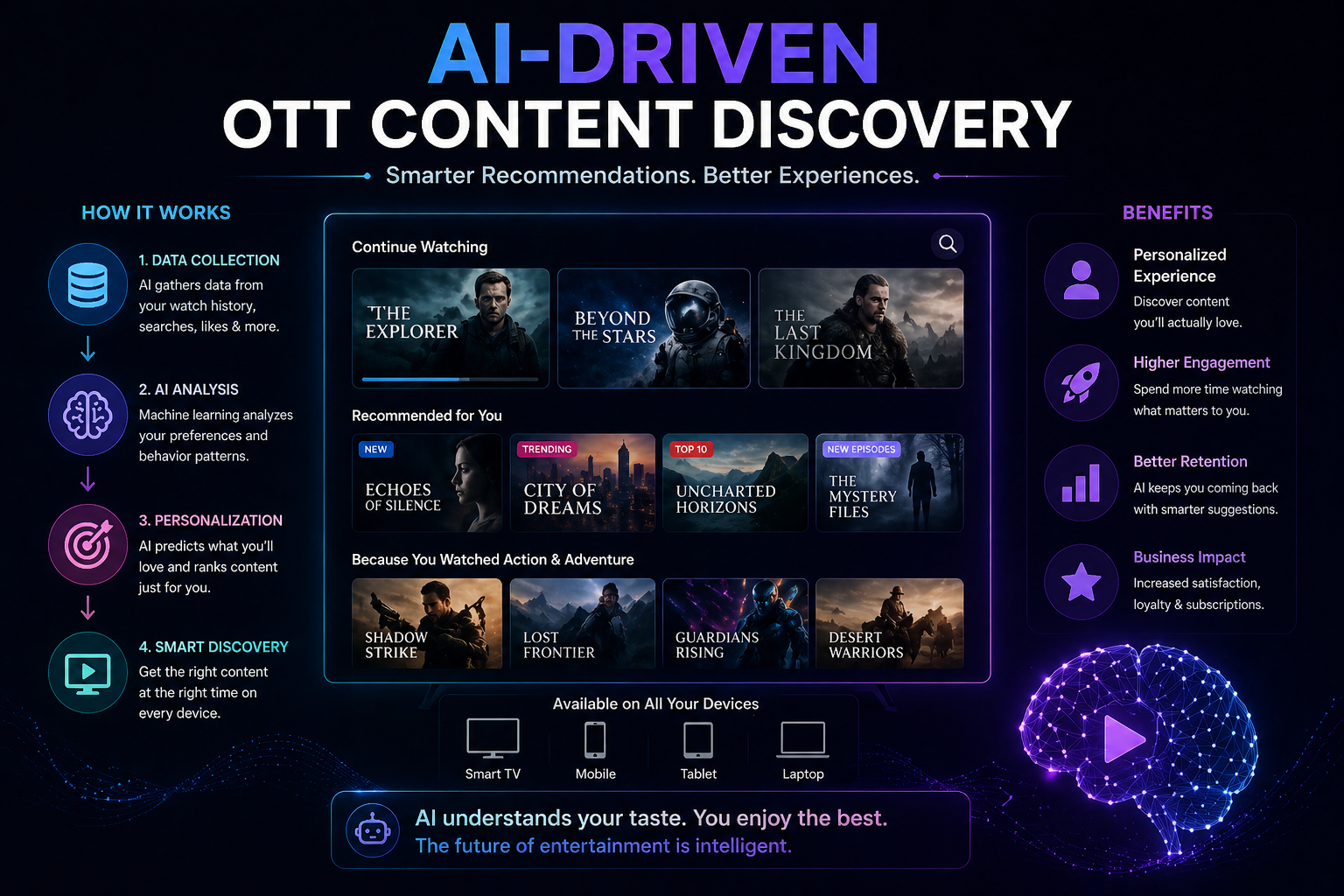
AI-driven OTT content discovery is basically a recommendation system that uses machine learning, which is software that learns from how people use it and gets better over time. But it’s not as simple as “you watched X, so you might like Y.”
Every time you watch something, stop it, rewind it, skip ahead, finish it in one sitting, or give up after ten minutes, that information is saved. The AI looks at how you act and compares it to how other users with similar tastes act. Then it shows you content that those users loved but you haven’t seen yet. It also takes into account the time of day, the type of device, and the length of the session, all of which affect what is suggested. The system sees a Friday night browse differently than a Monday morning commute watch.
Netflix goes even further by letting you personalize the artwork. The thumbnail for a title that you see is different from the one that your friend sees. If you often watch films with strong female leads, the poster for an action movie will probably show the female co-star. This small change makes a big difference in the number of people who click through.
Netflix has said that more than 80% of the content watched on the site comes from its recommendation engine, not from people actively searching for it. That number alone shows how much AI-powered OTT content discovery is changing what we watch without us even knowing it.
Why It Matters for Viewers and Platforms for AI-driven OTT content discovery
For people who watch
Time is the most obvious benefit. No one wants to spend half of their evening looking for something to watch. AI-driven OTT content discovery closes that gap and brings up titles that feel personally relevant instead of just popular.
There’s also a less obvious benefit: it shows you content that you wouldn’t have found otherwise. A person who mostly watches Hollywood blockbusters might get a well-timed push toward a Korean drama that has gotten great reviews or a strange indie documentary. When you manually browse a grid of thumbnails, you don’t often find things that are in different genres.
For platforms that stream
Finding good content directly lowers churn, which is the rate at which subscribers leave. A subscriber who always finds something good to watch doesn’t have much reason to cancel. Someone who scrolls for twenty minutes and then stops is likely to cancel.
Platforms also use insights from discovery to make decisions about what to make. If the data shows that 25–34-year-olds are really into psychological thrillers, that’s good information to have when deciding whether to make a new original series.
Examples from the real world
Netflix uses a multi-armed bandit algorithm, which is a statistical method that keeps testing different recommendations to see which ones lead to actual viewing and then changes future suggestions based on what it learns.
Spotify was the first to use the “Discover Weekly” model, which is a personalised playlist made by AI that has become one of the site’s most popular features. A lot of people say they found their favourite artists through it. That model has changed how video OTT platforms think about proactive discovery instead of reactive search.
Disney+ relies a lot on franchise loyalty. If you’ve seen a lot of Marvel movies, its AI will show you related content, like behind-the-scenes videos, spin-offs, and connections between the movies’ themes, instead of just suggesting more superhero movies from other studios.
The Real Limits for AI-driven OTT content discovery
It would be wrong to only talk about the good things. There are real limits to AI-driven OTT content discovery that you should know about:
- The problem with the filter bubble. If the AI only shows you things that are like what you’ve already watched, it slowly limits what you can watch. You might get stuck in a genre loop that’s hard to get out of unless you actively look for something else.
- Problem with a cold start. New users who haven’t watched anything yet get general suggestions until the system figures out what they like. When you first start using a new platform, it can feel like no one is there for you.
- The model is broken by shared accounts. A family account that parents, teens, and young kids all use sends out so many mixed signals that no one really likes the suggestions.
- It can’t tell how you feel. The AI might know that last month you liked dark crime dramas. It doesn’t know that you just need something light after a long week.
As a viewer, the filter bubble is the most important thing to be aware of. The algorithm gets better signals when you actively browse outside of your usual categories or use genre pages instead of just the homepage. This keeps your recommendations from getting too narrow over time.
Where It’s Going Next in AI-driven OTT content discovery
The next step is less about guessing what you liked in the past and more about figuring out what you want right now. Platforms are trying out conversational discovery, which lets you describe what you want in natural language and get a curated response instead of having to scroll through rows of thumbnails.
Some platforms are also starting to look at the actual content of shows at the scene level, looking at things like pacing, emotional tone, and visual style instead of just genre tags. That level of understanding could make suggestions a lot more accurate in the future.
Questions That Are Commonly Asked
What does OTT mean when it comes to streaming?
“Over-the-top” (OTT) means video content that comes directly from the internet instead of cable, satellite, or broadcast TV. Netflix, Disney+, Prime Video, and Apple TV+ are all streaming services. The term “over the top” means going around the usual ways that TV shows are distributed.
How does AI know what I want to watch before I look?
It doesn’t read your mind; it reads your actions. Every time you watch, pause, skip, or leave is recorded. The AI can guess what you want with a pretty high degree of accuracy by looking at what other people with similar tastes like and using contextual clues like the time of day and the type of device you have. It’s not magic; it’s pattern recognition on a large scale.
Can I change the recommendations I get for OTT on purpose?
Yes, more than most people know. Rating content gives the algorithm clear feedback right away. Finishing shows sends a stronger positive signal than just watching part of them. When different people in the same house use separate profiles, there are no mixed signals. And looking at genres that aren’t in your usual categories helps the system understand that you like more than what you’ve watched before.
Is AI content discovery the same on all streaming services?
No. Each platform has its own unique recommendation engine that works in different ways. Netflix puts a lot of weight on how many people finish. Disney+ focuses on franchise loyalty. Spotify’s audio model focuses on mood and the time of day. The AI technology behind each platform is similar, but they each put different things first and show recommendations in different ways.
AI-powered OTT content discovery has quietly become one of the most useful ways that machine learning is used in everyday life. It affects not only what we watch, but also what is made and what becomes popular. If you know how it works, you’ll be a more intentional viewer and get better recommendations from the platforms you already pay for.