It shouldn’t feel like reading a research paper to choose between two AI models. But most online comparisons are full of jargon, benchmark tables, and no useful tips. Let’s fix that.
A lot of people ask the question, “haiku or sonnet?” and for good reason. Both are strong, both are from Anthropic, and they both use the same Claude 4.5 engine. But they’re made for very different situations. If you make the wrong choice, you’ll either pay too much for power you don’t need or get a model that can’t keep up, which will make you angry.
This guide cuts through the noise and gives you a clear answer.
What Are Haiku and Sonnet?
Anthropic makes its Claude models in three steps. Imagine them as a ladder:
- Haiku: quick, light, and cheap
- Sonnet: smart, balanced, and adaptable
- Opus — the most thoughtful person, only for the hardest problems
In the battle between haiku and sonnet, you’re really comparing how fast and cheap they are to how deep and logical they are. They are both good in their own ways; they just serve different masters.
Sonnet 4.5 came out in late September 2025 and was advertised as Anthropic’s best coding model at the time. Two weeks later, Haiku 4.5 came out, promising almost the same performance for a lot less money. A lot of people were surprised by that second claim. It mostly works, it turns out.
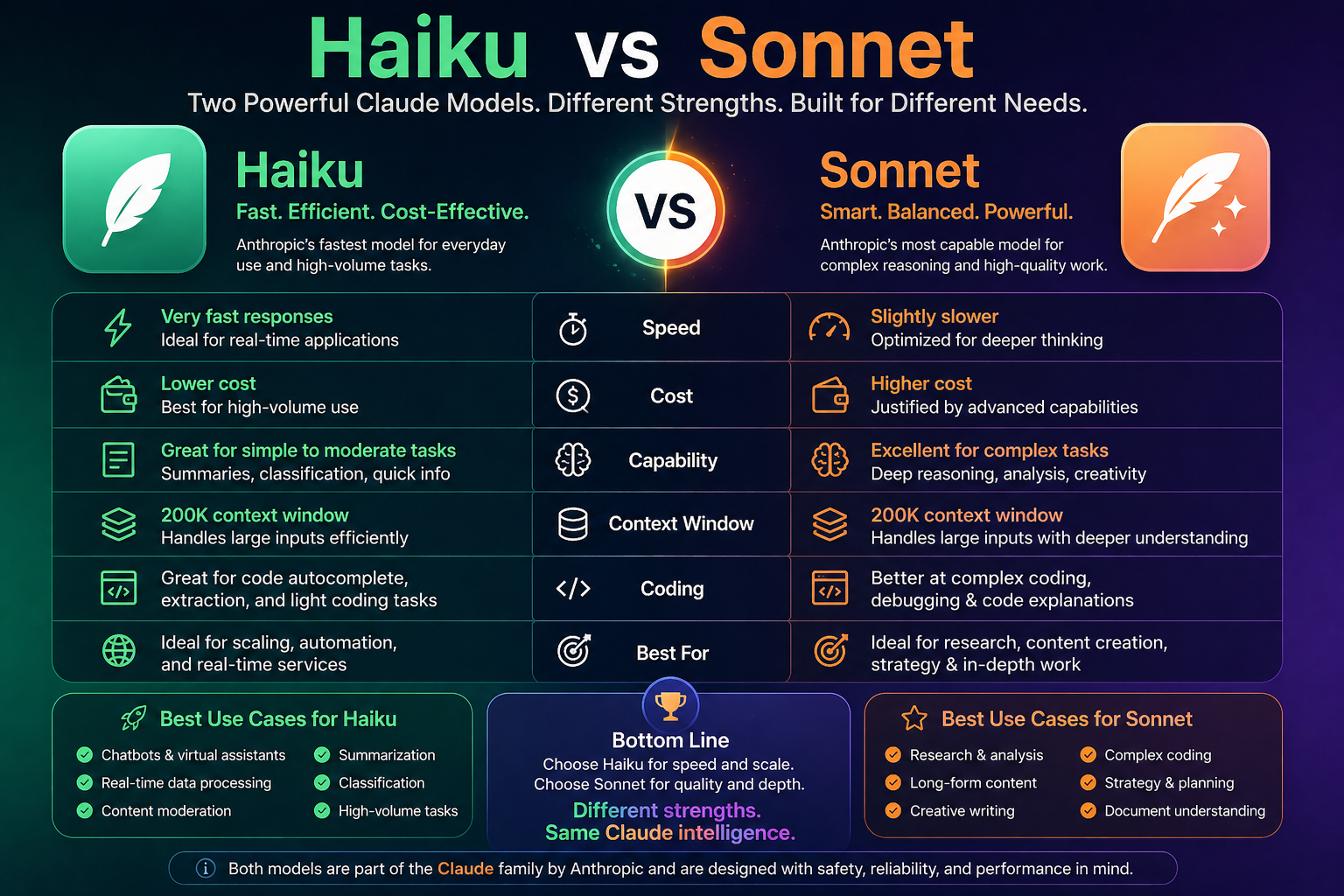
Speed: Haiku Is in a Different League
When it comes to speed, haiku vs. sonnet isn’t even close. On average workloads, Haiku 4.5 is about four to five times faster than Sonnet 4.5. Responses come in less than 200 milliseconds for short prompts. That’s faster than you can blink.
Why is this important? Think about being a student who needs help rewording a sentence in the middle of an essay. Or a developer who has to wait for suggestions to fill in the blanks while they type. Every second of delay messes up your flow. Haiku’s quickness makes everything feel real and instant.
Sonnet is not slow at all. But when you have thousands of AI interactions every day or are making something where users can see a loading spinner, Haiku’s edge is real and useful.
Reasoning Power: Sonnet Thinks More Deeply
This is where the difference between haiku and sonnet becomes clearer.
Haiku 4.5 gets a score of 73.3% and Sonnet 4.5 gets a score of 77.2% on SWE-bench Verified, a benchmark that tests models on real-world software engineering problems. Not more than a four-point difference. That’s great for a model that costs three times as much.
But percentages don’t tell the whole story. When things get hard, the difference shows up in real life. Sonnet can work with codebases that have more than one file without losing its place. It gives more detailed answers to research questions. When doing multi-step tasks that take a few minutes to finish, it’s more reliable.
One developer said that Haiku was like a fast intern: good for small tasks but needs more help with bigger ones. Sonnet was like a dependable teammate who understood everything.
Sonnet is worth the extra money if you need to do complicated, long-term reasoning for your job, like legal analysis, deep research, or long coding projects. Haiku is really great for everything else.
Cost: The difference in price between a haiku and a sonnet is big.
Let’s get real numbers on the table.
Model | Input Cost | Output Cost |
Haiku 4.5 | $1 per million tokens | $5 per million tokens |
Sonnet 4.5 | $3 per million tokens | $15 per million tokens |
Sonnet costs three times as much in both directions. This isn’t a big deal for a single blogger or student. But for a business that sends millions of AI requests every month, that multiplier adds up to a huge number very quickly.
For example, a startup that runs a customer support chatbot that handles 100,000 conversations a month could save tens of thousands of dollars a year by using Haiku for simple questions and only switching to Sonnet when things get complicated.
The cost difference between a haiku and a sonnet is the most important reason to think carefully about your use case before choosing one.
Features: Haiku Has Caught Up More Than You’d Think
A lot of the time, the difference between haiku and sonnet was in their features. Sonnet had long thoughts. Sonnet used a computer. Neither of these things were in Haiku.
With the 4.5 generation, that gap has gotten a lot smaller.
Haiku 4.5 is the first Haiku model to support “extended thinking,” which means that it can think through a problem step by step before giving you an answer. When you turn on this mode, Haiku does a lot better at hard coding tasks. It’s not quite a sonnet, but it’s a real improvement.
Now both models support:
- Inputs of text and images
- Using tools and agentic workflows
- Using a computer
- A context window of 200,000 tokens
- Answers in more than one language
Sonnet still has a real advantage in one area: its experimental 1 million token context window, which is still in beta. That extra space is important if you’re working with huge documents like legal contracts, huge codebases, or long research papers.
Real-World Use Cases: Who Wins Where?
Haiku Is the Better Fit When You Are…
- Writing or editing at scale — making captions, email drafts, product descriptions, and ad copy
- Making chatbots—for a good user experience, they need to respond quickly and naturally
- Doing light coding work like fixing syntax, making changes to single files, and writing simple scripts
- On a budget—Haiku makes your money go further, whether you’re a student, freelancer, or early-stage startup.
- Running high-volume workflows — tasks like classifying data, extracting data, and tagging content
Sonnet Is the Best Choice When You’re…
- Dealing with complicated codebases—multi-file logic, long refactors, and fixing hard problems across a project
- Doing serious research—writing summaries of long academic papers, combining sources that disagree, and making detailed reports
- Building agentic AI systems—jobs that need the model to plan, carry out steps, use tools, and stay consistent over long periods of time
- Working in high-stakes environments means that you need to be as reliable as possible because a wrong answer could have serious consequences.
When deciding between a haiku and a sonnet, it often comes down to whether your tasks are the same or different. Tasks that are the same over and over? A haiku. Real thought is needed for these unique, complicated problems. Sonnet.
Safety: Haiku’s Unexpected Win
Most people think that bigger models are safer. That assumption is incorrect in this instance.
Anthropic’s own safety tests showed that Haiku 4.5 has a statistically lower rate of misaligned behaviours than Sonnet 4.5 and Opus 4.1. By this standard, it’s rated AI Safety Level 2, which makes it Anthropic’s safest model.
This doesn’t mean Sonnet isn’t safe; it’s perfectly safe to use in production. But if safety measures are important to your business or your users, you should know how well Haiku does in this area.
The Better Choice: Use Both
Most guides don’t tell you this, but you don’t have to choose a side in the haiku vs. sonnet debate.
A lot of teams make products that use both models in smart ways. Haiku gets simple, quick, and regular requests. Sonnet gets anything that needs real depth or long-term reasoning. This hybrid setup gives you the best of both worlds: it saves money when you need it and is smart where it matters.
Think of it as a kitchen in a restaurant. Line cooks do the prep work and take care of regular orders (Haiku). The head chef takes over for the hard-to-make dishes that need a lot of skill and care (Sonnet). They all work together to make the whole thing work.
The End
There isn’t one right answer to the question of haiku vs. sonnet. It has the answer that fits your needs.
If you need a fast, cheap, and surprisingly powerful computer for most everyday tasks, Haiku 4.5 is the one to get. Sonnet 4.5 is worth every penny if you’re doing serious technical work, complicated reasoning, or building advanced AI systems.
If you’re not sure, start with Haiku. If you reach a limit, you can always switch to Sonnet for those tasks. Most people don’t.
Questions That Are Often Asked
Q1: What’s the main difference between a Haiku and a Sonnet?
Speed and how deep your thoughts go. Haiku is about four to five times faster and three times less expensive. Sonnet is better for tasks that are complicated and take a long time to think through. They both use the same Claude 4.5 generation, so they have a lot of the same basic features. However, Sonnet can handle more difficult problems.
Q2: Is Haiku good for coding?
Yes, for most coding jobs. The real-world software engineering test gives Haiku 4.5 a score of 73.3%, which is just below Sonnet’s 77.2%. Haiku is great for quick fixes, explaining code, editing a single file, and suggesting autocomplete. Sonnet is the better choice for big projects with many files or long coding sessions.
Q3: Which one is better for students and people who are new to it?
Haiku is a great way to learn for students and beginners. It’s faster, cheaper, and more than good enough for studying, getting help with writing, asking quick research questions, and learning how to code. You can get good help from AI without spending a lot of money, or even anything at all, depending on the platform you use.
Q4: Can I switch between Haiku and Sonnet depending on what I’m doing?
Yes, and a lot of developers do this. It’s common and smart to send simple tasks to Haiku and more difficult ones to Sonnet. It keeps costs down and makes sure that the more powerful model is used for high-stakes work.
Q5: Does Haiku have the same features as Sonnet?
Yes, for the most part. Haiku 4.5 now has features that used to be only available in Sonnet, like extended thinking, computer use, tool use, image input, and a 200,000-token context window. The main differences between the two are that Sonnet has an experimental 1 million token context window and it does slightly better on the hardest reasoning tasks.