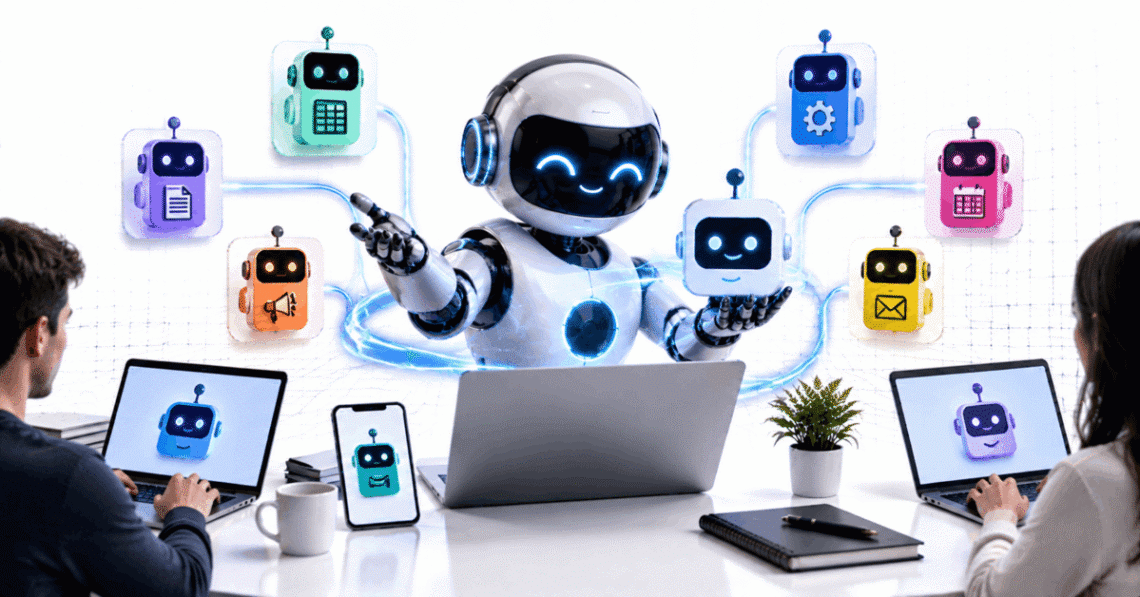
Bring Your Own Bot lets an enterprise run its own AI agent inside someone else’s contact center platform. The platform keeps handling routing, channels, analytics and oversight. You keep control of the intelligence.
Salesforce, Talkdesk, NICE, eGain and Voiso all offer some version of it. What none of them say out loud is what offering it concedes: that they no longer expect to win on whose bot is better.
First, It Is Not BYOC
These get confused constantly and they solve opposite problems.
| BYOB | BYOC | |
|---|---|---|
| You bring | Your AI agent | Your telephony carrier |
| Platform provides | Routing, channels, analytics | The contact center software |
| You keep control of | Model choice and decision logic | Phone numbers and carrier contracts |
Google’s Contact Center AI Platform runs a Bring Your Own Carrier programme letting you keep your existing carrier and numbers while using CCAI capabilities, integrating through SIP with an existing session border controller. Its enterprise licence includes 5,000 minutes per agent per month, with overage billed at platform rates, and telephony regulations prevent it operating in some regions entirely.
Useful, and nothing to do with AI. If someone offers you BYOC when you asked about bots, they have misheard you.
Who Actually Offers BYOB
eGain got there first, announcing a trademarked BYOB architecture in June 2020, well before the current wave. The pitch then was already the right one: enterprises wanting to use existing investments in proprietary and third-party bots rather than replacing them, with conversation control handed off across multiple bots and human agents.
Talkdesk offers two integration routes in its Autopilot product. A generic connector where your voice bot receives the audio stream and call context following Talkdesk’s protocol, which your bot vendor has to implement. Or pre-built connectors for certain AI providers, created through AI Launchpad by selecting the bring-your-own option.
NICE supports it through Virtual Agent Hub with custom integrations.
Voiso launched its version in April 2026 with the clearest articulation of the strategy anyone has offered, which we come back to below.
Salesforce has BYOB for Messaging inside Agentforce Service, and it carries the most conditions.
Read the Salesforce Conditions Carefully
This is where the marketing and the documentation part company.
Salesforce’s own developer documentation states that BYOB is designed for bot-to-customer interactions within messaging conversations and does not constitute a general-purpose AI or conversational tool. It does not support external reps or representatives operating outside the Salesforce Platform. Routing and handoff are limited to transfers between external bots and Salesforce-licensed service reps operating within Agentforce.
Unpack that. You can bring your own bot to talk to customers. You cannot bring your own humans. Every handoff terminates at a Salesforce-licensed seat.
There is also a licensing gate. You need the Agentforce Contact Center Digital SKU with the Partner Messaging Bot add-on licence, plus the SCRT2 integration user permission set in your org.
So the openness is real but bounded, and the boundary is drawn exactly where Salesforce’s revenue is. That is not a criticism, it is a commercial structure, and you should price it as one. For the wider platform this sits inside, see our look at Agentforce.
Why Vendors Are Doing This
Voiso’s framing is the most honest thing any vendor has said about this.
Their argument is that the competitive discussion has shifted. It is less about whose built-in bot has more features, and more about which platform lets an enterprise align with its own internal AI roadmap. The question buyers ask is no longer whether a platform has AI capabilities, but whether they can bring their own AI strategy into the contact center.
Underneath that sits a structural split. The communication platform becomes the execution environment for routing, channels and oversight. The intelligence layer stays under enterprise control. Industry observers describe the direction as LLM-agnostic infrastructure, and architectural openness is reportedly becoming a procurement factor among mid-market and enterprise buyers.
Read that as a concession. A contact center vendor supporting BYOB has decided it will not win on bot quality, and would rather keep the infrastructure contract than lose the account defending an AI layer it cannot keep competitive against frontier model providers.
That is rational. It is also a signal about where value is moving, and buyers should notice it.
What BYOB Actually Gets You
Model choice that survives your vendor. Your AI investment stops being hostage to one platform’s roadmap. Switch models as the frontier moves without re-platforming your contact center.
Governance alignment. If your organisation has settled on an approved model, data handling standard and audit approach, BYOB lets the contact center comply with it rather than carving out an exception.
Reuse of existing work. Teams that already built conversational logic do not throw it away, which was eGain’s original argument and still the most concrete one.
Negotiating position. A platform you can leave without rebuilding your AI is a platform you can negotiate with.
What It Costs You
The integration is yours to own. Talkdesk’s generic connector requires your bot to implement their protocol for receiving audio streams and call context. That is engineering work, and it is work you maintain as both sides change.
Support gets murkier. When a conversation fails, the platform points at your bot and your bot points at the platform. Establish who diagnoses what before you sign.
Handoff quality is the real risk. Passing context cleanly from an external bot to a human agent mid-conversation is the hardest part of this architecture, and it is the part customers notice. Test it with a deliberately difficult call, not a happy path.
And the licensing may not save you money. Salesforce’s add-on SKU means bringing your own bot still costs you a line item.
Who Should Consider It
Good fit: organisations with an existing AI strategy, an approved model, and internal capability to maintain an integration. BYOB lets the contact center serve the strategy instead of fragmenting it.
Poor fit: teams without engineering resource. A native bot that works reasonably beats a custom one nobody can maintain. Our review of Sierra AI covers the purpose-built end of that market.
Ask first if you mainly want analytics and quality monitoring rather than automation, since that is a different purchase. Our look at Observe.AI pricing covers that side.
Frequently Asked Questions
What is Bring Your Own Bot?
An architecture letting enterprises integrate their own or third-party AI agents into a contact center platform, while the platform continues handling routing, channels, analytics and oversight.
Is BYOB the same as BYOC?
No. BYOC is Bring Your Own Carrier, keeping your existing telephony provider while using a platform’s software. BYOB is about the AI layer. Different problems entirely.
Does Salesforce BYOB need extra licensing?
Yes. The Agentforce Contact Center Digital SKU with the Partner Messaging Bot add-on licence, plus the SCRT2 integration user permission set.
The Practical Call
If you have an AI strategy worth protecting, BYOB is how you stop a contact center contract from overriding it. That is a genuine reason to ask for it by name during procurement.
Just read the conditions rather than the datasheet. Salesforce’s documentation says plainly that handoff terminates at Salesforce-licensed seats and that this is not a general-purpose conversational tool, and that kind of boundary will exist in every vendor’s version even where it is less clearly written down. The openness is real. It is also carefully shaped around what the vendor still intends to sell you.
Published: September 14, 2026