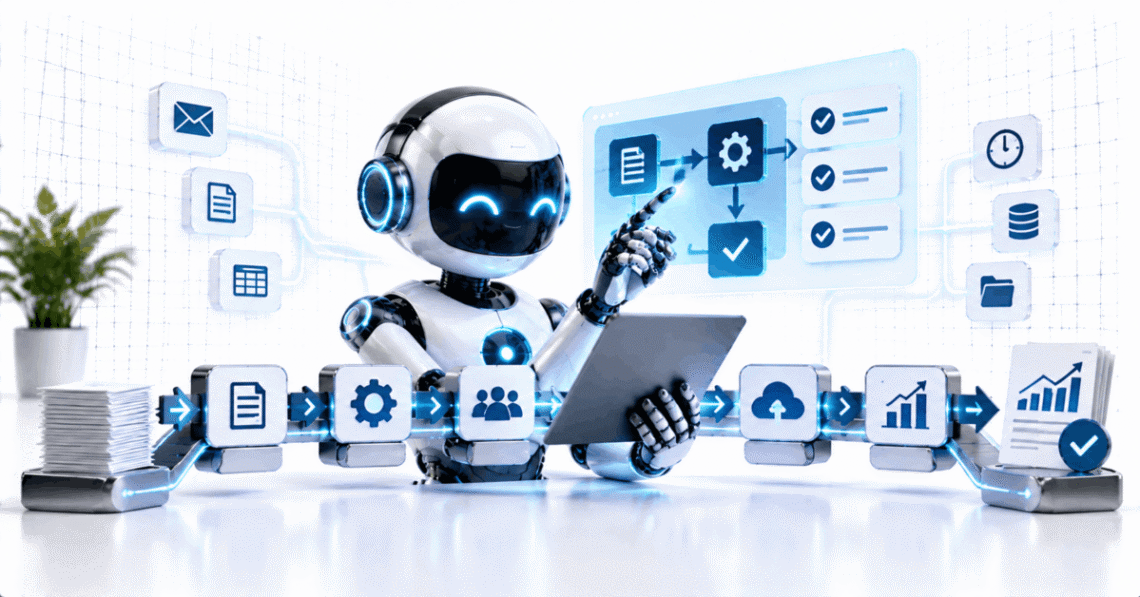
Digital process automation software builds process applications using modeling, orchestration, dynamic case management, and AI-led support. That is Forrester’s own definition, and its Q3 2026 landscape report covers 39 vendors in the category.
The same report names the thing that may replace it. Forrester calls adaptive process orchestration (DPA) the top disruptor and expects feature overlap between the two to grow. If you are about to sign a multi-year platform contract, that is not a footnote.
What DPA Is, and What It Isn’t
The category gets confused with two neighbors constantly.
It is not RPA. Robotic process automation drives discrete tasks at the user interface level, clicking through screens the way a person would. DPA digitises complete cross-department processes with a business process management engine underneath and dynamic case management on top. Different problem, different architecture.
It is not a workflow tool. Zapier-style automation connects triggers to actions. DPA handles processes where the path changes based on the case, where multiple departments touch the same file, and where an audit trail matters as much as the outcome.
Think insurance claims, loan origination, patient onboarding, and regulatory submissions. Processes with exceptions, approvals, and consequences.
Who Forrester Puts at the Top
The Q3 2025 Forrester Wave for DPA named Appian, IBM, Pegasystems, Salesforce, and ServiceNow as leaders. Analysis of the 2026 field typically lists seven enterprise platforms: Appian, Pegasystems, IBM Cloud Pak for Business Automation, Bizagi, Camunda, Newgen’s NewgenONE, and Axon Ivy.
A practical note that matters more than the rankings: all seven use custom quote-based pricing with no public price list. Not one publishes self-serve tiers. Budgeting for DPA means getting into a sales process first, which is itself a filter on who this category is for.
One differentiator worth knowing if you care about agent interoperability. Camunda is the only platform among them with a confirmed official Model Context Protocol server. As of late August 2026, no official MCP server was documented on Appian’s public developer resources. If you want AI agents talking to your process engine through an open standard rather than a proprietary integration, that gap is real. Our guide to Zapier MCP use cases covers why MCP support has become a procurement question rather than a technical detail.
The Disruption Forrester Flagged
This is the part buyers should sit with.
Adaptive process orchestration targets the traditional orchestration logic that DPA platforms are built around. The difference is how a process gets authored. In DPA you design a visual workflow. In APO the process is increasingly written as plain-language agent instructions instead.
That is a genuine architectural challenge rather than a feature race. A visual BPMN diagram and a set of natural-language instructions to an agent are not the same artifact, and a platform built for one does not trivially become the other.
Forrester expects the two categories to converge. For a buyer, that means the question is not only which DPA platform is best today, but which vendor is positioned to survive a shift in how processes get defined at all.
Ask that directly in the sales conversation. A vendor with a clear answer is a safer bet than one with a better feature grid.
The Hyperscalers Are Squeezing From Above
Standalone DPA vendors face pressure from a second direction. Cloud hyperscalers are embedding automation natively into their platforms, which pushes independents toward differentiating on vertical expertise, AI depth, or ecosystem partnerships.
Microsoft launched autonomous agent capabilities in Copilot Studio in November 2024, letting enterprises build AI-driven workflow agents with no code. IBM released Watsonx Orchestrate in June 2024, combining generative AI with pre-built connectors for more than 150 enterprise applications.
If your organization already runs deep on one cloud, the native option may cover enough of the requirement to make a dedicated platform hard to justify. Worth pricing before you shortlist.
Ignore the Market Size Figures
Every vendor deck cites a market forecast. The forecasts do not agree with each other, and not by a small margin.
One research house puts the global DPA software market at roughly $3.47 billion in 2026, growing to $5.57 billion by 2035. Another values the Asia Pacific market alone at $8.3 billion in 2024 and the United States alone at $9.2 billion in the same year.
Those figures cannot both be true. One source’s entire global market is smaller than another’s estimate for a single country. The discrepancy is a definitional problem, since some counts include services and adjacent categories while others count license revenue only, but the practical consequence is the same.
Do not use DPA market size numbers to justify a purchase, and be skeptical of any vendor that leads with one.
Compliance Is Becoming the Real Requirement
The EU AI Act reached full application on 2 August 2026, and it is reshaping what buyers need from these platforms.
Automated decision points now need traceability, controls, and audit-ready evidence. Where a DPA suite embeds generative or agentic capability, transparency and documentation practices have to be operationalized rather than promised, and the whole thing has to sit correctly alongside GDPR obligations.
This changes the evaluation. A platform that makes good decisions but cannot show you why is now a compliance liability in a way it was not two years ago. Ask to see the audit trail for an AI-influenced decision during the demo, not the accuracy claim.
The wider governance question here is the same one facing every organization: accumulating agents faster than it can track them, which we covered in our look at AI governance for professional services.
Before You Shortlist
Four questions that separate real requirements from feature envy.
- Is this actually a cross-department process? If it lives in one team, a workflow tool costs a fraction of this and will be running next week.
- What is your exception rate? DPA earns its cost on processes with genuine variation. Straightforward, high-volume, low-variation work is RPA territory.
- Does your cloud provider already cover it? Price the native option first, even if you expect to reject it.
- What does the vendor say about adaptive process orchestration? Forrester named it the disruptor. A vendor who has not thought about it has not read their own category’s research.
Our guide to AI workflow design covers the modelling side before you get to platform selection, and AI ROI examples cover how to size the business case.
Frequently Asked Questions
What is digital process automation software?
Forrester defines it as platforms that develop process applications using advanced programming principles with modeling, orchestration, dynamic case management, and AI-led support. In practice, software for digitizing complex multi-department business processes.
How much does DPA software cost?
No leading vendor publishes pricing. All seven of the major enterprise platforms use custom quote-based pricing, so you will not find a figure without entering a sales process.
Is DPA the same as RPA?
No. RPA automates discrete tasks at the user interface level. DPA orchestrates entire cross-department processes with a BPM engine and case management underneath. Many organizations run both.
The Practical Call
DPA is a real category solving a real problem, and for genuinely complex regulated processes there is not much else that does the job.
Go in with two things fixed in your head. Nobody publishes a price, so budget for a procurement cycle rather than a signup. And the analyst firm that defines this category has named its disruptor by name, which means the platform you buy today needs a credible answer for how processes get authored three years from now. That question will tell you more about a vendor than any Wave placement will. For the operational side of running this once it is chosen, see our guide to AI operations automation.
Published: September 14, 2026