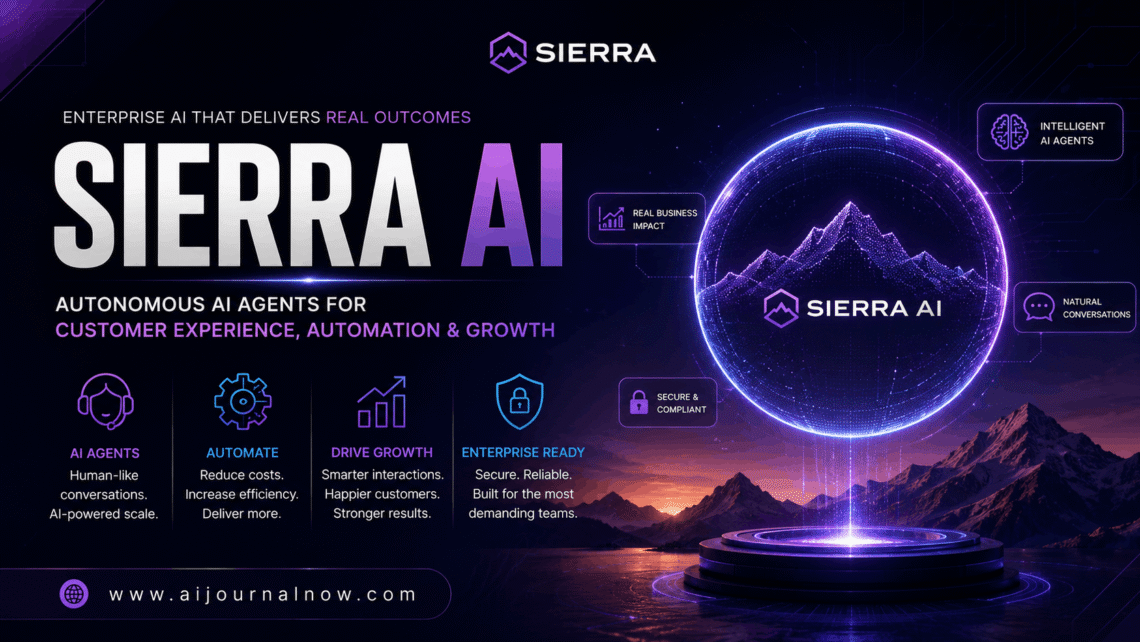
When Sierra AI launched publicly in early 2024, it entered one of the most crowded technology categories imaginable—AI-powered customer service. Yet within seven quarters, it had crossed $100 million in annual recurring revenue and earned a valuation of $10 billion. That kind of trajectory doesn’t happen by accident, and it’s worth understanding exactly what Sierra AI is, how it works, and whether it’s something your business should be paying attention to.
What Is Sierra AI?
Sierra AI is an enterprise conversational AI platform built to deploy autonomous agents that handle real customer interactions—not just answer FAQs, but actually resolve problems. Think about processing a return, updating a subscription, troubleshooting a device, or handling a billing dispute from start to finish, without routing the customer to a human unless truly necessary.
The company was founded by Bret Taylor and Clay Bavor. Taylor is best known as the former co-CEO of Salesforce and the current chair of OpenAI’s board. Bavor spent years leading major product efforts at Google, including Gmail and Google Drive. That pedigree gave Sierra AI an unusual advantage from day one—credibility with enterprise buyers who might otherwise wait years before trusting an AI startup with their customer relationships.
Headquartered in San Francisco, the company has raised over $1.5 billion in funding as of mid-2026, with investors including Sequoia, Benchmark, Google’s GV, and Greenoaks Capital. The numbers reflect genuine enterprise adoption, not speculative momentum.
How Sierra AI Works
The core product is called Agent OS — a platform that lets companies build, deploy, test, and optimize AI agents across multiple channels. These agents operate over chat, voice, email, and SMS, and they connect directly into a business’s existing systems to take real actions.
That last part is what separates Sierra AI from most chatbot tools. A traditional chatbot reads a script. A Sierra AI agent can look up an account, verify a transaction, process a cancellation, and confirm the outcome—all in a single conversation. The agents use large language models to understand natural language, but the actual decision-making is guided by the company’s own policies and constraints, which businesses configure within the platform.
The voice product, launched in late 2024, grew so quickly that phone calls overtook text as the primary channel for Sierra AI agents within a year. That tells you something meaningful about how customers are actually using it — they’re not just typing into a chat window. They’re having full conversations with AI that feels capable enough to speak out loud.
Who Uses Sierra AI and Why
Sierra AI targets mid-to-large enterprises, particularly those dealing with high volumes of inbound customer contacts. Its clients include financial services firms like SoFi and Ramp, as well as consumer brands like Sonos and OluKai. These aren’t companies that would risk their customer relationships on untested software — their adoption signals a level of real-world reliability that matters.
Financial Services
Companies like SoFi use it to handle loan inquiries, account management, and customer onboarding at scale. Financial services have strict compliance requirements, and the fact that Sierra AI has penetrated this sector speaks to the platform’s ability to operate within tightly governed workflows.
Consumer Brands
Brands with large e-commerce operations use it to handle returns, exchanges, product troubleshooting, and shipping updates. OluKai, for instance, uses it to manage shoe returns and exchanges without requiring human agents to handle every case. That frees customer service teams to focus on genuinely complex situations.
Subscription Businesses
For companies managing large subscriber bases—like SiriusXM—Sierra AI handles tasks like radio refreshes, plan changes, and billing questions. These are repetitive, high-volume interactions that would otherwise consume significant human resources.
What Makes Sierra AI Different From Other AI Customer Service Tools
The market is full of platforms claiming to automate customer service. What Sierra AI does differently comes down to a few specific things.
Action-Oriented Agents vs. Information Retrieval
Most chatbots retrieve information and hand off to humans when something needs to be done. Sierra AI agents are built to complete tasks within connected systems. The distinction sounds small but matters enormously in practice—customers don’t just want answers, they want resolution.
The Agent Development Lifecycle
It has developed what it calls the agent development lifecycle—a framework for building, testing, and continuously improving agents over time. This includes analyzing which conversations went well, identifying where agents struggled, and running structured tests before changes go live. For businesses, this means the agent gets better over time rather than staying static.
Memory and Context
The platform’s Agent Data Platform gives agents access to customer history and context, so conversations don’t start from scratch every time. A customer who called last week about a billing issue doesn’t have to re-explain their situation. The agent already knows.
Limitations and Honest Considerations
Sierra AI is not a fit for every organization, and it’s worth being direct about the constraints.
Cost and scale requirements. Sierra AI is built for enterprise. Small businesses or early-stage startups are unlikely to see the ROI that justifies the platform’s pricing, which is designed for companies handling millions of customer interactions.
Setup and integration time. Deploying an effective AI agent isn’t a plug-and-play process. Businesses need to configure policies, integrate with their existing systems, and invest time in testing before an agent is ready to handle real customers. That onboarding investment is real.
Dependence on data quality. The agents are only as useful as the systems they connect to. If a company’s CRM is messy or its internal data is inconsistent, the agent’s performance will reflect those gaps.
Not a replacement for all human support. Sierra AI is designed to handle high-volume, repeatable interactions. Complex, emotionally sensitive, or highly ambiguous situations still benefit from human judgment. The best implementations treat Sierra AI as a first layer, not a full replacement.
What sierra ai Means for Businesses, Freelancers, and Marketers
If you work in customer experience, product, or operations at a mid-size or larger company, Sierra AI represents a category of tooling you’ll need to understand—if not evaluate—in the next few years. Customer-facing AI agents are moving from experimental to standard infrastructure faster than most organizations anticipated.
For marketers and content strategists, the rise of Sierra AI also changes expectations around brand voice in automated interactions. If a company’s AI agent sounds robotic or inconsistent with brand tone, that’s a marketing failure as much as a technical one. Building agents with consistent personality and voice is increasingly part of the brand work.
For business owners with e-commerce operations, the ROI case is concrete. Reducing average handle time, increasing first-contact resolution, and cutting after-hours support costs are measurable outcomes that Sierra AI customers report. That doesn’t mean the investment is always justified, but it does mean the math is worth running.
FAQ
Q: Is it only for large enterprises? Currently, yes—Sierra AI is designed for companies handling high volumes of customer interactions, typically mid-market and enterprise organizations. Smaller businesses would likely find more affordable AI customer service tools better suited to their scale.
Q: How long does it take to deploy a Sierra AI agent? Deployment timelines vary by complexity. Simple agents handling a narrow set of tasks can be live within weeks. More complex deployments involving deep system integrations and policy configuration typically take two to four months before going into production.
Q: Does it replace human customer service agents? Not entirely. The platform is designed to handle high-volume, repeatable interactions autonomously while routing genuinely complex or sensitive cases to human agents. Most Sierra AI customers report that it changes the nature of human agent work rather than eliminating it—freeing people to focus on harder problems.
Q: What channels does Sierra AI support? The platform supports chat, voice, email, and SMS. Voice has become the fastest-growing channel, with phone calls overtaking text as the primary interaction mode for many Sierra AI deployments within a year of the voice product’s launch.
The Bigger Picture
Sierra AI isn’t interesting just as a company story—it’s interesting as a signal. The speed at which enterprises have adopted it, and the seriousness with which investors have backed it, suggests that autonomous customer-facing AI agents aren’t a future concept anymore. They’re current infrastructure for companies that want to scale without proportionally scaling headcount.
Whether you’re evaluating it for your organization or simply watching the AI space, understanding what it does and how it’s different gives you a clearer picture of where enterprise software is heading. The bar for what an AI tool is expected to do — not just inform, but act — has shifted noticeably in a very short time.
Also Read: Edge AI News: What’s Happening Right Now and Why It Matters


