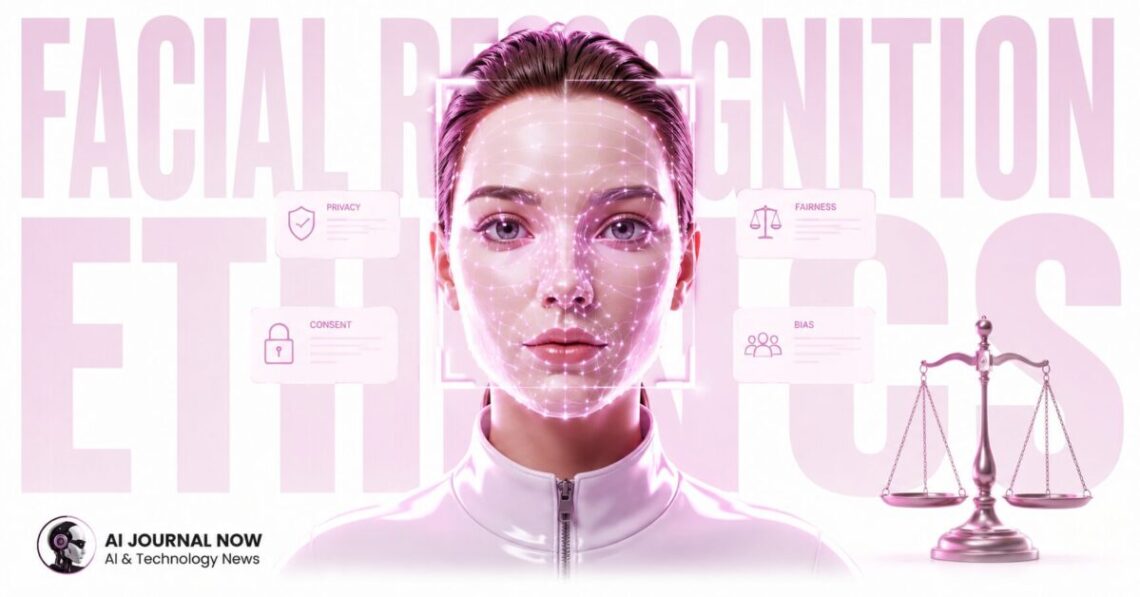
Facial recognition is everywhere, and most people have no idea how often it scans their face. Airports, shopping malls, stadiums, police departments — the technology has spread faster than any serious public conversation about whether it should. That gap between deployment and deliberation is precisely where facial recognition ethics becomes urgent.
This isn’t a distant policy debate. It’s happening now, and the choices governments and companies make in the next few years will shape how this technology either serves or harms people for decades.
Why Facial Recognition Raises Ethical Questions Other Tech Doesn’t
Most surveillance tech requires some kind of trigger — a login, a search, a tap. Facial recognition is passive. You walk past a camera and your identity can be captured, logged, and cross-referenced without your knowledge or agreement. That’s a fundamentally different relationship between citizens and surveillance than anything that existed before.
What tends to surprise people is that this passivity is precisely the feature, not a limitation. Law enforcement agencies and retailers value it because subjects don’t need to cooperate. But that same quality makes it nearly impossible to obtain informed consent.
There’s also the permanence problem. You can change a password. You can’t change your face. If a biometric database is breached or a government changes its policies, the data is already out there, tied to something immutable about you.
The Accuracy Problem: Who Gets Misidentified
The technical performance of facial recognition systems is uneven in ways that follow troubling patterns. Research — including landmark studies from MIT Media Lab researcher Joy Buolamwini — has shown that many commercial facial recognition systems perform significantly worse on darker-skinned faces, particularly women. Error rates that are negligible for white men can climb dramatically for Black women.
This isn’t a minor calibration issue. When law enforcement uses facial recognition, a false positive can lead to the arrest of an innocent person. That’s already happened in documented cases in the United States, where police systems misidentified men and wrongfully detained them.
In my experience reading through how these systems are built and tested, I often find that the bias problem stems from training data that underrepresents certain demographics. These systems learn from the data they are shown. If the data skews toward one group, accuracy skews that way too.
For anyone considering deploying facial recognition in a high-stakes context, this accuracy disparity isn’t an edge case to plan around. It’s a central ethical problem that hasn’t been solved.
Consent and Transparency in Facial Recognition Ethics
Most jurisdictions haven’t defined clear legal standards for what consent means when it comes to biometric data. Some cities and states have moved ahead on their own. Illinois’ Biometric Information Privacy Act (BIPA) is one of the more robust examples, requiring explicit written consent before collecting biometric data and giving individuals the right to sue. But Illinois is the exception.
In most places, if a company runs your face through a recognition system at an event you attended, there’s no law requiring them to tell you, ask you, or delete the data afterward.
The transparency gap affects both consumers and civic bodies. Consumers often don’t know when they’re being scanned. But civic bodies often don’t know either. Many cities have discovered after the fact that police departments purchased and deployed facial recognition tools without city council authorization or public debate. That’s not a hypothetical scenario — it’s been documented in places like Detroit and New Orleans.
Law Enforcement Use: Where the Stakes Are Highest
The most contentious application of facial recognition ethics involves policing. When the technology works, it can help identify a suspect caught on camera. When it fails, it can produce wrongful arrest. And even when it works correctly, its use raises questions about what kind of surveillance society we want to live in.
There’s a real argument that facial recognition in public spaces effectively ends anonymous participation in civic life. If your face is logged every time you attend a protest, visit a place of worship, or go to a political rally, the chilling effect on free expression is real even if you’ve done nothing wrong.
Several major cities, including San Francisco, Boston, and Portland, have banned government use of facial recognition. Some federal agencies have paused or restricted its use. But the patchwork nature of these restrictions means deployment is still common in many places, often without clear accountability mechanisms.
What’s also underappreciated is the database problem. Facial recognition is only as limited as the database it searches against. If a local police department’s system is connected to a national database of driver’s license photos, every adult who has ever had a driver’s license is effectively enrolled in a face recognition system they never opted into.
Commercial Uses: Retail, Banking, and Beyond
Law enforcement gets the most attention, but commercial use of facial recognition has expanded just as rapidly. Retailers have used it to flag suspected shoplifters. Banks have trialed it for authentication. Advertisers have explored it for measuring emotional responses to content. Some employers have used it to track attendance.
Each of these use cases brings its own ethical texture. Retail flagging systems have wrongly accused innocent shoppers, and there’s evidence these errors also carry demographic bias. Emotional analysis tools — systems that claim to read sentiment from facial expressions — rest on dubious scientific foundations that researchers have challenged seriously. The American Psychological Association and others have raised concerns about whether you can reliably infer emotional states from facial movements at all.
One thing worth flagging is how consent erodes in commercial contexts. You agree to a company’s terms of service without knowing facial recognition is part of the package. Or you enter a store that uses it, and a small sign near the entrance counts as “notice.” In most jurisdictions, both scenarios are legally tolerated, even though neither reflects meaningful consent. Tools like facial editing software have made people more aware of how their facial data can be captured and manipulated, but awareness of passive recognition systems in commercial spaces remains low.
The Regulatory Landscape: Where Things Stand
Regulation is catching up, slowly. The European Union’s AI Act takes a notably strict approach to biometric surveillance, banning real-time remote biometric identification in public spaces with limited exceptions. That’s among the most restrictive frameworks anywhere.
In the United States, there’s no comprehensive federal law. The FTC has flagged facial recognition as an area of concern, and some members of Congress have pushed for legislation, but as of mid-2026, no federal framework covers it broadly. What exists is a collection of state laws (Illinois, Texas, and Washington, among others) and local ordinances.
China represents the other extreme—extensive deployment of facial recognition as an instrument of state control, with documented use against minority populations in Xinjiang. That example should inform any honest discussion about the technology, because it demonstrates what happens when deployment outpaces any ethical or democratic constraint. Those interested in how machine intelligence companies are navigating these pressures globally will find the contrast between US, EU, and Chinese approaches particularly instructive.
What Ethical Deployment Could Actually Look Like
The ethical issues with facial recognition mean that the technology can be used appropriately in some cases. They mean that responsible deployment requires a set of conditions that are currently absent in most contexts.
Minimum conditions worth considering:
- Explicit, informed consent for most commercial and optional use cases
- Regular, independent accuracy audits broken down by demographic group
- Clear limits on data retention and use
- Transparency reports from both government agencies and companies deploying the technology
- Democratic oversight before government deployment, not after
Some researchers and organizations have also argued for a moratorium on high-risk uses—particularly real-time policing applications—until accuracy and oversight frameworks meet a higher standard. That’s not an unreasonable position given what we know about current error rates and their distribution. The broader question of AI workflow design in sensitive contexts — how systems are built, tested, and governed before they go live — is directly relevant here.
Facial Recognition Ethics: FAQ
Is facial recognition legal in the United States?
There’s no federal law that broadly governs it. A mix of state laws and local ordinances applies in certain jurisdictions. In many places, it’s legal with few restrictions.
Which facial recognition systems are the most biased?
Multiple studies have found bias across several commercial systems, including those from major technology companies. Performance gaps tend to be most pronounced for darker-skinned women. Accuracy varies by system and testing conditions, so there’s no single definitive ranking.
Can I opt out of facial recognition systems?
In most places, no formal opt-out mechanism exists. A few jurisdictions with stronger biometric privacy laws give individuals more rights. Practically, avoiding cameras in public spaces is the only reliable opt-out option for most people. Some users have explored tools like antidetect browsers as part of broader digital privacy practices, though these address online tracking rather than physical surveillance.
Do companies need to disclose if they use facial recognition?
In most jurisdictions, disclosure requirements are minimal or nonexistent. Illinois and a handful of other states require some form of consent for biometric data collection. The National Institute of Standards and Technology (NIST) regularly evaluates facial recognition technology but doesn’t set legal requirements.
What’s the difference between facial recognition and facial detection?
Facial detection identifies that a face is present in an image. Facial recognition matches that face to an identity in a database. The ethical concerns are primarily around recognition, not detection, though detection is often the first step. Tools like reverse video search use related image-matching techniques, which provides some sense of how widespread this underlying technology has become.
The honest assessment of where facial recognition ethics stands right now: the technology has outrun the governance, and the people most likely to be harmed by its failures are often the people who already have the least institutional recourse. This observation is not neutral. It’s a pattern worth taking seriously, whether you’re a policymaker, a business owner, or just someone who walks past cameras every day without considering it.